- Plants
- ›Vascular Plants
- ›flowering plants
- ›Dicots
- ›Nances, Willows, and Allies
- ›willow family
- ›Salix
- ›Vetrix
- ›Arbuscella
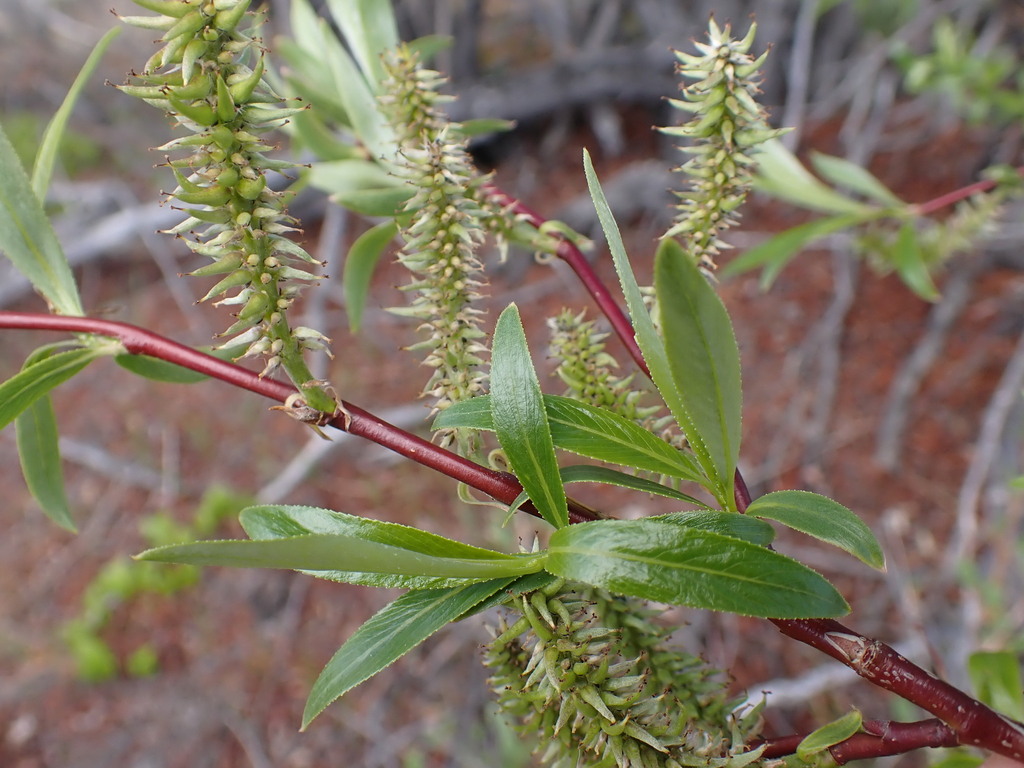
Little-tree Willow
Salix arbusculoides
Salix arbusculoides is a species of flowering plant in the willow family known by the common name little tree willow. It is native to northern North America, where its distribution extends across Alaska and most of Canada.
This willow is a shrub or tree growing up to 9 meters tall. It has many branches with smooth gray or reddish-brown bark. The leaves are up to 7.5 centimeters long and often have a thin coat of hairs on the undersides. Immature leaves have thicker coats of hair and are paler and yellowish in color. The leaves have toothed edges that are studded with glands that function as resin glands as well as hydathodes. This species is dioecious, with male and female catkins borne on separate individuals. The flowers are pollinated by insects, especially bees.
From the article Salix arbusculoides on Wikipedia (CC BY-SA), quoted section by section
At the table
This plant was used medicinally by the Eskimo for ailments such as skin sores and watery eyes. Native Americans used parts of willows, including this species, for medicinal purposes, basket weaving, to make bows and arrows, and for building animal traps. It is a species of diamond willow and can be used for woodworking.
Wikipedia: “Medicinal uses”
Where it lives
Recorded sightings
—
geo-referenced records in GBIF, from museums, herbaria and field observers.
Drag the globe to turn it. Dots are where records exist, not a range map; darker means more records.
In the stacks
Searching the stacks…
Every page naming Salix arbusculoides in the Biodiversity Heritage Library →
This page is assembled live from iNaturalist, GBIF, Wikipedia, the Source Library and the Internet Archive. It is not yet part of the hand-edited codex. iNaturalist taxon 168314.