- Plants
- ›Vascular Plants
- ›flowering plants
- ›Dicots
- ›Roses, Elms, Figs, and Allies
- ›rose family
- ›brambles, roses, strawberries, and allies
- ›rose tribe
- ›Rosa
- ›Rosa
- ›Bracteatae
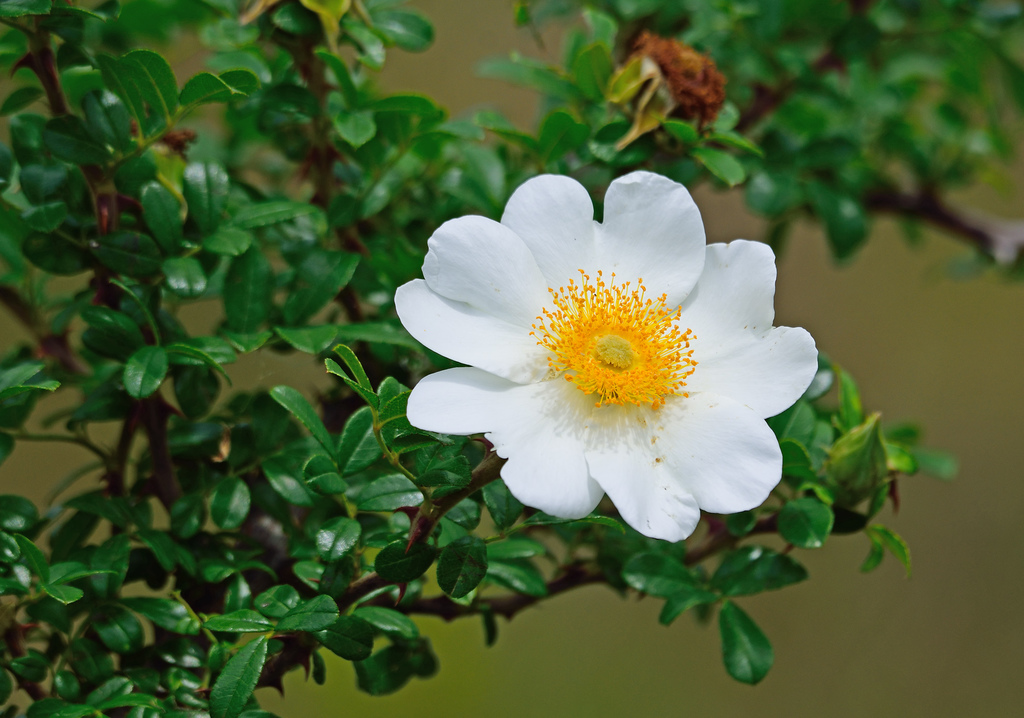
Macartney's rose
Rosa bracteata
Rosa bracteata, commonly known as the Macartney rose, is a species of rose native to southern China and Taiwan that has become invasive in parts of the United States following its introduction as an ornamental plant. It is the only wild species in the section Bracteatae of the genus Rosa. In 2026, a chromosome-scale genome assembly of Rosa bracteata was published, providing a genomic resource for rose evolution and breeding studies.
From the article Rosa bracteata on Wikipedia (CC BY-SA), quoted section by section
Description
The Macartney rose is native to southern China and Taiwan, but is now considered to be an invasive species across many states in the United States ever since its introduction as an ornamental plant.
Range & habitat
Rosa bracteata is a highly adaptable plant and can grow in highly disturbed areas. It can be found in areas ranging from pastures, rangeland, drainage ditches, and along roadsides and fence lines. R. bracteata tends to prefer dark, waterlogged, and clay-based soil compositions. This species was introduced into the United States from Asia, and is only found within the lower 48 states, mostly in the southeastern United States. Some of the states it can be found in include Texas, Louisiana, Arkansas, Mississippi, Alabama, Georgia, Florida, South Carolina, North Carolina, Tennessee, Kentucky, Virginia, and Maryland. Its method of dispersal is through animals, where it is spread by livestock, birds, and other herbivorous organisms. The rose's fruit gets eaten by these animals, which acts as a germination technique after going through the digestive tract of the foraging animal.
Wikipedia: “Distribution and habitat”
What it does
Rosa bracteata is a perennial evergreen shrub that often forms dense clumps. This species of rose can grow up to 10 feet (3.0 m) in height and width.
Leaves and stem. Rosa bracteata has recurved thorns which are modified leaves all along its stem. Its leaves are serrated and placed in an alternate pattern and range between 1 and 3 inches (2.5 and 7.6 cm) in length; they are pinnately compound with 5 to 9 thick leaflets per leaf. The tops of the leaves can be described as glossy or shiny as compared to the bottoms of the leaves which are a muted green.
Flowers, fruit and seeds. The flowers of this rose occur in either single or bunched compositions, usually donning five-petaled white flowers of 1–3 in number on bunches of short stalks. These flowers can typically be seen from April to June which are a part of the spring and summer months in the Northern Hemisphere. Its hips are spherical in shape and are usually a reddish color when ripe. These can be seen from July to December. Its seeds are generally dormant when first created but germinate in temperatures around 41 °F (5 °C); its optimal temperatures for growth fall between 68 and 86 °F (20 and 30 °C).
Wikipedia: “Morphology and ecology”
In human culture
Rosa bracteata – bracteata referring to the notable bracts below the flowers – is commonly referred to as the Macartney rose. Its name links back to a German botanist, Johann Christoph Wendland, who is credited with naming the species. The name Macartney rose originates from the mid 18th century, when it was named after George Macartney, the 1st Earl Macartney in England. According to the Global Invasive Species Database, this rose is also referred to by other names – though less commonly – such as the Chickasaw rose and the fragrant white climbing rose, both of English origin, and shuo bao qiang wei, which is of Chinese origin.
Wikipedia: “Etymology”
Where it lives
Recorded sightings
—
geo-referenced records in GBIF, from museums, herbaria and field observers.
Drag the globe to turn it. Dots are where records exist, not a range map; darker means more records.
In the stacks
Searching the stacks…
Every page naming Rosa bracteata in the Biodiversity Heritage Library →
This page is assembled live from iNaturalist, GBIF, Wikipedia, the Source Library and the Internet Archive. It is not yet part of the hand-edited codex. iNaturalist taxon 167976.