- Plants
- ›Vascular Plants
- ›flowering plants
- ›Dicots
- ›Legumes, Milkworts, and Allies
- ›Legumes
- ›Faboideae
- ›Phaseoleae
- ›Cajaninae
- ›Rhynchosia
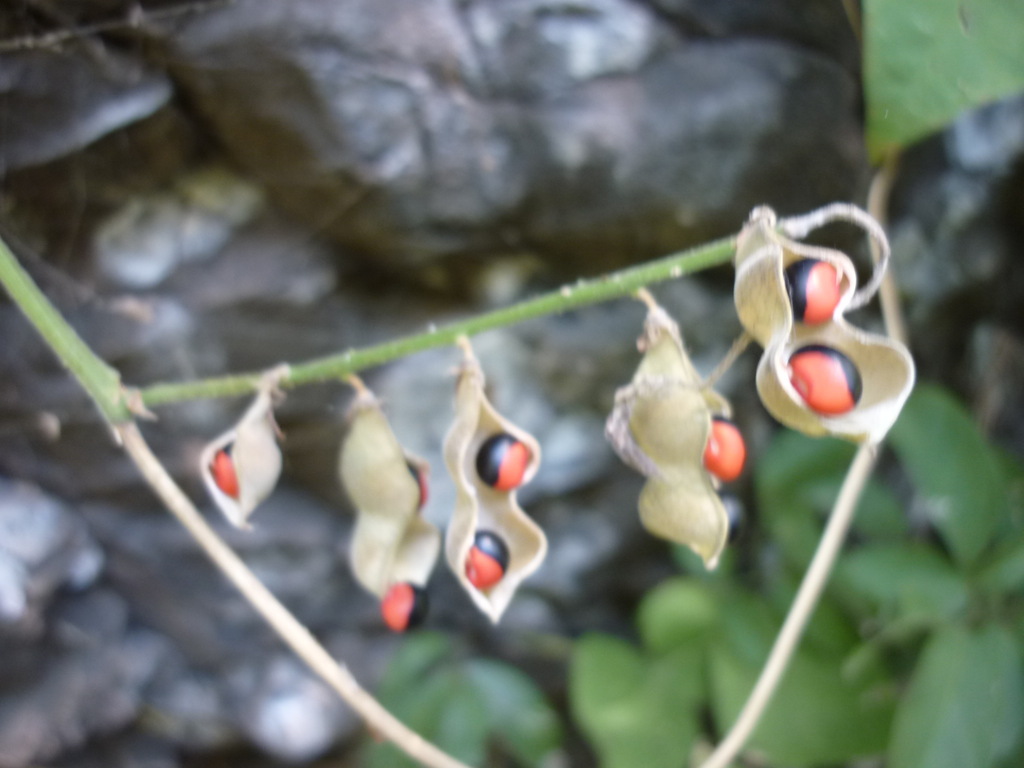
rosary snoutbean
Rhynchosia precatoria
Rhynchosia precatoria, known variously as rosary snoutbean, 'crab-eyes', or ojo de perico, among other names, is a viny member of the family Fabaceae.
From the article Rhynchosia precatoria on Wikipedia (CC BY-SA), quoted section by section
Description
Rhynchosia precatoria is an herbaceous, twining or sometimes sprawling vine able to climb several meters (yards) high, at least under ideal conditions. Its stems are hairy, the hairs varying from long and soft to stiff and lying on the stem's surface, sometimes with yellow, dot-like glands mixed among them. Atop petioles which are up to 7cm long (2¾ inches), three hairy leaves are divided into leaflets as long as 12.5cm (~5 inches). Raceme-type inflorescences are up to 30cm long (~1ft), with individual flowers on pedicels up to 2mm long (5⁄64 inch). Flowers are dark or brownish purple with yellow stripes, with petals as long as 9mm (23⁄64 inch). Legume-type fruits split open to release one or two roundish seeds, which are up to 8mm long (5⁄16 inch), and red with a black spot.
Range & habitat
Rhynchosia precatoria occurs from the southern parts of the US states of Arizona and Florida, south through the moister parts of Mexico and possibly through Central America into Colombia in South America. The usual authorities are somewhat at odds as to how far south it occurs. Currently the iNaturalist page for the species shows documented observations stopping at about the Guatemalan border.
Wikipedia: “Distribution”
At the table
Mainly the attractive red and black beans are used artisanally, as for making bracelets and necklaces. In Mexican traditional medicine the Mayo people in northwestern Mexico have used aqueous infusions of the plant for respiratory illness and inflammations; the infusions have shown anti-inflammatory clinical results.
== References ==
Wikipedia: “Human uses”
In human culture
The genus name Rhynchosia is derived from the Greek rhynchos, which means "beak, or snout," alluding to the shape of the "keel" of the genus's papilionaceous flowers, like a boat's keel. With one of this species' common names being Rosary Snoutbean, one wonders whether the species name precatoria could be based on the Latin verb precari, meaning "to pray, beg, beseech," etc., which might come to mind of someone who has seen Rhynchosia preatoria beans used as prayer beads.
Wikipedia: “Etymology”
Where it lives
Recorded sightings
—
geo-referenced records in GBIF, from museums, herbaria and field observers.
Drag the globe to turn it. Dots are where records exist, not a range map; darker means more records.
In the stacks
Searching the stacks…
Every page naming Rhynchosia precatoria in the Biodiversity Heritage Library →
This page is assembled live from iNaturalist, GBIF, Wikipedia, the Source Library and the Internet Archive. It is not yet part of the hand-edited codex. iNaturalist taxon 167839.