- Plants
- ›Vascular Plants
- ›flowering plants
- ›Dicots
- ›Mints, Plantains, Olives, and Allies
- ›Acanthus Family
- ›Acanthoideae
- ›Justicieae
- ›Graptophyllinae
- ›Pseuderanthemum
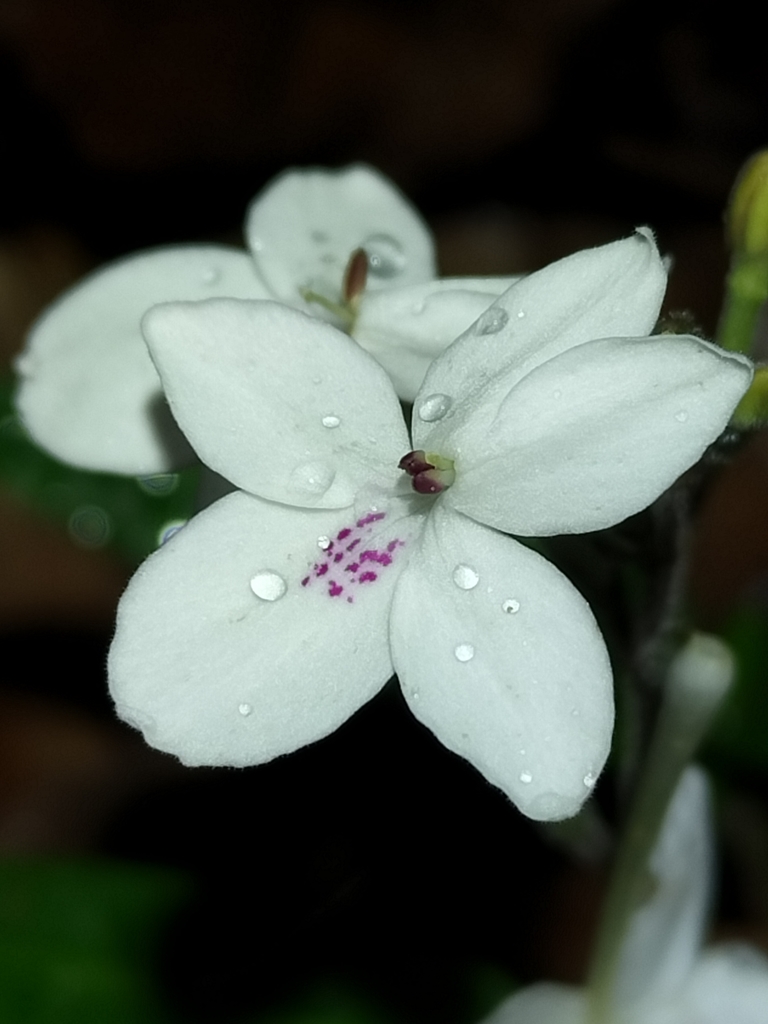
Pastel Flower
Pseuderanthemum variabile
Pseuderanthemum variabile, commonly known as pastel flower or love flower in its native range, or night and afternoon in the US, is a small perennial herb in the family Acanthaceae which is native to Australia, Papua New Guinea and New Caledonia. It can be an unwelcome nuisance in orchid nurseries in Australia.
From the article Pseuderanthemum variabile on Wikipedia (CC BY-SA), quoted section by section
Description
Pseuderanthemum variabile is a creeping herb with a highly variable appearance, growing up to 30 cm (12 in) high, all parts of which may be pubescent. The wiry stems are around 1–2 millimetres (0.04–0.08 in) wide. The leaves are lanceolate to ovate in shape with entire margins, and their arrangement is opposite and decussate. They measure up to 7 cm (2.8 in) long by 4 cm (1.6 in) wide with petioles up to 30 mm (1.2 in) long, and have from 3 to 6 lateral veins either side of the midrib. The leaf colour varies greatly. The upper surface is usually dark green to mid-green, but may have varying amounts of light grey or (rarely) purple patterning. The lower surface of the leaf is usually light green but may also be purple or dark red (see gallery for examples). The inflorescence is produced from the terminal axil, and the zygomorphic flowers have five petals. Two petals are smaller than the others and are usually uppermost. They measure around 7 by 4 mm (0.28 by 0.16 in) and overlap each other slightly. Two more are held perpendicular to the first pair, one on either side, and the last (and largest) petal is opposite the first pair. This one measures about 10 by 6 mm (0.39 by 0.24 in) and is often decorated with a variable number of small purple spots. …
Range & habitat
This species is found in Papua New Guinea, eastern parts of New South Wales and Queensland in Australia, and in New Caledonia. It may occupy a number of forest types in Australia, most often rainforest and wet sclerophyll forest, but also woodlands, open forest and deciduous vine thickets. It has been introduced to Florida, South Carolina and Puerto Rico.
Wikipedia: “Distribution and habitat”
What it does
It is the food plant for caterpillars of a number of butterflies in the family Nymphalidae, including Doleschallia bisaltide, Hypolimnas alimena, Hypolimnas bolina, Hypolimnas misippus and Junonia orithya.
Wikipedia: “Ecology”
At the table
It is an attractive addition to gardens, and can be used as a feature, a ground cover, or a gap filler in a rockery. It is easily grown from seed or cuttings. In Australia, it is reported by some orchid nurseries as a pest, as it often appears in pots and may be difficult to eradicate.
Wikipedia: “Cultivation and uses”
Where it lives
Recorded sightings
—
geo-referenced records in GBIF, from museums, herbaria and field observers.
Drag the globe to turn it. Dots are where records exist, not a range map; darker means more records.
In the stacks
Searching the stacks…
Every page naming Pseuderanthemum variabile in the Biodiversity Heritage Library →
This page is assembled live from iNaturalist, GBIF, Wikipedia, the Source Library and the Internet Archive. It is not yet part of the hand-edited codex. iNaturalist taxon 167477.