- Plants
- ›Vascular Plants
- ›flowering plants
- ›monocots
- ›Agaves, Orchids, Irises, and Allies
- ›Orchids
- ›Orchidoid Orchids
- ›Orchideae
- ›Orchidinae
- ›Platanthera
- ›Blephariglottis
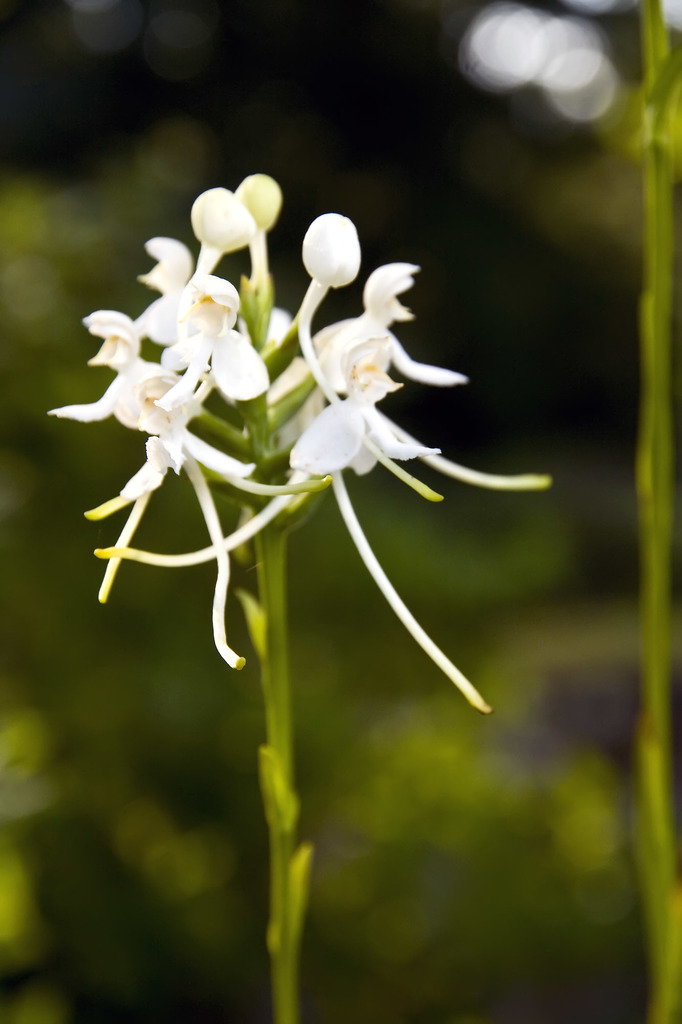
white fringeless orchid
Platanthera integrilabia
Platanthera integrilabia, commonly called white fringeless orchid, is a species of flowering plant in the orchid family (Orchidaceae). It is native to seven states in the Southeastern United States; Kentucky, Mississippi, Tennessee, Alabama, Georgia, North Carolina, and South Carolina. However, the white fringeless orchid is only known from 52 populations that are primarily concentrated in Tennessee and Kentucky on the Cumberland Plateau. It is typically found in flat swampy habitats, especially near the head of streams and usually in partial open sunlight. The white fringeless orchid is also involved in a symbiotic relationship with mycorrhizal fungi that aids in seed germination and growth.
From the article Platanthera integrilabia on Wikipedia (CC BY-SA), quoted section by section
Description
Platanthera integrilabia is a mycotrophic perennial containing up to 20 sweetly scented white flowers and reaching up to 2-feet tall. It has two leaves restricted to the base of the stem and conspicuous elongated nectar-containing spurs that come from the back of the flower and curve forward in front. The white fringeless orchid reproduces primarily through outcrossing, and is pollinated by butterflies such as the eastern tiger swallowtail and silver-spotted skippers. These butterflies have the ability to reach the nectar within the spurs with their lengthened tongues. The white fringeless orchid differs from other Platanthera species by its round labellum. It typically flowers from late July to early September, but can flower as early as June in the southern part of its range. The percentage of flowering individuals in a population for a given year is typically very low, with many individuals reproducing clonally through tubers.
What it does
The white fringeless orchid lives in a mycotrophic symbiotic relationship with the mycorrhizal fungus Epulorhiza inquilina that influences orchid seed germination. Mycorrhizal fungi infect a plant's root system in a mutually beneficial way, providing access to a large amount of water and nutrients (such as nitrogen, copper, phosphorus, and zinc) for sugars and carbon in return from the plant. There are thousands of different mycorrhizal fungi, and this relationship between a fungus and the roots of its host plant has existed for 400-500 million years. Mycorrhizal fungi are vital for the successful development of orchid populations, and therefore testing for the presence of fungi at restoration sites is essential. Mycorrhizal fungi can increase pathogen resistance and tolerance to drought, improve soil structure, and increase nutrient and water uptake.
Wikipedia: “Symbiotic relationship with fungi”
Where it lives
Recorded sightings
—
geo-referenced records in GBIF, from museums, herbaria and field observers.
Drag the globe to turn it. Dots are where records exist, not a range map; darker means more records.
In the stacks
Searching the stacks…
Every page naming Platanthera integrilabia in the Biodiversity Heritage Library →
This page is assembled live from iNaturalist, GBIF, Wikipedia, the Source Library and the Internet Archive. It is not yet part of the hand-edited codex. iNaturalist taxon 167022.