- Plants
- ›Vascular Plants
- ›flowering plants
- ›Dicots
- ›nightshades, bindweeds, gooseweeds, and allies
- ›nightshade family
- ›nightshades and allies
- ›groundcherries, lanterns, and allies
- ›Physalis
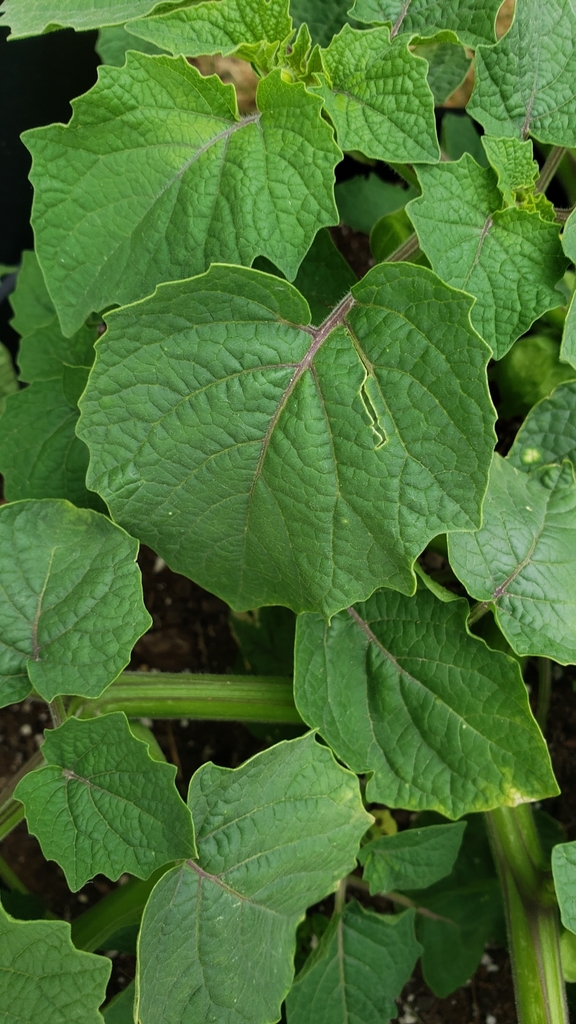
Strawberry Groundcherry
Physalis grisea
Physalis grisea is a species of flowering plant in the nightshade family known by common names including strawberry ground-cherry, downy ground-cherry, and strawberry-tomato in English. The name downy ground-cherry is due to the soft hairs that give the plant a gray cast. This downy gray coloration is the origin of the specific epithet grisea. Physalis grisea is native to northeastern North America.
From the article Physalis grisea on Wikipedia (CC BY-SA), quoted section by section
Description
Physalis grisea has frequently been incorrectly described as Physalis pruinosa. Physalis grisea has also been confused with Physalis pubescens. The leaves of Physalis grisea have net-like venation patterns, and the fruit is rust-colored. The leaves are simple, alternate, and the edge of the leaf blade has teeth. The leaves dry orange. There are five petals in the flower, which are fused. The corolla of Physalis grisea features brown spots on the throat, and the fruiting calyx as long as broad and is acute at its apex with blue anthers.
How it is grown
Physalis grisea is cultivated for its berries, which are used in pies and preserves.
== References ==
Wikipedia: “Cultivation”
Where it lives
Recorded sightings
—
geo-referenced records in GBIF, from museums, herbaria and field observers.
Drag the globe to turn it. Dots are where records exist, not a range map; darker means more records.
In the stacks
Searching the stacks…
Every page naming Physalis grisea in the Biodiversity Heritage Library →
This page is assembled live from iNaturalist, GBIF, Wikipedia, the Source Library and the Internet Archive. It is not yet part of the hand-edited codex. iNaturalist taxon 166805.