- Plants
- ›Vascular Plants
- ›flowering plants
- ›Dicots
- ›Heathers, Balsams, Primroses, and Allies
- ›heath family
- ›typical heathers, azaleas, and allies
- ›Phyllodoceae
- ›Phyllodoce
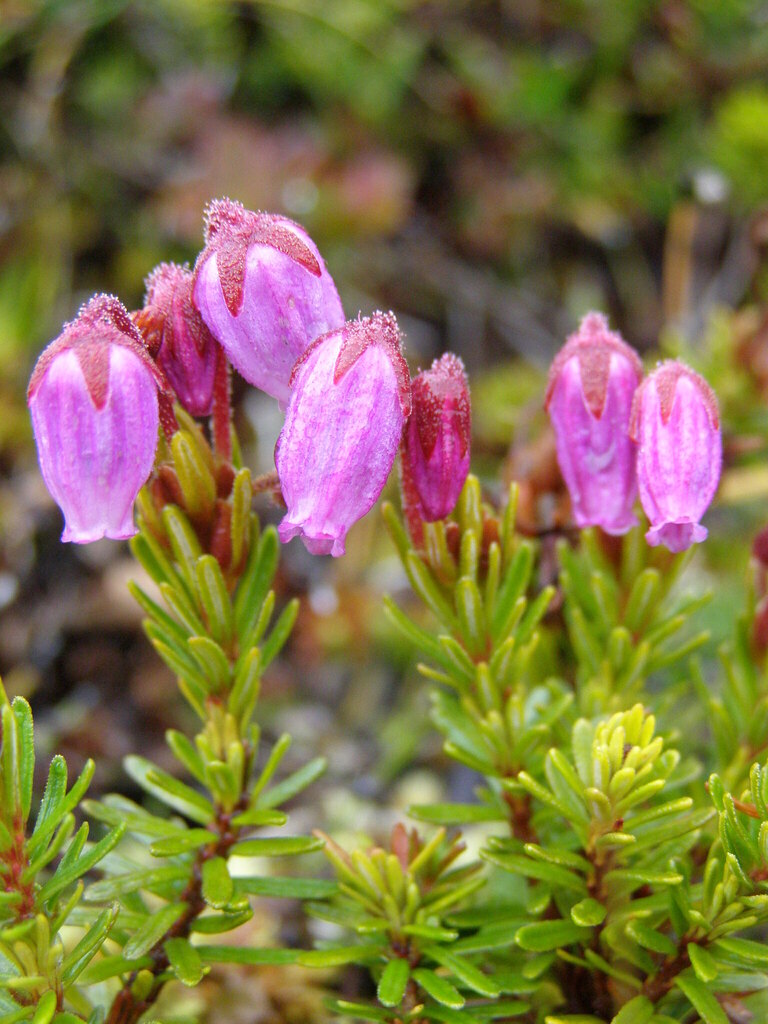
Blue Mountain-heath
Phyllodoce caerulea
Phyllodoce caerulea, known as blue heath in British English and purple mountain heather or blue mountainheath in American English, is an evergreen species of dwarf shrub that grows up to around 15 cm (6 in) tall, and bears clusters of 2–6 purple flowers. It is native to boreal regions around the Northern Hemisphere, but with large gaps in its distribution.
From the article Phyllodoce caerulea on Wikipedia (CC BY-SA), quoted section by section
Description
Phyllodoce caerulea is a low shrub, typically growing 5–15 centimetres (2–6 in) high, and exceptionally reaching 25 cm (10 in). Its evergreen leaves are 4–10 mm (0.16–0.39 in) long and 1.7–3.6 mm (0.07–0.14 in) wide, and are borne on 1-millimetre (0.04 in) long petioles; they are arranged alternately. The flowers are borne in clusters of 2–6; each flower is 8–12 mm (0.3–0.5 in) long, with a corolla composed of five fused petals that begin purple, but fade to a bluish pink. These are surrounded by five sepals, and themselves surround the 8–10 free stamens and a superior ovary that produces nectar at its base.
Range & habitat
Phyllodoce caerulea has a patchy circumboreal distribution, with gaps between 110° W and 155° W and between 70° E and 125° E.
In Europe, P. caerulea is found from Iceland to the Kanin Peninsula. Its Icelandic distribution is also disjunct, comprising the area around Eyjafjörður and a site near Desjarmyri. In the British Isles, P. caerulea is confined to a few sites in the Scottish Highlands. It was first discovered around a spring at an altitude of 740 metres (2,430 ft) on the slopes of the Sow of Atholl, but has since been found at a few sites in the Ben Alder forest. It became a protected species in the UK in 1975 under the Conservation of Wild Creatures and Wild Plants Act. There are reports of the plant's occurrence in the Swiss Alps, but no herbarium specimens have been found to confirm this. The species has not been observed on the Faroe Islands, Jan Mayen, Bjørnøya, Svalbard or Franz Josef Land. In Asia, Phyllodoce caerulea occurs in the Ural Mountains, around Lake Baikal and in the Mongolian Khangai and Kentii mountains, but is absent from most of central Siberia. It occurs on Hokkaido, Sakhalin, the Kamchatka Peninsula and in Beringia. In North America, P. caerulea is found in coastal Alaska, the Northwest Territories, Quebec and Labrador, as well as scattered sites in the Gaspé Peninsula and the White Mountains of New Hampshire and Vermont. …
Wikipedia: “Distribution”
Where it lives
Recorded sightings
—
geo-referenced records in GBIF, from museums, herbaria and field observers.
Drag the globe to turn it. Dots are where records exist, not a range map; darker means more records.
In the stacks
Searching the stacks…
Every page naming Phyllodoce caerulea in the Biodiversity Heritage Library →
This page is assembled live from iNaturalist, GBIF, Wikipedia, the Source Library and the Internet Archive. It is not yet part of the hand-edited codex. iNaturalist taxon 166760.