- Plants
- ›Vascular Plants
- ›flowering plants
- ›Dicots
- ›Nances, Willows, and Allies
- ›Leaf-flower Family
- ›Phyllanthoideae
- ›Phyllantheae
- ›Phyllanthus
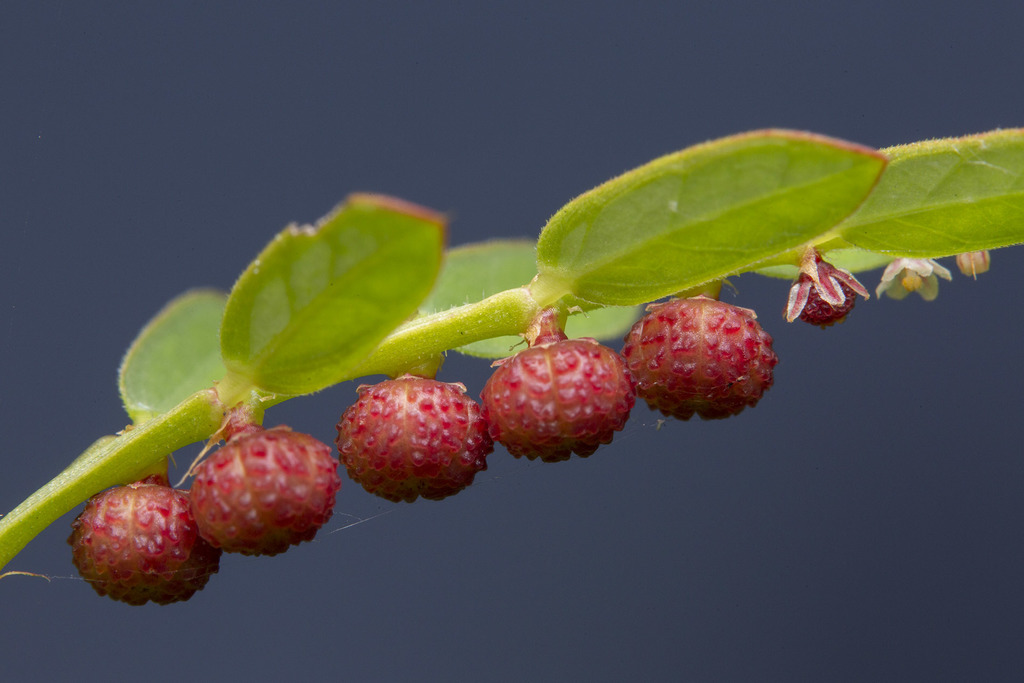
Chamberbitter
Phyllanthus urinaria
Phyllanthus urinaria is a species of annual flowering plant in the family Phyllanthaceae. It is native to Asia and has an introduced presence in tropical and subtropical areas worldwide. It has common names such as chamber bitter, gripeweed, shatterstone, stonebreaker, and leafflower.
From the article Phyllanthus urinaria on Wikipedia (CC BY-SA), quoted section by section
Description
Phyllanthus urinaria is a summer annual and germinates from early summer to early fall, requiring warm soil and light. It grows to a height of about 60 centimetres (2 feet), has small alternate leaves resembling those of the genus Mimosa, disposed in two ranges. It is suffruticose, woody at the base and herbaceous above. The leaves are large at the tip and smaller towards the petiole. The leaves are closed at night and are open in the day. Flowers are greenish white, minute and appear in the leaf axils, hanging on short pedicels below the leaves. Numerous small green-red fruits, round and smooth, are found along the underside of the stems, which are erect and red. It reproduces by seeds, which are found in the green, wart-like fruit attached to the underside of the branch.
Range & habitat
Although of Asian origin, Phyllanthus urinaria is widely found in other regions of the world, including Mexico, Central America, South America, Australia, Africa, and the United States. P. urinaria is a warm-season, tropical or subtropical species that prefers summer average temperatures greater than 10 degrees Celsius (50 degrees Fahrenheit) and winter average temperatures greater than 0 °C (32 °F). It has been reported in many habitats, including roadsides, disturbed lands, forests, cropland, and nurseries.
Wikipedia: “Distribution and habitat”
Where it lives
Recorded sightings
—
geo-referenced records in GBIF, from museums, herbaria and field observers.
Drag the globe to turn it. Dots are where records exist, not a range map; darker means more records.
In the old herbals & bestiaries

In the stacks
Searching the stacks…
Every page naming Phyllanthus urinaria in the Biodiversity Heritage Library →
This page is assembled live from iNaturalist, GBIF, Wikipedia, the Source Library and the Internet Archive. It is not yet part of the hand-edited codex. iNaturalist taxon 166758.