On eBird ↗
Great Shrike-Tyrant
Live sightings near you, the range map, bar charts of when it is seen, and Macaulay Library photos and recordings.
Great Shrike-Tyrant
Agriornis lividus
The great shrike-tyrant (Agriornis lividus) is a species of bird in the family Tyrannidae. It is found in Chile and adjacent areas of south-western Argentina.
From the article Great shrike-tyrant on Wikipedia (CC BY-SA), quoted section by section
Description
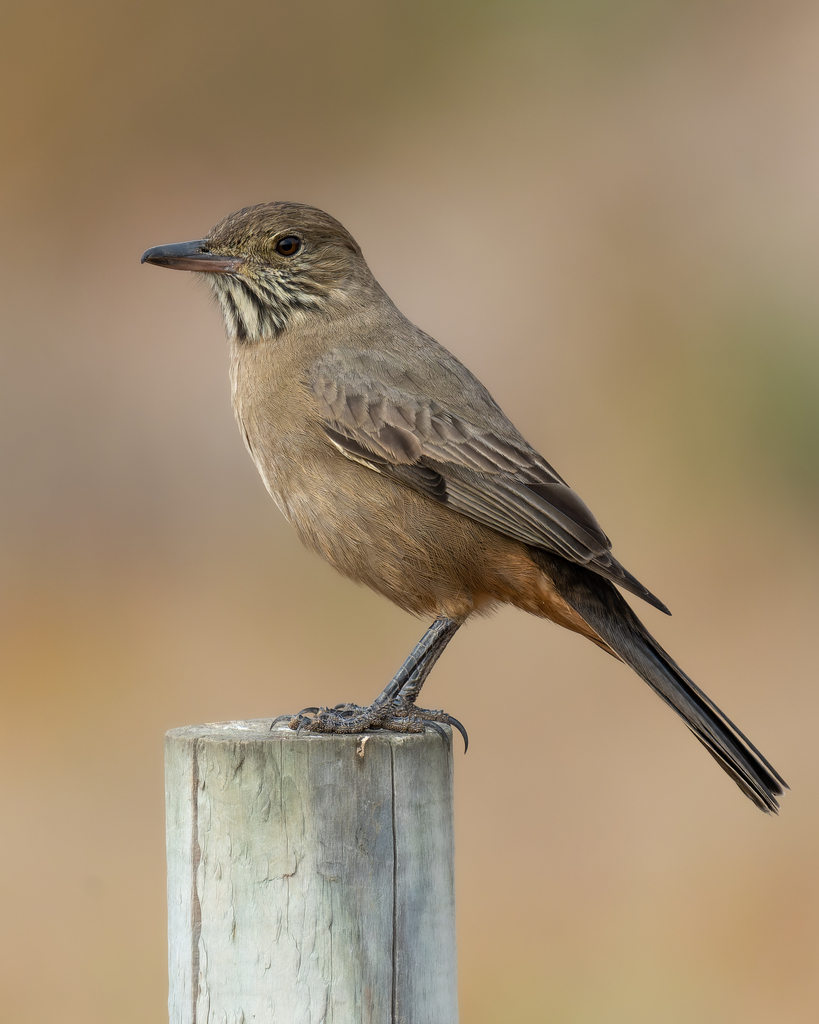
The great shrike-tyrant is the largest species of tyrant flycatcher, weighing an average of about 99 g (3.5 oz). It is 26 to 28 cm (10 to 11 in) long. The sexes have the same plumage. Adults of the nominate subspecies have a mostly grayish brown head with some whitish on the lores and a cinnamon tinge on the ear coverts. Their upperparts are grayish brown. Their wings are mostly a duskier grayish brown with pale brown edges on the flight feathers. Their tail is mostly black with buffy white tips and edges of the outer webs of the outer feathers. Their throat is white with heavy black streaks. Their underparts are a paler grayish brown than their upperparts, with a cinnamon or cinnamon-buff wash on the lower belly and crissum. Subspecies A. l. fortis is larger and slightly brighter than the nominate. Juveniles are browner than adults, with indistinct streaks on the head, back, and upper breast, less streaking on the throat than adults, and a wholly cinnamon-buff belly. Adults of both subspecies have a dark iris, a heavy hooked bill with a black maxilla and a dark-tipped orange mandible, and blackish legs and feet.
Range & habitat
The nominate subspecies of the great shrike-tyrant is found along the coast and mountains of Chile from the Atacama Region to Valdivia in the Los Ríos Region. Subspecies A. l. fortis is found in far southern Chile's Aysén and Magallanes regions and in southern Argentina from southern Neuquén Province south into Tierra del Fuego. The species inhabits semi-arid to somewhat moister landscapes including scrublands with cacti and bromeliads, somewhat open shrubby areas and agricultural regions, pastures with nearby shrubby areas, and open Nothofagus woodlands. It shuns heavily woodlands and populated areas. In elevation it ranges from sea level to 1,800 m (5,900 ft) though it mostly occurs below 1,500 m (4,900 ft).
Wikipedia: “Distribution and habitat”
What it does
The great shrike-tyrant feeds on insects; small mammals, reptiles, and amphibians; and bird eggs and nestlings. It mostly forages in pairs, though the members are typically not close together. It perches on a rock, shrub, or fence and typically captures prey by dropping on it from the perch and in mid-air by "hawking".
Wikipedia: “Feeding”
Listen
Looking for field recordings…
Where it lives
Recorded sightings
—
geo-referenced records in GBIF, from museums, herbaria and field observers.
Drag the globe to turn it. Dots are where records exist, not a range map; darker means more records.
In the stacks
Searching the stacks…
Every page naming Agriornis lividus in the Biodiversity Heritage Library →
This page is assembled live from iNaturalist, GBIF, Wikipedia, the Source Library and the Internet Archive. It is not yet part of the hand-edited codex. iNaturalist taxon 16654.