- Plants
- ›Vascular Plants
- ›flowering plants
- ›Dicots
- ›pinks, cactuses, and allies
- ›cacti
- ›globular cacti, moonlight cacti, torch cacti, and allies
- ›Globular Cactuses
- ›Pediocactus
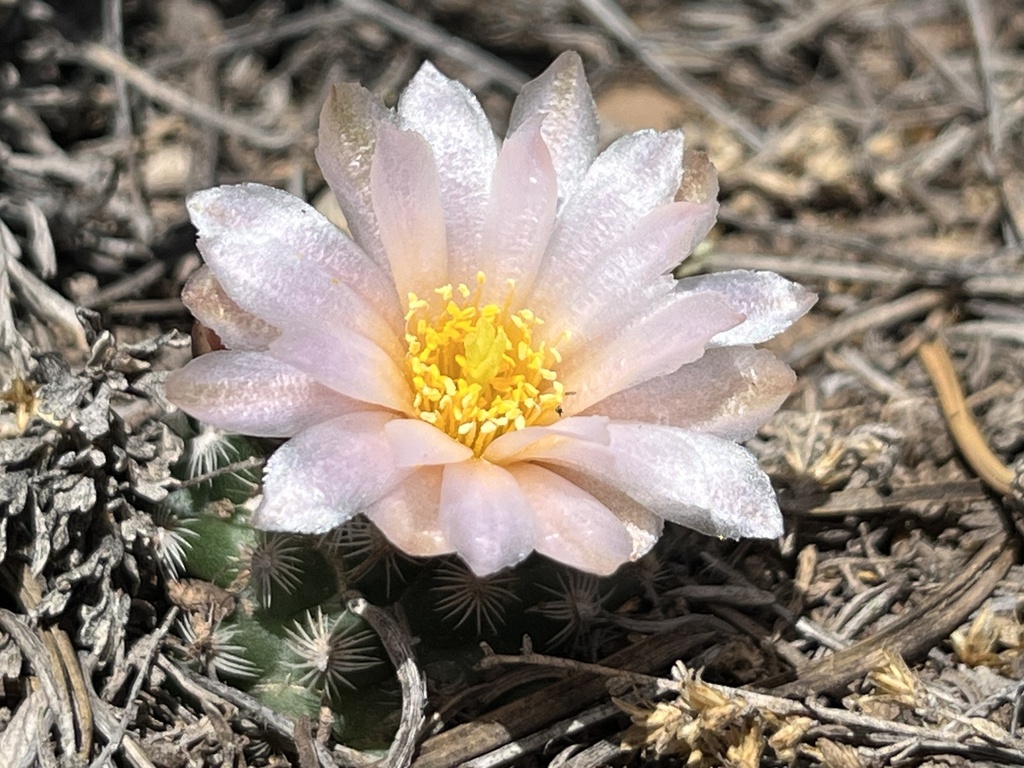
Knowlton's Cactus
Pediocactus knowltonii
Pediocactus knowltonii is a rare species of cactus known by the common names Knowlton's miniature cactus, Knowlton's pincushion cactus, and Knowlton's minute cactus. It is endemic to San Juan County, New Mexico, in the United States. It is the smallest and rarest species in genus Pediocactus. It is threatened by a number of human activities. It is federally listed as an endangered species of the United States.
From the article Pediocactus knowltonii on Wikipedia (CC BY-SA), quoted section by section
Description
A tiny cactus, it may reach a maximum size of 55 millimeters tall by 30 mm wide. It is often smaller, growing to the size of a US penny. An individual is considered to be an adult when it exceeds 10 mm in diameter. It is spherical or somewhat cylindrical in shape. The areoles are round and covered in hairs. Each areole has up to 26 radial spines which are red, pink, or white in color. The spines are less than 2 mm long. The plant produces a flower up to 35 mm long by 25 mm wide with pinkish tepals, the outer ones sporting brownish midstripes. The fruit is green, ripening reddish, and measures about 4 mm long. According to a genetic analysis, this species probably evolved as a mutation of the larger Pediocactus simpsonii.
Range & habitat
It is endemic to San Juan County, New Mexico in the United States, where there is a single population on a patch of territory measuring about 12 acres (49,000 m2). As of 2008, there are approximately 6100 individuals in this population. The cactus occurs on land very close to the Colorado border; in fact, it has been observed within 30 meters (100 ft) of the state border, but it does not technically occur within the state of Colorado, and is thus an endemic of New Mexico. Its habitat is pinyon-juniper woodland and sagebrush with loamy, gravelly alluvial soils. In some areas the substrate is covered in cobbles. The cactus may grow in the open or in the shade of larger plants.
Wikipedia: “Distribution and habitat”
Where it lives
Recorded sightings
—
geo-referenced records in GBIF, from museums, herbaria and field observers.
Drag the globe to turn it. Dots are where records exist, not a range map; darker means more records.
In the stacks
Searching the stacks…
Every page naming Pediocactus knowltonii in the Biodiversity Heritage Library →
This page is assembled live from iNaturalist, GBIF, Wikipedia, the Source Library and the Internet Archive. It is not yet part of the hand-edited codex. iNaturalist taxon 166257.