- Plants
- ›Vascular Plants
- ›flowering plants
- ›monocots
- ›grasses, sedges, cattails, and allies
- ›grasses
- ›Paniceae, andropogoneae, paspaleae, and allies
- ›Paspalums and allies
- ›Paspalums, carpetgrasses, vine mesquites, and allies
- ›Paspalum
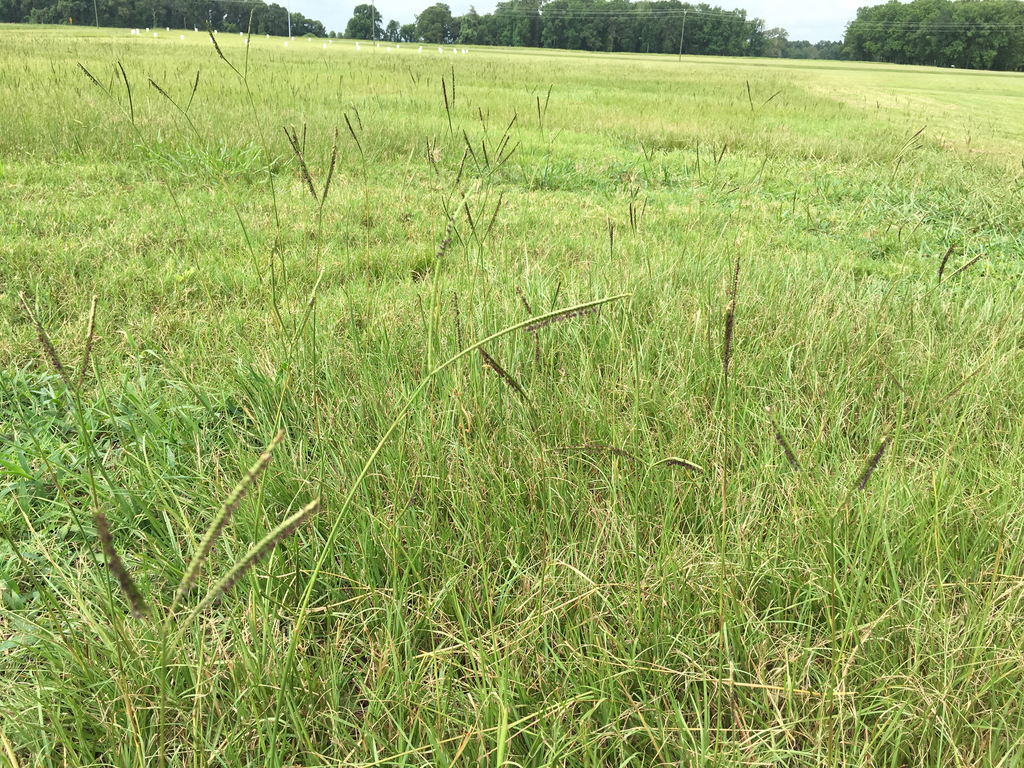
Bahia grass
Paspalum notatum
Paspalum notatum, known commonly as bahiagrass, common bahia, and Pensacola bahia, is a tropical to subtropical perennial grass (family Poaceae). It is known for its prominent V-shaped inflorescence consisting of two spike-like racemes containing multiple tiny spikelets, each about 2.8–3.5 millimetres (0.11–0.14 in) long.
This grass is low-growing and creeping with stolons and stout, scaly rhizomes. The stolons are pressed firmly to the ground and root freely from the internodes, forming a dense sod. The flat, tough-textured leaves are usually hairless, with blades 2–6 millimetres (0.079–0.236 in) wide. They are flat, folded, and inrolled, tapering to a fine point. The leaf bases at the terminus of each rhizome usually have a purplish hue. The stems reach 20–75 centimetres (7.9–29.5 in) tall.
Where it lives
Recorded sightings
—
geo-referenced records in GBIF, from museums, herbaria and field observers.
Drag the globe to turn it. Dots are where records exist, not a range map; darker means more records.
In the stacks
Searching the stacks…
Every page naming Paspalum notatum in the Biodiversity Heritage Library →
This page is assembled live from iNaturalist, GBIF, Wikipedia, the Source Library and the Internet Archive. It is not yet part of the hand-edited codex. iNaturalist taxon 166188.