On eBird ↗
Least Flycatcher
Live sightings near you, the range map, bar charts of when it is seen, and Macaulay Library photos and recordings.
Least Flycatcher
Empidonax minimus
The least flycatcher (Empidonax minimus), (also called chebec, or chebecker, after the sound it makes), is a small insect-eating bird. It is the smallest Empidonax flycatcher in eastern North America.
From the article Least flycatcher on Wikipedia (CC BY-SA), quoted section by section
Description
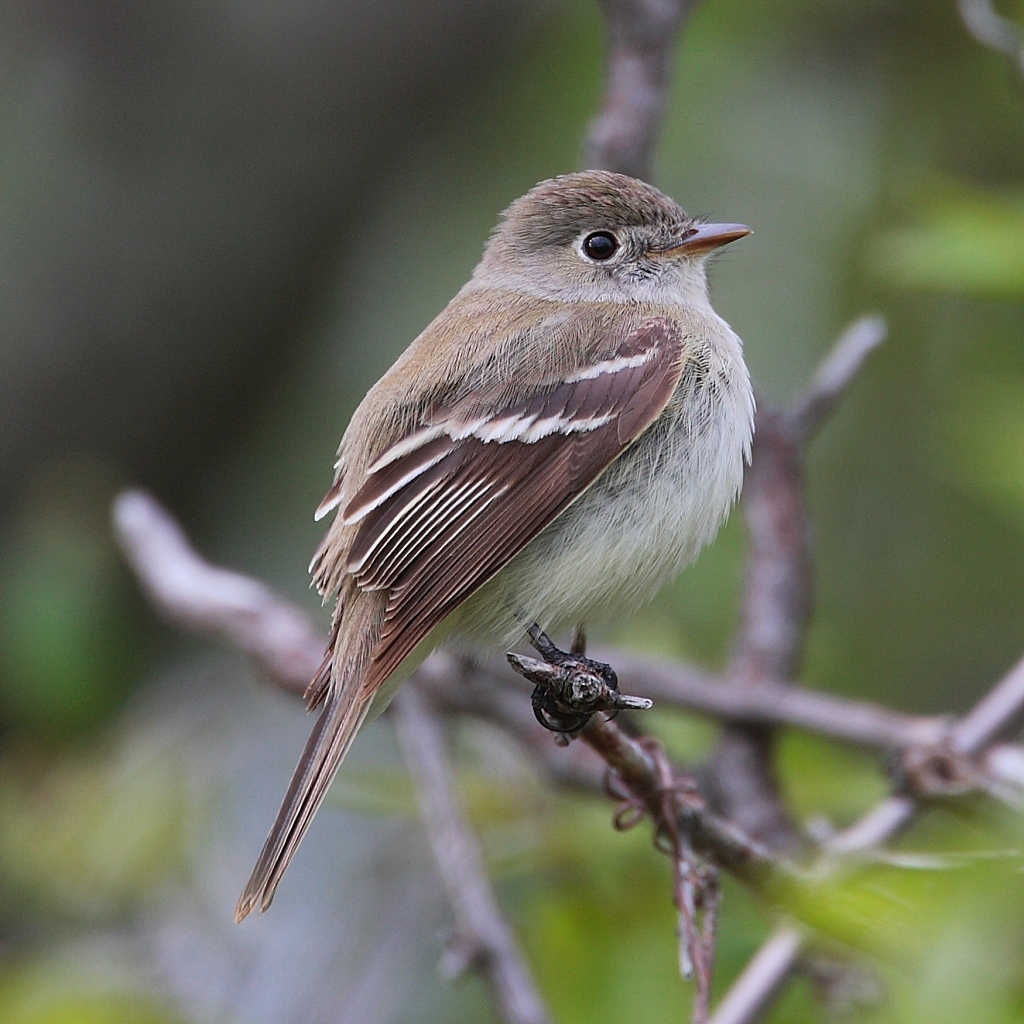
The least flycatcher is hard to distinguish from the other birds of its genus. The bird is one of the smallest of the genus Empidonax, measuring 12 to 14 cm in height with a wingspan of 19 to 22 cm and weighing approximately 10.3 g. Its plumage is dull olive-gray on its back and whitish on its belly, notably brighter than the other Empidonax birds. The least flycatcher's wings are lined with two white bars, and white rings contour its eyes. Its beak is short and the lower mandible is yellowish. The juveniles look similar to the adults except that their wing bars are slightly darker, with tawny/olive hues. Because other flycatchers also have those field marks, the best way to identify the least flycatcher is by its call and habitat.
Range & habitat
The least flycatcher inhabits the Eastern Rockies of Canada, and the Central-North and Northeastern United-States. During winter, they migrate to Central America and establish themselves from Mexico to Panama. The least flycatcher lives in aspen clusters, orchards, shade trees and open woods. They breed in deciduous or mixed forests and occasionally in coniferous groves. They tend to prefer breeding sites near clearing or edges but can also nest in dry woods. They spend the winter in Central America where they nest in forest edges and second growth. The least flycatcher also made its way in the open country. They often live in villages or city parks, nesting in shade trees and orchards, or along rural roads and forest edges.
Wikipedia: “Distribution and habitat”
What it does
The least flycatcher, as its name indicates, feeds on flies but includes many other items in its diet. They mainly eat insects such as many small wasps, winged ants, beetles, caterpillars, midges, a few true bugs, grasshoppers, spiders and other small invertebrates. They also occasionally eat berries. To forage, the least flycatcher mainly catches its insects mid-air, but they also catch some insects from the vegetation. When foraging, the bird watches from a perch and flies out to catch the insects that pass by. The Least flycatcher is considered a slow searcher in comparison to other birds, switching perch around 10 times/minute and frequently turning around on its perch to get a 360° view. Least flycatchers rarely glean but hover extensively in comparison to its congeners. Those perches are mainly dead twigs of the bottom part of a tree located in opened patches of the forest. In short, Robinson and Holmes (1982) determined that the least flycatcher attacks 81.1% of their preys by hovering, 9.6% by hawking, 6.2% by flush-chasing and 3.1% by gleaning.
Wikipedia: “Diet”
Listen
Looking for field recordings…
Where it lives
Recorded sightings
—
geo-referenced records in GBIF, from museums, herbaria and field observers.
Drag the globe to turn it. Dots are where records exist, not a range map; darker means more records.
In the stacks
Searching the stacks…
Every page naming Empidonax minimus in the Biodiversity Heritage Library →
This page is assembled live from iNaturalist, GBIF, Wikipedia, the Source Library and the Internet Archive. It is not yet part of the hand-edited codex. iNaturalist taxon 16602.