On eBird ↗
Gray-crowned Flatbill
Live sightings near you, the range map, bar charts of when it is seen, and Macaulay Library photos and recordings.
Gray-crowned Flatbill
Tolmomyias poliocephalus
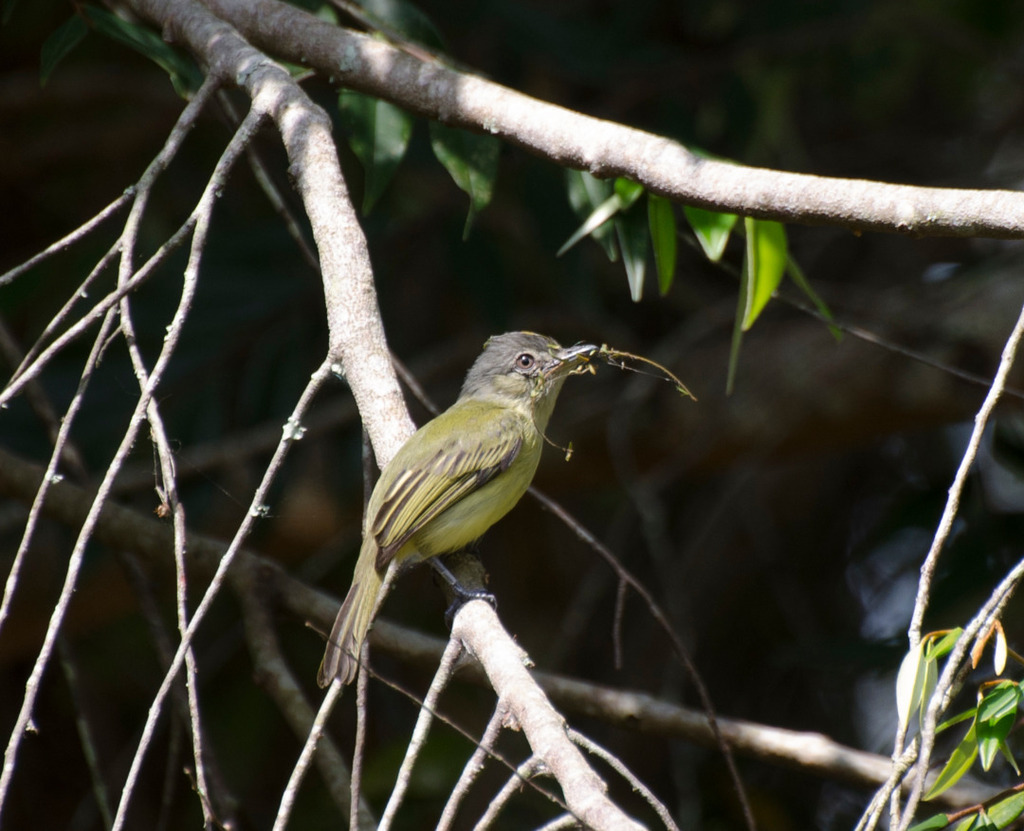
The grey-crowned flatbill or grey-crowned flycatcher (Tolmomyias poliocephalus) is a species of bird in the family Tyrannidae. It is found in humid forest in the Amazon and Atlantic Forest in South America. It closely resembles the yellow-margined and yellow-olive flatbills, but its lower mandible is dark with a pale base. It is a fairly common bird with a wide range and the International Union for Conservation of Nature has rated it as "least concern".
From the article Grey-crowned flatbill on Wikipedia (CC BY-SA), quoted section by section
Description
The gray-crowned flatbill is 12 to 12.5 cm (4.7 to 4.9 in) long and weighs about 11 g (0.39 oz). The sexes have the same plumage. Adults of the nominate subspecies have a mostly gray head with a whitish stripe above the lores, a faint whitish eye-ring, and greenish gray ear coverts. Their back, rump, uppertail coverts are olive. Their wings are blackish with yellow edges on the coverts and remiges that appear as two wing bars and sometimes a pale speculum. Their throat is greenish, their breast and flanks olive, and their belly and vent pale yellow. Subspecies T. p. sclateri has a pale gray throat and a duller green back and paler yellow belly than the nominate. T' p. klagesi is intermediate between the nominate and sclateri. All subspecies have a yellow, pale gray, or pale brown iris, a wide flat bill with a black maxilla and a dark mandible with an orange-pink base, and gray legs and feet.
Range & habitat
The borders between the grey-crowned flatbill's subspecies are not well defined. As is best known, the nominate subspecies is found from southern Amazonas state in southwestern Venezuela south through eastern and southeastern Colombia, eastern Ecuador, and eastern Peru and east into western Brazil to the lower Negro and Tefé rivers. T' p. klagesi has a limited range in central and eastern Venezuela from Delta Amacuro south through Bolívar into northern Amazonas. T. p. sclateri has a disjunct distribution. Its main population adjoins those of the other two subspecies. It extends through the Guianas east across northern Brazil to the Atlantic and south through western Brazil to northern and central Bolivia. A smaller population is found separately in eastern Brazil from Pernambuco south to Espírito Santo. The grey-crowned flatbill primarily inhabits humid forest both terra firme and várzea. It also is found in mature secondary forest. It mostly stays from the forest's mid-story to its canopy. In elevation it mostly occurs below 600 m (2,000 ft) though it reaches 1,000 m (3,300 ft) in Venezuela and Peru and locally as high as 1,400 m (4,600 ft) in the latter country.
Wikipedia: “Distribution and habitat”
What it does
The grey-crowned flatbill feeds on insects though details are lacking. It typically forages singly or in pairs and often joins mixed-species feeding flocks. It feeds mostly from the forest's mid-story up to the canopy. It sits with a horizontal pose, often with its tail cocked, and captures prey mostly with short upward sallies from a perch to grab or hover-glean it from leaves.
Wikipedia: “Feeding”
Listen
Looking for field recordings…
Where it lives
Recorded sightings
—
geo-referenced records in GBIF, from museums, herbaria and field observers.
Drag the globe to turn it. Dots are where records exist, not a range map; darker means more records.
In the stacks
Searching the stacks…
Every page naming Tolmomyias poliocephalus in the Biodiversity Heritage Library →
This page is assembled live from iNaturalist, GBIF, Wikipedia, the Source Library and the Internet Archive. It is not yet part of the hand-edited codex. iNaturalist taxon 16555.