- Plants
- ›Vascular Plants
- ›flowering plants
- ›Dicots
- ›Legumes, Milkworts, and Allies
- ›Legumes
- ›Acacias, Mimosas, Mesquites, and Allies
- ›Mimoseae
- ›Mimosa
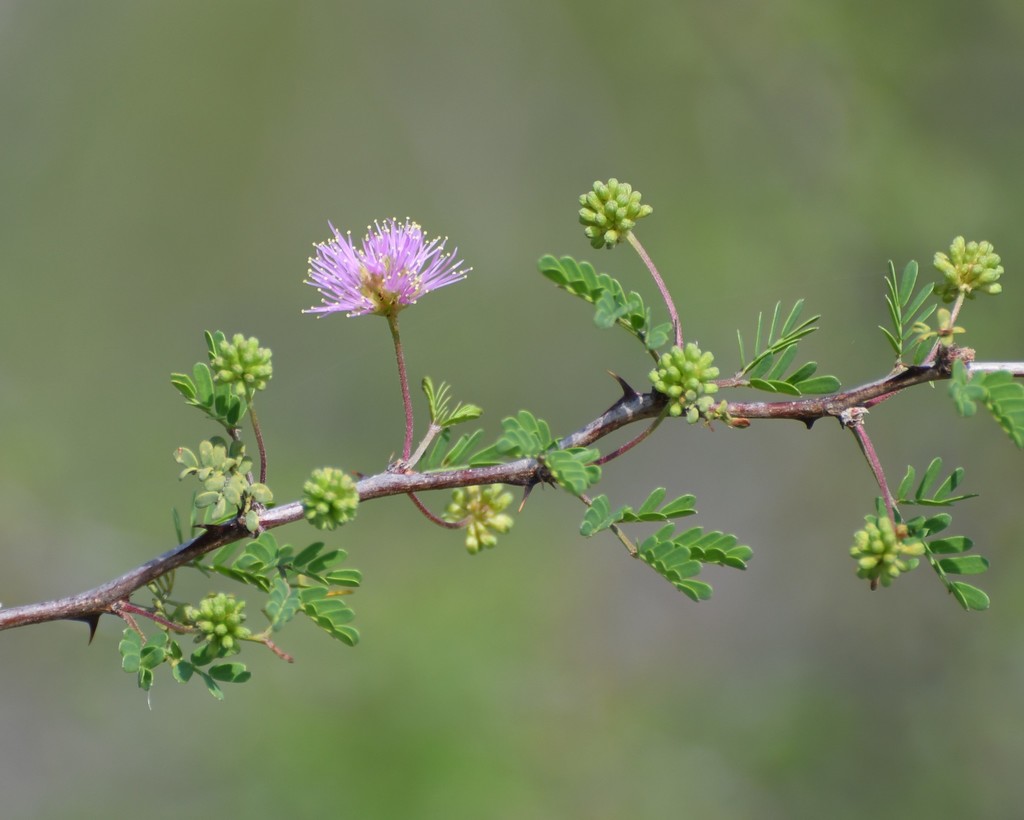
Texas Mimosa
Mimosa texana
Mimosa texana is a shrub in the Fabaceae family. It is commonly known as the Texas mimosa, the Texas catclaw or the Wherry mimosa and is endemic to upland regions of Mexico and Texas. This species used to be classified as Mimosa biuncifera but it was found that phenotypic variations occurred across its range and a new taxonomy was proposed by Rupert C. Barneby in 1986, splitting the species into Mimosa aculeaticarpa var. biuncifera and Mimosa...
From the article Mimosa texana on Wikipedia (CC BY-SA), quoted section by section
Description
This species is a straggly many-branched deciduous shrub of up to two metres tall. It has slender zigzag dark-colored twigs armed below leaf nodes with backward-curved prickles. The alternate bipinnate leaves typically have 1 to 5 pairs of pinnae per leaf with 3 to 9 pairs of leaflets per pinna. The globular flowers can vary from creamy-white to deep pink and typically reach peak bloom each year in April, although the species can bloom following rains anytime between March and September. The flowers are fragrant and attract numerous insects. The seedpods are brick red and flattened with prickly edges and are typically produced from May through October.
== References ==
Range & habitat
Texas Mimosa is found on alkaline soils in northeastern Mexico and in Texas across the southern Trans-Pecos and Edwards Plateau as well as in south Texas in the vicinity of Zapata and Starr counties. It is uncommon and grows on caliche and gravelly hillsides.
Wikipedia: “Distribution”
Where it lives
Recorded sightings
—
geo-referenced records in GBIF, from museums, herbaria and field observers.
Drag the globe to turn it. Dots are where records exist, not a range map; darker means more records.
In the stacks
Searching the stacks…
Every page naming Mimosa texana in the Biodiversity Heritage Library →
This page is assembled live from iNaturalist, GBIF, Wikipedia, the Source Library and the Internet Archive. It is not yet part of the hand-edited codex. iNaturalist taxon 165401.