- Plants
- ›Vascular Plants
- ›flowering plants
- ›Dicots
- ›borages
- ›borage family
- ›Cynoglossoideae
- ›Asperugeae
- ›Mertensia
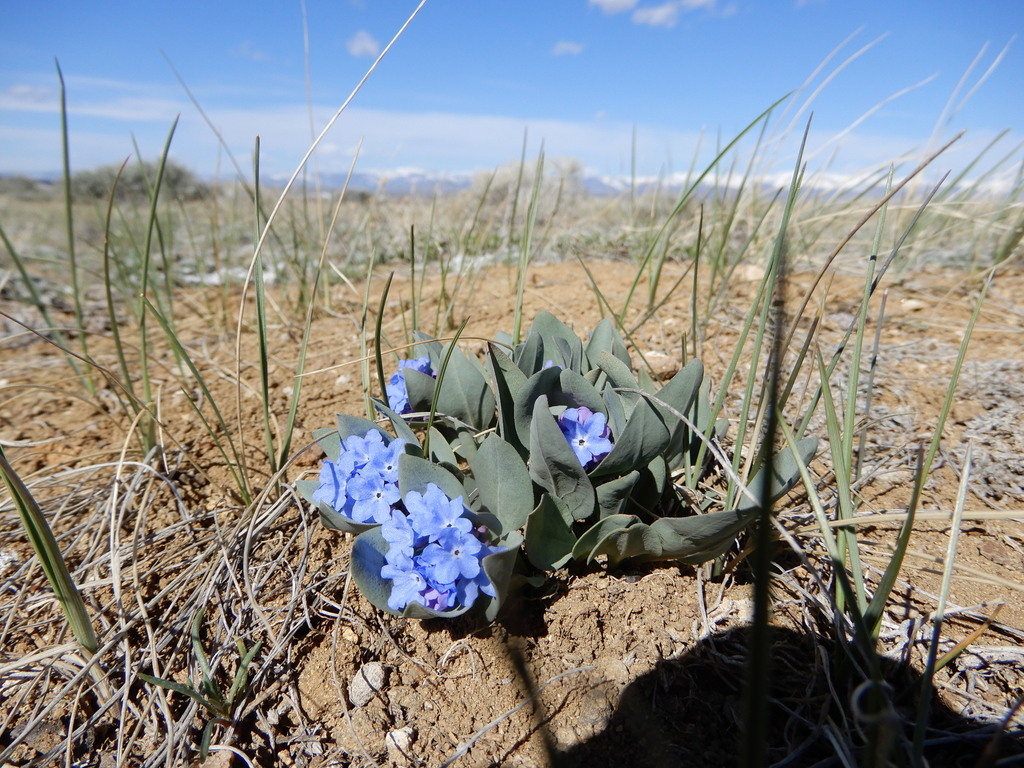
Rocky Mountain Bluebells
Mertensia humilis
Mertensia humilis is a species of plant in the borage family that grows in areas of Wyoming and Colorado in the western United States. In 2023 the species was rated as vulnerable to extinction.
From the article Mertensia humilis on Wikipedia (CC BY-SA), quoted section by section
Description
Mertensia humilis is a perennial plant with a woody taproot. Its stems range in height from 4 to 20 centimeters, growing straight upwards or leaning outwards at an angle. Plants have both basal leaves, ones that spring directly from the base of the plant, and cauline leaves, one attached to the stems. The leaves are hairless and can have small pimple-like structures on the surface. The basal leaves are oblong-ovate to oblong-lanceolate, egg shaped somewhat rectangular to spear head shaped but somewhat rectangular. The leaves on the stems are linear-oblong to lanceolate-oblong in shape with bases that attach directly to the main stem or nearly so. The inflorescences are crowded with blue flowers. Each flower is a narrow bell shape 7–8 millimeters long, with the enclosed tube portion 3–6 mm long. The fruits are nutlets with a rough surface, 2.5 3.5 mm long.
Range & habitat
Most of the natural range of Mertensia humilis is in Wyoming extending north to south across Johnson, Natrona, Carbon, and Albany, counties. In Colorado it is only found in two northern counties, Larimer and Jackson. In Wyoming there are 40 known occurrences and 25 other places where it has become locally extinct. In Colorado there are five occurrences where the species has been recently observed and three more where they had not been seen in the 20 years prior to 2020. It grows at elevations of 2,000 to 2,800 meters (6,400 to 9,100 ft). The species grows on in the sagebrush steppe and also in open woodlands in Wyoming.
Conservation. In 2023 NatureServe evaluated Mertensia humilis as globally vulnerable (G3). They also rated it vulnerable (S3) in the state of Wyoming and critically imperiled (S1) in Colorado. When writing about the species in 1937 Louis Otho Williams wrote, "Although M. humilis seems to be restricted in range, within that area it is extremely common. The truncated summit of the Laramie Mountains between Cheyenne and Laramie is literally blue with the plant when it is in flower."
Wikipedia: “Range and habitat”
Where it lives
Recorded sightings
—
geo-referenced records in GBIF, from museums, herbaria and field observers.
Drag the globe to turn it. Dots are where records exist, not a range map; darker means more records.
In the stacks
Searching the stacks…
Every page naming Mertensia humilis in the Biodiversity Heritage Library →
This page is assembled live from iNaturalist, GBIF, Wikipedia, the Source Library and the Internet Archive. It is not yet part of the hand-edited codex. iNaturalist taxon 165347.