- Plants
- ›Vascular Plants
- ›flowering plants
- ›Dicots
- ›magnolias, nutmegs, and allies
- ›magnolia family
- ›Magnolioideae
- ›Magnolia
- ›Tuliparia
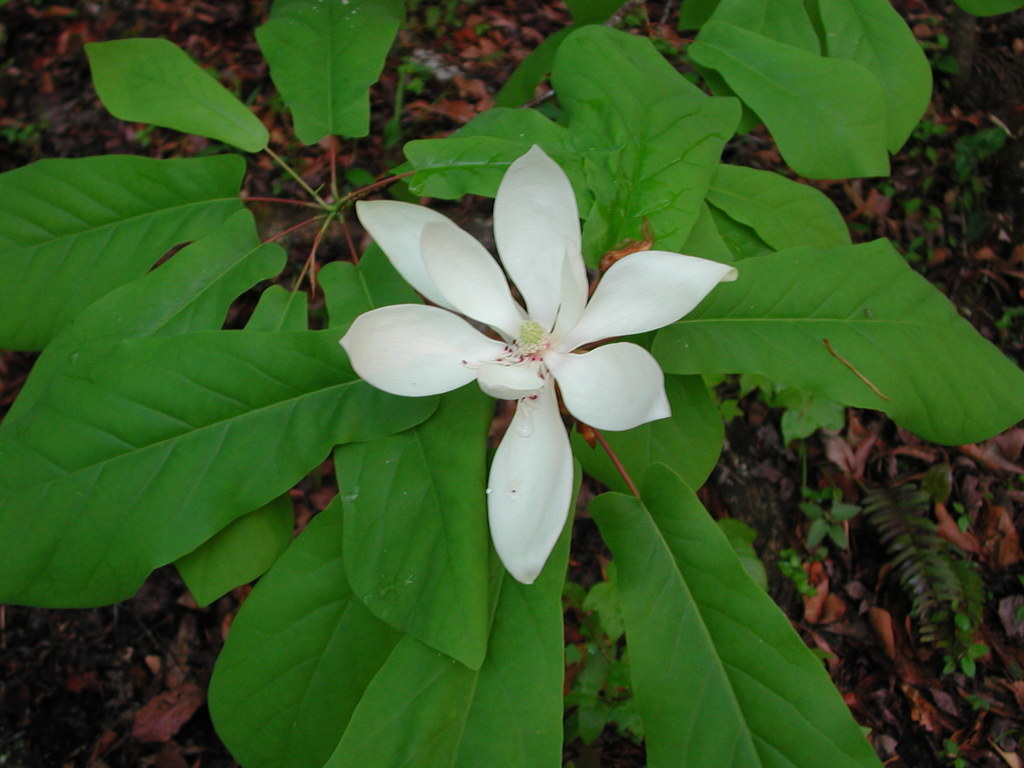
Fraser Magnolia
Magnolia fraseri
Magnolia fraseri, commonly known as Fraser's magnolia, Fraser magnolia, mountain magnolia, earleaf cucumbertree, or mountain-oread, is a species of magnolia native to the southeastern United States in the southern Appalachian Mountains and adjacent Atlantic and Gulf Coastal Plain from West Virginia to northern Florida and to eastern Texas. The Appalachian plants are classified as Magnolia fraseri var. fraseri, and the more coastal plants as M. fraseri var. pyramidata. These two kinds of magnolia are sometimes recognized as distinct species, M. fraseri and M. pyramidata, respectively.
From the article Magnolia fraseri on Wikipedia (CC BY-SA), quoted section by section
Description
Fraser's magnolia (named after the Scottish botanist John Fraser) is a small, deciduous tree growing to 25 m (80 ft) tall, as a basal-branching, fragrant plant, with gray and brown, unfurrowed bark; similar to beech, but more "warty" and mossy. The leaves are quite large, 15–25 cm (rarely up to 53 cm) long and 8–18 cm (rarely up to 29 cm) broad, with a pair of auricles (or "ear-lobes") at the base and an entire margin; they are green above and glaucous blue-green below. The showy white flowers are 16–25 cm in diameter with nine tepals; they open in late spring or early summer, after the foliage. The fruit is a woody, oblong, cone-like structure (like all magnolias) 6.5–12 cm long, covered in small, pod-like follicles each containing one or two red seeds that hang out from the cone by a slender thread when ripe. A good seed crop occurs only about every 4–5 years. Reproduction is accomplished by both seed and vegetative sprouts. The fruit is eaten by wildlife, helping disperse the seeds. In the Appalachian Mountains, Fraser's Magnolia is a popular nest tree for the northern flying squirrel. The tree grows best on rich, moist, well-drained soil. The very large showy white flowers and large-leaved, coarse-textured foliage make it an attractive ornamental tree, but otherwise it has little commercial value. …
Where it lives
Recorded sightings
—
geo-referenced records in GBIF, from museums, herbaria and field observers.
Drag the globe to turn it. Dots are where records exist, not a range map; darker means more records.
In the stacks
Searching the stacks…
Every page naming Magnolia fraseri in the Biodiversity Heritage Library →
This page is assembled live from iNaturalist, GBIF, Wikipedia, the Source Library and the Internet Archive. It is not yet part of the hand-edited codex. iNaturalist taxon 165074.