On eBird ↗
Streak-necked Flycatcher
Live sightings near you, the range map, bar charts of when it is seen, and Macaulay Library photos and recordings.
Streak-necked Flycatcher
Mionectes striaticollis
The streak-necked flycatcher (Mionectes striaticollis) is a species of bird in the family Tyrannidae, the tyrant flycatchers. It is found in Bolivia, Colombia, Ecuador, and Peru.
From the article Streak-necked flycatcher on Wikipedia (CC BY-SA), quoted section by section
Description
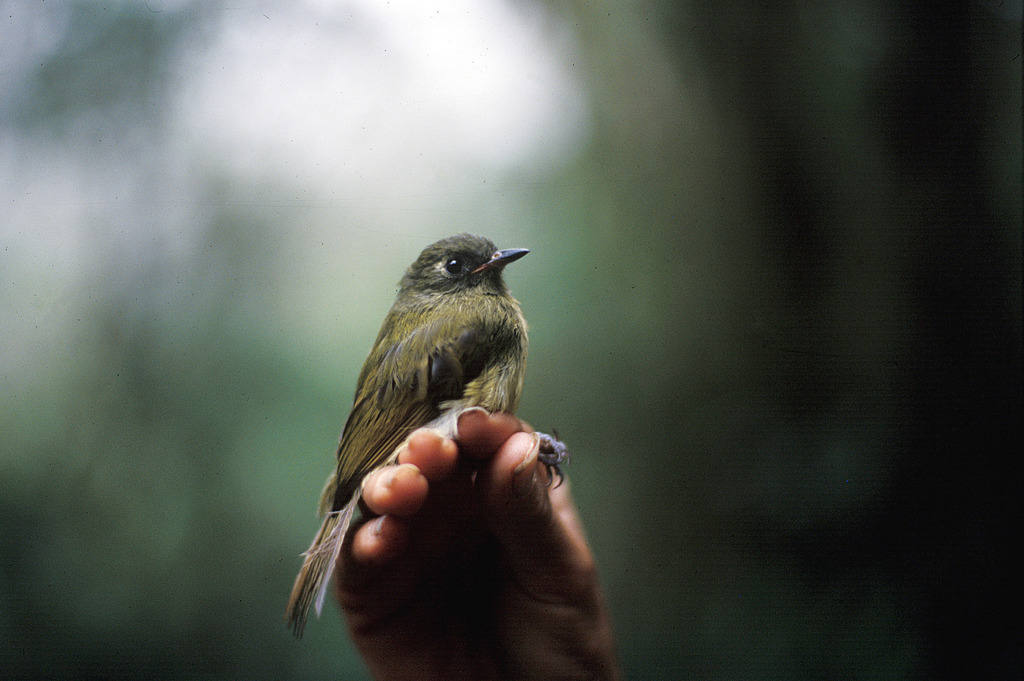
The streak-necked flycatcher is 13 to 13.5 cm (5.1 to 5.3 in) long and weighs 13 to 17 g (0.46 to 0.60 oz). The sexes have the same plumage. Adults of the nominate subspecies M. s. striaticollis have a dark gray face with white streaks and a small white spot behind the eye. Their crown and nape are slaty gray and the rest of their upperparts are dark olive. Their wings and tail are olive, sometimes with faint buffish olive wing bars. Their throat and upper breast are slate-gray with white streaks. Their lower breast and flanks are streaked with dark olive and yellow and their belly is yellow. Subspecies M. s. columbianus has a dark olive-gray crown, a grayish olive face, and a gray throat and upper breast with thin white streaks. M. s. palamblae has an olive wash on the gray face and crown and a gray chin. Its throat and upper breast are streaked dark olive and yellow and its lower breast and belly are yellow. M. s. viridiceps has a dark olive crown, a dark gray face, and an olive throat and upper breast with thin white streaks. Both sexes of all subspecies have a dark brown iris, a long dark brownish gray bill with a pinkish base to the mandible, and dark gray legs and feet.
Range & habitat
The subspecies of the streak-necked flycatcher are found thus:
M. s. columbianus: Colombian Andes except in the southwest; eastern Andean slope of Ecuador M. s. viridiceps: west slope of the Andes in far southwestern Colombia and south on the west slope through Ecuador M. s. palamblae: west slope of the Andes of northern Peru from near the Ecuadorian border south to Huánuco Department M. s. striaticollis east slope of the Andes of Peru from Pasco Department south into northern Bolivia as far as western Santa Cruz Department The streak-necked flycatcher primarily inhabits humid montane forest in the upper tropical and lower temperate zones. It also occurs at the forest edges and in secondary forest. In elevation it ranges between 1,500 and 2,700 m (4,900 and 8,900 ft) in Colombia, mostly between 1,500 and 2,500 m (4,900 and 8,200 ft) but locally lower in Ecuador, between 1,700 and 3,100 m (5,600 and 10,200 ft) on the west slope in Peru, and between 500 and 3,300 m (1,600 and 10,800 ft) though mostly between 1,000 and 2,400 m (3,300 and 7,900 ft) on the east slope in Peru.
Wikipedia: “Distribution and habitat”
What it does
The streak-necked flycatcher feeds on insects and small fruits. It forages in bushes, thickets, and trees from the forest's understory to its sub-canopy. It typically perches upright on a branch and makes short sallies to hover-glean prey from leaves and twigs. It also sometimes takes flying prey on the wing. It typically forages singly and occasionally joins a mixed-species feeding flock.
Wikipedia: “Feeding”
Listen
Looking for field recordings…
Where it lives
Recorded sightings
—
geo-referenced records in GBIF, from museums, herbaria and field observers.
Drag the globe to turn it. Dots are where records exist, not a range map; darker means more records.
In the stacks
Searching the stacks…
Every page naming Mionectes striaticollis in the Biodiversity Heritage Library →
This page is assembled live from iNaturalist, GBIF, Wikipedia, the Source Library and the Internet Archive. It is not yet part of the hand-edited codex. iNaturalist taxon 16506.