- Plants
- ›Vascular Plants
- ›flowering plants
- ›Dicots
- ›Mustards, Capers, and Allies
- ›mustard family
- ›Brassicoideae
- ›Camelinodae
- ›Lepidieae
- ›Lepidium
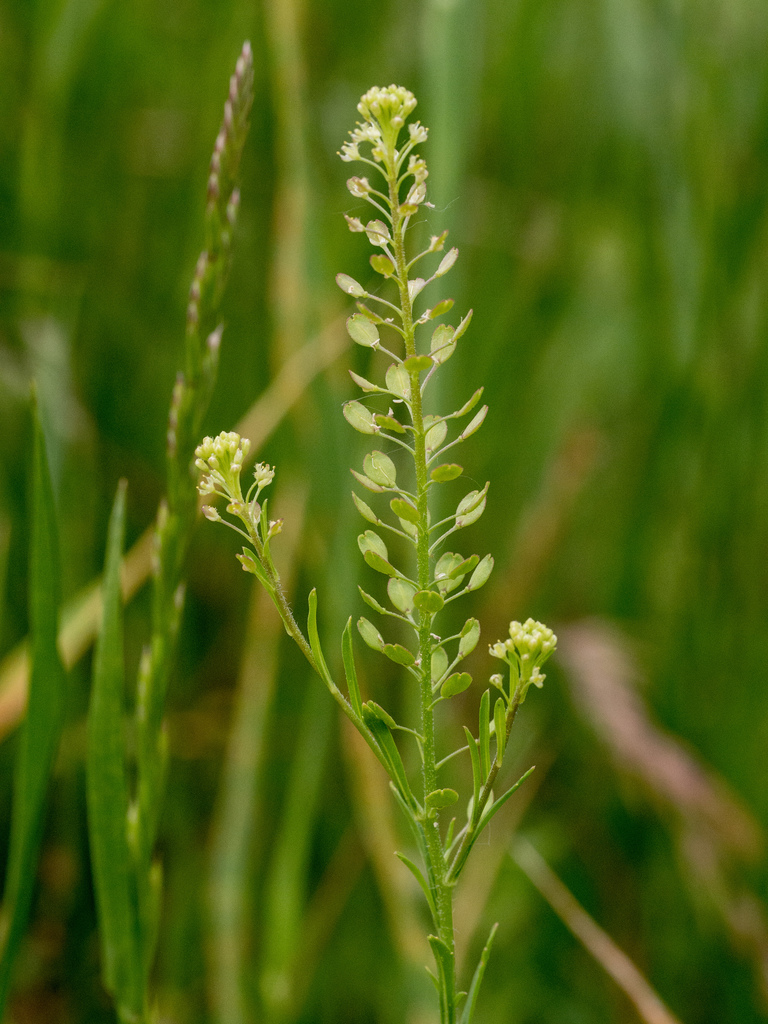
Southern pepperweed
Lepidium austrinum
Southern Pepperweed, Lepidium austrinum, is an herbaceous plant whose leaves early in life form a rosette, but later the stem branches from the base. Under ideal conditions it may reach up to 94 cm (37 inches) in height, and it can behave either as an annual or a biennial. Its stem leaves may be much longer than wide, with the widest portion near the tip, to very narrow. Leaf margins may be smooth to toothed, with
From the article Lepidium austrinum on Wikipedia (CC BY-SA), quoted section by section
Description
Lepidium austrinum is an herbaceous plant whose leaves early in life form a rosette, but later the stem branches from the base. Under ideal conditions it may reach up to 94 cm (37 inches) in height, and it can behave either as an annual or a biennial. Its stem leaves may be much longer than wide, with the widest portion near the tip, to very narrow. Leaf margins may be smooth to toothed, with leaves at the base deeply lobed. Its very small flowers are white, or sometimes the flowers bear no petals. The fruits are flattened, somewhat rounded in shape, and each bears a conspicuous notch at its tip. One feature distinguishing this species from many other Lepidium species is that its green parts are covered with stiff, moderately long hairs.
Range & habitat
The native area of distribution for Lepidium austrinum is from the central to east-central USA south through the northeastern quarter of Mexico.
Wikipedia: “Range”
What it does
A study of the effects of plant secondary compounds, or secondary metabolites, on the food supply of white-tailed deer in the Tamaulipan thorn scrub of northern Mexico (also known as the "Tamaulipan Mezquital" and "Brush Country") found Lepidium austrinum to be consumed by deer in the spring. The plant's "dry matter digestibility" was found to be 65.6% -- about average among the forbs consumed. Its total nitrogen – an indicator for protein content – was 2.4g per 100g−1 dry matter. Several species of birds feed on the fruit pods.
Wikipedia: “Ecology”
In human culture
Possibly the genus name Lepidium by Linnaeus originates from the similar plant named Lepidium latifolium by Pliny the Elder (AD 23/24 – 79, long before Linnaeus), which he based on the Greek lepis, for "scale" -- in reference to the vaguely scale-like fruits. However, one wonders about the Latin lepidus, describing something that's pleasant, fine, elegant or neat, which could describe the fruits'peppery taste. The species name austrinum is from Latin meaning "southern, south."
== References ==
Wikipedia: “Etymology”
Where it lives
Recorded sightings
—
geo-referenced records in GBIF, from museums, herbaria and field observers.
Drag the globe to turn it. Dots are where records exist, not a range map; darker means more records.
In the stacks
Searching the stacks…
Every page naming Lepidium austrinum in the Biodiversity Heritage Library →
This page is assembled live from iNaturalist, GBIF, Wikipedia, the Source Library and the Internet Archive. It is not yet part of the hand-edited codex. iNaturalist taxon 164511.