On eBird ↗
Buff-banded Tyrannulet
Live sightings near you, the range map, bar charts of when it is seen, and Macaulay Library photos and recordings.
Buff-banded Tyrannulet
Mecocerculus hellmayri
The buff-banded tyrannulet (Mecocerculus hellmayri) is a species of bird in the family Tyrannidae. It is found in Argentina, Bolivia, and Peru. Its natural habitat is subtropical or tropical moist montane forests.
From the article Buff-banded tyrannulet on Wikipedia (CC BY-SA), quoted section by section
Description
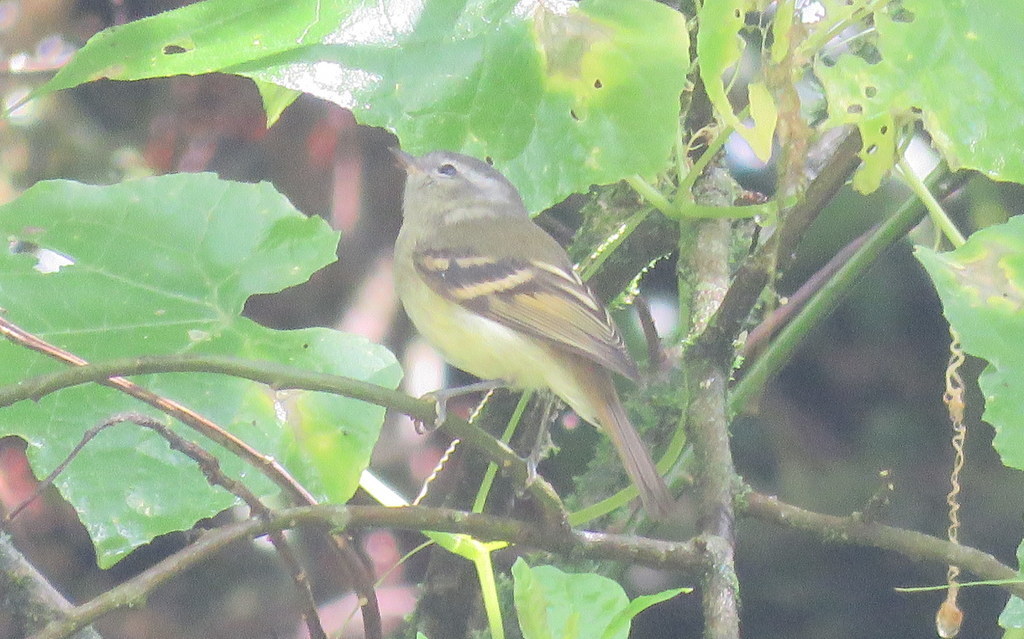
The buff-banded tyrannulet is about 11 cm (4.3 in) long and weighs 10 to 11 g (0.35 to 0.39 oz). The sexes have the same plumage. Adults have a medium gray crown. They have a thin white supercilium and a faint blackish stripe through the eye on an otherwise whitish face. Their upperparts are mostly greenish olive with an ochraceous olive rump and uppertail coverts. Their wings are dusky with pale buffy yellow edges on the flight feathers. Their wing coverts have pale buff tips that show as two bars on the closed wing. Their tail is dusky olive. Their throat is grayish white, their breast and sides grayish white with a darker but faint grayish wash, and their belly and undertail coverts yellowish white. Both sexes of have a brown iris, a thin and pointed black bill, and medium gray legs and feet.
Range & habitat
The buff-banded tyrannulet is found from northern Puno Department in southeastern Peru south through Bolivia into northwestern Argentina's Jujuy Province. It inhabits humid montane evergreen forest in the subtropical zone, especially cloudforest with much moss, and also Podocarpus forest. In elevation it occurs between 1,100 and 2,600 m (3,600 and 8,500 ft) in Bolivia and between 1,500 and 2,300 m (4,900 and 7,500 ft) in Argentina.
Wikipedia: “Distribution and habitat”
What it does
The buff-banded tyrannulet's diet has not been detailed. It usually forages singly and often joins mixed-species feeding flocks. It forages mostly in the forest's mid-story to the canopy. It takes most of its food by gleaning from leaves and twigs while perched, though it occasionally makes short upward flights to briefly hover.
Wikipedia: “Feeding”
Listen
Looking for field recordings…
Where it lives
Recorded sightings
—
geo-referenced records in GBIF, from museums, herbaria and field observers.
Drag the globe to turn it. Dots are where records exist, not a range map; darker means more records.
In the stacks
Searching the stacks…
Every page naming Mecocerculus hellmayri in the Biodiversity Heritage Library →
This page is assembled live from iNaturalist, GBIF, Wikipedia, the Source Library and the Internet Archive. It is not yet part of the hand-edited codex. iNaturalist taxon 16422.