- Plants
- ›Vascular Plants
- ›flowering plants
- ›Dicots
- ›Roses, Elms, Figs, and Allies
- ›oleaster family
- ›Hippophae
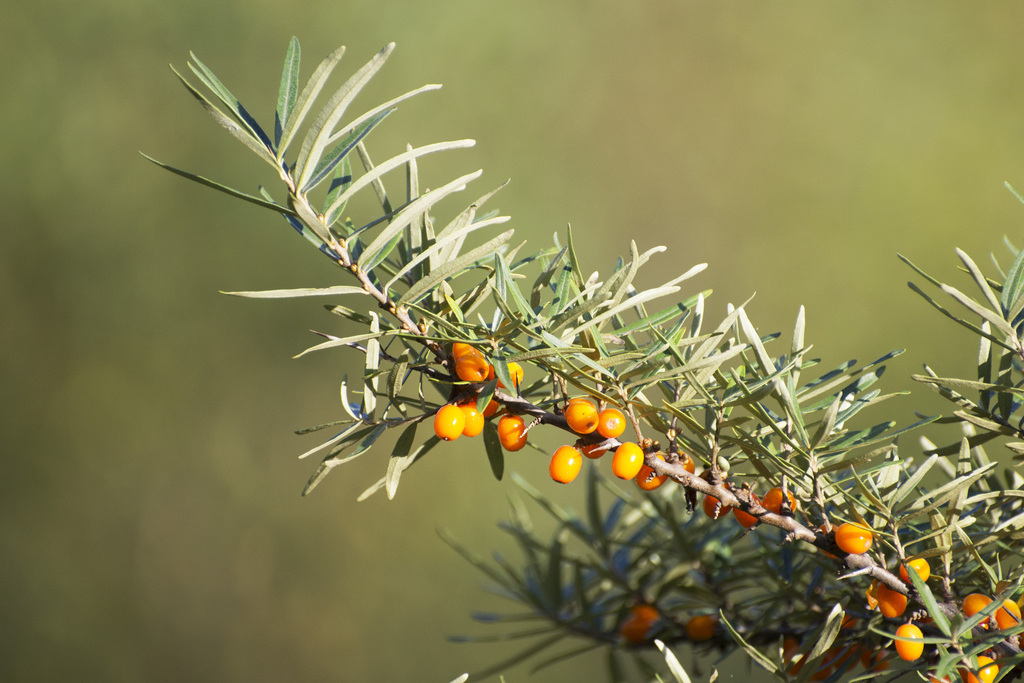
Sea-buckthorn
Hippophae rhamnoides
Sea-buckthorn (Hippophae rhamnoides), also known as sea buckthorn, sandthorn, sallowthorn or seaberry, is a species of flowering plant in the family Elaeagnaceae, native to cold-temperate regions of Eurasia. It is a spiny deciduous shrub. The fruit has culinary uses, while its extracts, including its oil, are used in the cosmetics industry and within traditional medicine. It is also used as animal fodder, in horticulture, and for ecological purposes.
From the article Sea buckthorn on Wikipedia (CC BY-SA), quoted section by section
Description
Sea-buckthorn is a hardy, deciduous suckering shrub that can grow between 2–5 metres (6 ft 7 in – 16 ft 5 in) high, rarely 15 m (49 ft), forming extensive clonal colonies by root sprouts. It has rough, brown or black bark and a thick crown of greyish-green foliage. Like many species of the family Elaeagnaceae, the young shoots and leaves are covered in small silvery scales. The leaves are alternate, narrow and lanceolate, 1–8 cm long and up to 1 cm broad with silvery-green surfaces at first; the upper side darkens to mid to dark grey-green through the summer as the scales wear off, while the underside remains silvery. It is dioecious, with male and female flowers growing on different shrubs. The sex of seedlings can only be determined at the first flowering, which mostly occurs after three years. The male inflorescence is built up of four to six apetalous flowers, while the female inflorescence normally consists of only one apetalous flower and contains one ovary and one ovule. Fertilisation occurs solely via wind pollination, so male plants need to be close to female plants to allow for fertilisation and fruit production. The globose to oval fruit are 6–8 mm diameter, grow in compact dense clusters, and are typically bright orange, but vary from pale yellow to dark orange. …
Wikipedia: “Description and biology”
Range & habitat
Hippophae rhamnoides is native to cold-temperate regions of Europe and Asia, between 27° and 69°N latitude and 7°W and 122°E longitude. These regions include the North Sea coasts of Great Britain, the Netherlands, and Denmark, the Baltic coasts of Finland, Poland, Latvia, and Germany, the Gulf of Bothnia in Sweden, as well as coastal areas of the United Kingdom, Norway and the Netherlands. In Asia, H. rhamnoides can be found in the northern regions of China, throughout most of the Himalayan region, including India, Nepal and Bhutan, Pakistan and Afghanistan. It is found in a variety of locations: on hills and hillsides, valleys, riverbeds, along coastal regions, on islands, in small isolated or continuous pure stands, but also in mixed stands with other shrub and tree species. H. rhamnoides has also recently been planted in countries such as Canada, the United States, Bolivia, Chile, Japan and South Korea. The current total area of H. rhamnoides is about 3.0 million ha worldwide. This number includes both wild and cultivated plants. Of these, approximately 2.5 million ha are situated in China (1.0 million ha of wild plants and 1.5 million ha in plantations), 20 000 ha in Mongolia, 12 000 ha in India and 3 000 ha in Pakistan. This makes China the largest agricultural producer of H. rhamnoides. …
Wikipedia: “Distribution”
What it does
It is particularly drought- and salt-tolerant and can thus be successfully used for land reclamation, against further soil erosion, as shelterbelt or in agroforestry. These characteristics are mainly due to the deep root system that the plant develops. For example, in eastern China, new agroforestry systems have been developed to reclaim land with high salinity contents and H. rhamnoides is included in the system as shelterbelt, providing a habitat to different birds and small mammals.
Wildlife habitat and conservation. Sea-buckthorn provides habitats for various wildlife species. Its dense bushes offer shelter, while its nutrient-rich berries serve as a food source for birds and small mammals. The berries are eaten by thrushes, particularly fieldfares, and warblers like blackcaps and common whitethroats, and also by larger species like magpies. In regions like Ladakh, these shrubs support a range of native wildlife, providing both cover and food for birds and small mammals. In the Canadian prairies, species such as sharp-tailed grouse, grey partridge, and common pheasants rely on sea-buckthorn for food and shelter. Its importance as a wildlife habitat has been documented across multiple regions, highlighting its role in promoting biodiversity.
Soil. …
Wikipedia: “Ecology”
At the table
The fruit has a high vitamin C content, approximately 400 mg per 100 grams. Additionally, the fruit has high concentrations of vitamin E and vitamin K. The berries also contain vitamin B12. The main carotenoid is the provitamin A, beta-carotene, while other carotenoids include zeaxanthin, and lycopene. The most prevalent dietary minerals in sea-buckthorn fruit are potassium (300–380 mg/100 g), manganese (0.28–0.32 mg/100 g), and copper (0.1 mg/100 g).
Wikipedia: “Nutrition”
How it is grown
Seed propagation is not commonly used in orchards because the species is dioecious, therefore the sex cannot be determined in the seed, or prior to 3 to 4 years of growth. Male plants must be replaced. If seedlings of unknown sex are planted, it may result in an uneven distribution of male and female plants. To avoid this problem, excessive male plants are replaced with female plants, or vegetative propagation from mature plants of known sex is done. With vegetative propagation, the cuttings will bear fruit 1 to 2 years earlier than seed propagated trees and the genetics and sex are known from the mother plant. Sea-buckthorn can be propagated using either hardwood or softwood cuttings, root cuttings, layering and suckers. Cross-pollination is by wind action only. The ratio and distance of male to female plants is important, as the number of female trees in each planting directly affects the total yield. Recommendations for male and female ratio vary from 6 to 12%, while the distance within which the female plant can be pollinated is about 100 m (330 ft). It has been shown that as the distance from the female plant to the male plant (polliniser) increases (64m), the yield of the female plant decreases.
Wikipedia: “Propagation”
In human culture
The genus name Hippophae comes from Ancient Greek ἵππος (híppos), meaning 'horse', and φάος (pháos), meaning 'light', and is due to the ancient Greeks use of sea-buckthorn leaves as horse fodder to make their coats shine more. The specific epithet rhamnoides derives from Rhamnus plus -oides, resembling, referring to the superficial similarity to the buckthorn genus Rhamnus.
Wikipedia: “Etymology”
Where it lives
Recorded sightings
—
geo-referenced records in GBIF, from museums, herbaria and field observers.
Drag the globe to turn it. Dots are where records exist, not a range map; darker means more records.
In the stacks
Searching the stacks…
Every page naming Hippophae rhamnoides in the Biodiversity Heritage Library →
This page is assembled live from iNaturalist, GBIF, Wikipedia, the Source Library and the Internet Archive. It is not yet part of the hand-edited codex. iNaturalist taxon 163812.