On eBird ↗
Cinnamon Flycatcher
Live sightings near you, the range map, bar charts of when it is seen, and Macaulay Library photos and recordings.
Cinnamon Flycatcher
Pyrrhomyias cinnamomeus
The cinnamon flycatcher (Pyrrhomyias cinnamomeus) is a species of bird in the family Tyrannidae, the tyrant flycatchers. It is native to the cloud forests of the Andes and other South American mountain ranges, and is found in Argentina, Bolivia, Colombia, Ecuador, Peru, and Venezuela.
From the article Cinnamon flycatcher on Wikipedia (CC BY-SA), quoted section by section
Description
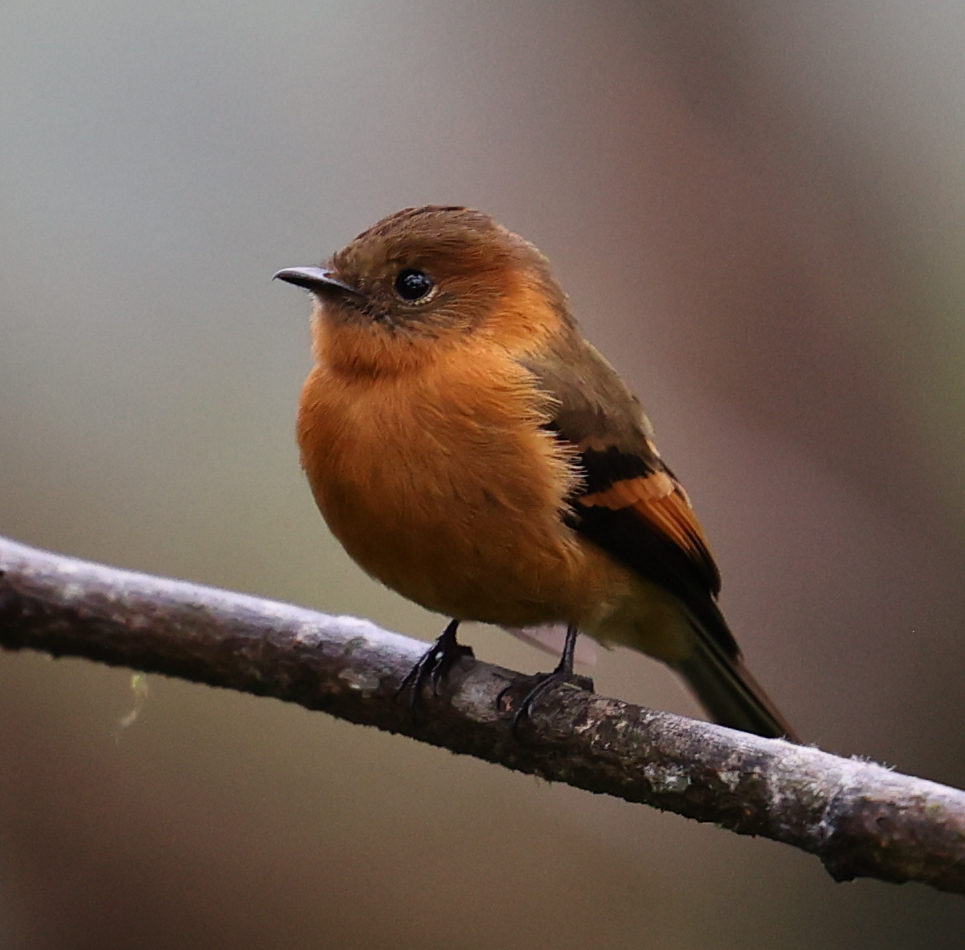
The cinnamon flycatcher is 11 to 13 cm (4.3 to 5.1 in) long and weighs about 11 g (0.39 oz). The sexes have the same plumage. Adults of the nominate subspecies P. c. cinnamomeus have a dark brownish crown with a partially hidden yellow patch in the center. They have a faint buffy eye-ring and patch above the lores, olive-brown cheeks and nape, and cinnamon-rufous sides of the neck. Their upperparts are olive-brown with a thin, often hidden, cinnamon-orange band on the rump. Their wings are black with wide rufous edges on the flight feathers and wide rufous tips on the coverts that show as two wing bars. Their tail is blackish. Their throat and underparts are cinnamon-rufous; the belly is lighter than the rest. They have a dark iris, a wide black bill, and blackish legs and feet. Juveniles are browner than adults, with ochraceous tips on the lower back and tail feathers and without a crown patch. The other subspecies of the cinnamon flycatcher differ from the nominate and each other thus:
P. c. assimilis: reddish brown crown, orange-rufous back, thin olive band on upper rump above the orange-buff one, rufous tail feathers with dark brown band near the end, and more rufous on the flight feathers than the nominate P. c. …
Range & habitat
The subspecies of the cinnamon flycatcher are found thus:
P. c. assimilis: the isolated Sierra Nevada de Santa Marta in northern Colombia P. c. vieillotioides: Andes of Venezuela from northern Táchira to Lara and Venezuelan Coastal Range from Yaracuy and Carabobo to Miranda P. c. spadix: Venezuelan Coastal Range in Anzoátegui, western and southern Sucre, and northern Monagas P. c. pariae: cerros Humo and Azul on the Paria Peninsula in northeastern Venezuela P. c. pyrrhopterus: from Andes of southern Táchira in western Venezuela and Serranía del Perijá on the Venezuela-Colombia border south through the Colombian Andes, both slopes of the Ecuadoran Andes, and into Peru's Andes to Cajamarca Department on the western slope and San Martín Department on the eastern slope P. c. cinnamomeus: eastern slope of the Andes from San Martín Department in Peru south through Bolivia into northwestern Argentina as far as Tucumán Province The cinnamon flycatcher inhabits foothill and montane forest in the subtropical and temperate zones. There it favors brushy clearings and edges both natural and along roads. In Colombia at least it often is found near rock faces. In elevation it ranges between 700 and 2,900 m (2,300 and 9,500 ft) in Venezuela, 1,500 and 3,000 m (4,900 and 9,800 ft) in Colombia, 1,200 and 3,000 m (3,900 and 9,800 ft) in Ecuador, and 900 and 3,400 m (3,000 and 11,200 ft) in Peru.
Wikipedia: “Distribution and habitat”
What it does
The cinnamon flycatcher feeds on arthropods and also includes berries in its diet. It typically forages in pairs and joins mixed-species feeding flocks but does not follow them out of its territory. It typically perches on an exposed branch from near the ground up to about 15 m (50 ft) above it but not in treetops. It captures prey in mid-air with short sallies from the perch ("hawking") and usually returns to the same perch.
Wikipedia: “Feeding”
Listen
Looking for field recordings…
Where it lives
Recorded sightings
—
geo-referenced records in GBIF, from museums, herbaria and field observers.
Drag the globe to turn it. Dots are where records exist, not a range map; darker means more records.
In the stacks
Searching the stacks…
Every page naming Pyrrhomyias cinnamomeus in the Biodiversity Heritage Library →
This page is assembled live from iNaturalist, GBIF, Wikipedia, the Source Library and the Internet Archive. It is not yet part of the hand-edited codex. iNaturalist taxon 16346.