- Animals
- ›Arthropods
- ›Hexapods
- ›Insects
- ›Winged and Once-winged Insects
- ›True Bugs, Hoppers, Aphids, and allies
- ›True Hoppers
- ›Planthoppers
- ›Fulgoroidea
- ›Lanternflies
- ›Aphaeninae
- ›Aphaenini
- ›Lycorma
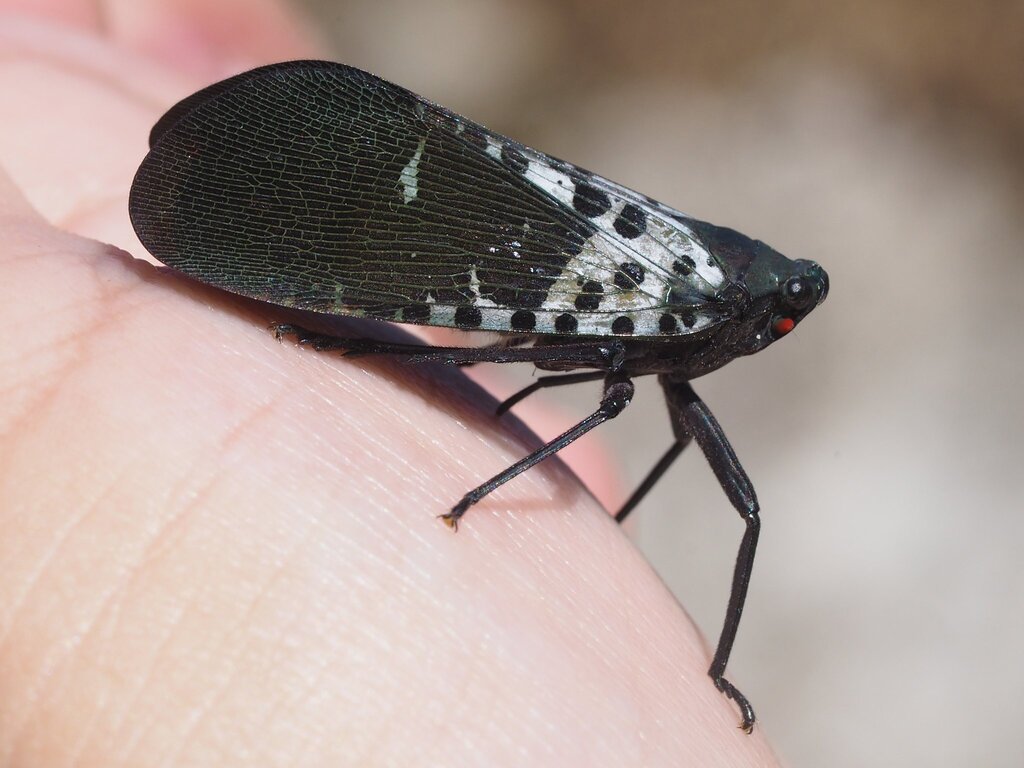
Lycorma punicea
Lycorma punicea is a planthopper species indigenous to parts of India, China, and Bangladesh. L. punicea was originally discovered in 1843 by Frederick William Hope.
From the article Lycorma punicea on Wikipedia (CC BY-SA), quoted section by section
Description
Adult L. punicea range from 12 to 12.5 millimeters in length. The head, legs, abdomen, and thorax are a castaneous-red color. The tegmina is testaceous. 3/4ths of the tegmina are covered by dark, large spots, giving it a much darker appearance. The basal half of the hindwings are purplish-red with black spots, and a gray band across the wing just before the dark black apical area. It is similar to L. imperialis in appearance albeit being much smaller.
Range & habitat
Lycorma punicea is native to Sylhet, India (specifically the Assam and Dikrong Valley areas,) and parts of China. L. punicea, along with the rest of the genus Lycorma, are parasitized by the eupelmid wasp Anastatus orientalis and by Dryinus sinicus, a dryinid wasp.
== References ==
Wikipedia: “Distribution and ecology”
What it does
Lycorma punicea is hemimetabolous, meaning that it goes through nymphal (instar) stages before molting into an adult, rather than having larval and pupal stages. L. punicea lays eggs coated in a waxy layer much like the rest of the species in its genus during late fall to early winter, and hatches in the spring.
Wikipedia: “Life cycle”
Listen
Looking for field recordings…
Where it lives
Recorded sightings
—
geo-referenced records in GBIF, from museums, herbaria and field observers.
Drag the globe to turn it. Dots are where records exist, not a range map; darker means more records.
In the stacks
Searching the stacks…
Every page naming Lycorma punicea in the Biodiversity Heritage Library →
This page is assembled live from iNaturalist, GBIF, Wikipedia, the Source Library and the Internet Archive. It is not yet part of the hand-edited codex. iNaturalist taxon 1633596.