On eBird ↗
Zimmer's Tody-Tyrant
Live sightings near you, the range map, bar charts of when it is seen, and Macaulay Library photos and recordings.
Zimmer's Tody-Tyrant
Hemitriccus minimus
Zimmer's tody-tyrant (Hemitriccus minimus) is a species of bird in the family Tyrannidae, the tyrant flycatchers. It is found in Bolivia, Brazil, Ecuador, and Peru.
From the article Zimmer's tody-tyrant on Wikipedia (CC BY-SA), quoted section by section
Description
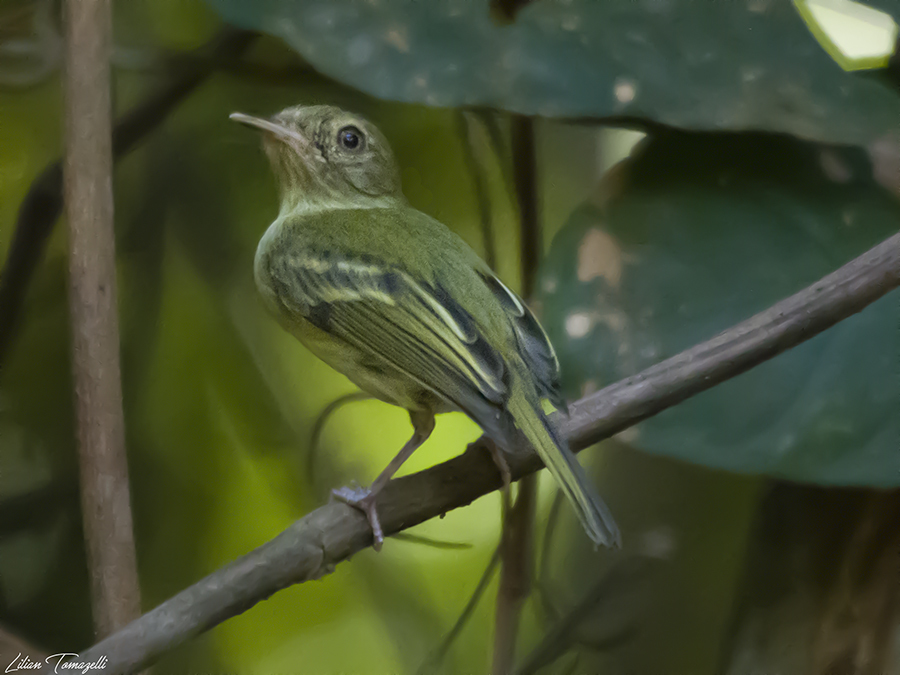
Zimmer's tody-tyrant is about 10 cm (3.9 in) long and weighs 6 to 8 g (0.21 to 0.28 oz). The sexes have the same plumage. Adults have a dark brown-olive crown with even darker dusky streaks. They have buffy lores, an indistinct buffy eye-ring, and brown ear coverts. Their back and rump are brownish olive. Their wings are dusky with yellow edges on the flight feathers that give a two-toned effect. The wing coverts have yellowish to yellowish green tips that show as two distinct wing bars. Their tail is brownish olive. Their throat is white with dusky streaks, their breast and sides are yellowish olive-buff with faint dusky streaks, and the center of their belly is pale yellow. They have a nearly white to pale straw iris, a black bill with a lighter base, and gray to pinkish gray legs and feet.
Range & habitat
Zimmer's tody-tyrant has a disjunct distribution in the southern Amazon Basin. By far the largest area is in Brazil, roughly from northwestern Acre and Amazonas states east to Pará and south to Tocantins and Mato Grosso and into northeastern Bolivia. Isolated smaller areas are in the northeastern Peruvian departments of San Martín and Ucayali and in eastern Ecuador's Pastaza Province near the Peruvian border. In all areas its distribution is patchy but it is suspected to be present between the known sites. It inhabits stunted forest on sandy, nutrient-poor, soil in blackwater areas and to a lesser extent in terra firme forest along ridgetops. In elevation it reaches 450 m (1,500 ft) in Brazil.
Wikipedia: “Distribution and habitat”
What it does
Zimmer's tody-tyrant feeds on insects. It typically forages in pairs, mostly between about 9 and 12 m (30 and 40 ft) above the ground in the crown of stunted forest and in vine tangles in the mid-level of taller forest. It takes most of its prey using short upward sallies from a perch to grab it from the underside of leaves.
Wikipedia: “Feeding”
Listen
Looking for field recordings…
Where it lives
Recorded sightings
—
geo-referenced records in GBIF, from museums, herbaria and field observers.
Drag the globe to turn it. Dots are where records exist, not a range map; darker means more records.
In the stacks
Searching the stacks…
Every page naming Hemitriccus minimus in the Biodiversity Heritage Library →
This page is assembled live from iNaturalist, GBIF, Wikipedia, the Source Library and the Internet Archive. It is not yet part of the hand-edited codex. iNaturalist taxon 16319.