- Plants
- ›Vascular Plants
- ›flowering plants
- ›Dicots
- ›pinks, cactuses, and allies
- ›cacti
- ›globular cacti, moonlight cacti, torch cacti, and allies
- ›Globular Cactuses
- ›Ferocactus
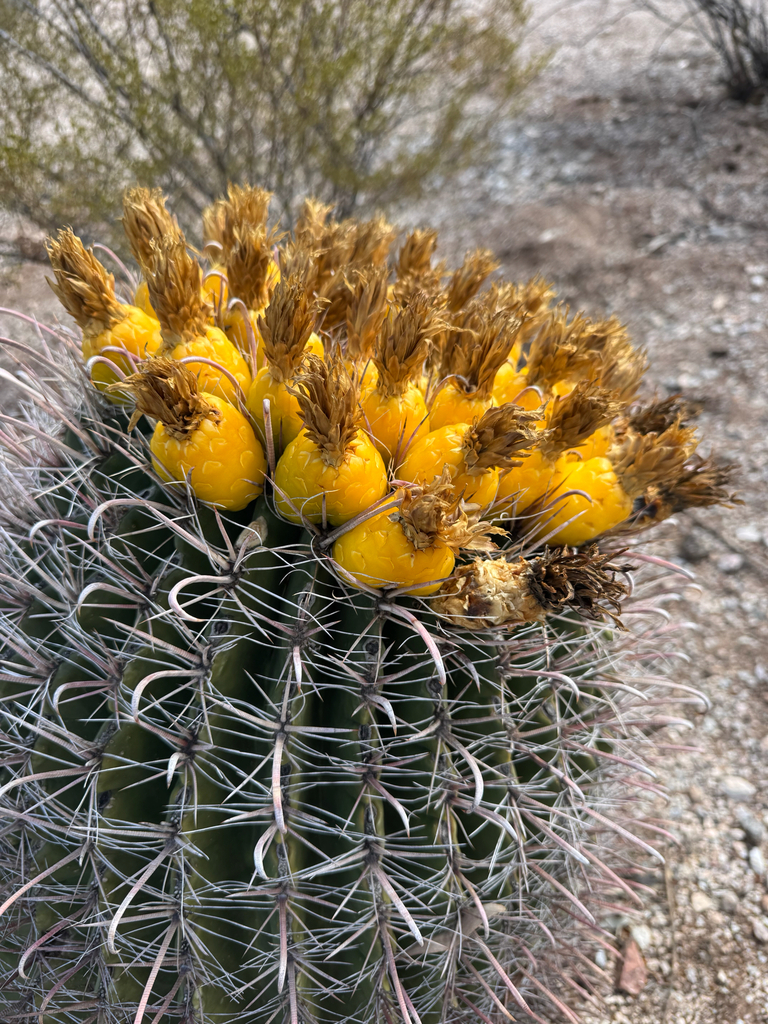
fishhook barrel cactus
Ferocactus wislizeni
Ferocactus wislizeni, the fishhook barrel cactus, also called Arizona barrel cactus, candy barrel cactus, and Southwestern barrel cactus, is a species of flowering plant in the cactus family Cactaceae, native to northern Mexico and the southern United States. It is a ball-shaped cactus eventually growing to a cylindrical shape, with spiny ribs and red or yellow flowers in summer.
Some sources mistakenly spell the epithet "wislizenii." The correct spelling is with one "i," per ICN article 60C.2.
From the article Ferocactus wislizeni on Wikipedia (CC BY-SA), quoted section by section
Description
The fishhook barrel cactus typically grows to a diameter of roughly 2.25 ft (0.69 m) and a height of 3–6 ft (0.91–1.83 m). However, specimens as wide as 3 ft (0.91 m) and tall as 10 ft (3.0 m) have been recorded. The common name comes from the spines, which are thick and hooked. It has a leathery asparagus green cortex (skin) with approximately 15-28 ribs per cactus. Its flowers are yellow to red-orange and appear atop the cactus fruit during the summer months. The fruits are green when unripe, yellow after the flower dries up, and persist atop the cactus long after the flower is gone, sometimes for more than a year. In adulthood, fishhook barrel cacti generally lean southward, toward the sun, earning them the nickname "compass barrel cactus." One theory about why this happens is, the afternoon sun is so intense it slows the growth on the exposed side, causing the plant to grow unevenly. Older barrels can lean so far they uproot themselves and fall over, especially after heavy rains when the soil is loose. Its life cycle is 50–100 years. Like Sclerocactus, Ferocactus typically grows in areas where water flows irregularly or depressions where water can accumulate for short periods of time. …
Range & habitat
The fishhook barrel cactus is native to southwestern United States and northwestern Mexico. More specifically, it can be found in southern Arizona, southern New Mexico, El Paso County, Texas and northern Sonora, Sinaloa, and Chihuahua, Mexico. It grows in gravelly or sandy soil, more commonly on bajadas than steep slopes, at 1000 to 5300 feet (300–1600 m) elevation. It prefers full sun, and does well in hot arid climates. It is, however, frost-tolerant to 5 °F (-15 °C)
Ecology. The flowers are pollinated by cactus bees (Lithurge spp.). Mule deer, birds, Antelope Ground Squirrels and javelina eat the fruit. The birds especially like the seeds. The people of the Sonoran Desert use the fruit for candy and jelly. The Seri and O'odham eat the flowers and use the fruit, which is sour, as emergency food. Tradition says that the barrel cactus is a source of water for people lost without water in the desert. There are records of the southwestern Native Americans using it for that purpose, but the water contains oxalic acid and is likely to cause diarrhea if ingested on an empty stomach. The skin thickens with age, making older cacti more fire resistant. Even so, average mortality due to fire is 50 to 67 percent within the first two years following fire. In urban areas, the Fishhook Barrel is valued as an ornamental plant. …
Wikipedia: “Distribution”
Where it lives
Recorded sightings
—
geo-referenced records in GBIF, from museums, herbaria and field observers.
Drag the globe to turn it. Dots are where records exist, not a range map; darker means more records.
In the stacks
Searching the stacks…
Every page naming Ferocactus wislizeni in the Biodiversity Heritage Library →
This page is assembled live from iNaturalist, GBIF, Wikipedia, the Source Library and the Internet Archive. It is not yet part of the hand-edited codex. iNaturalist taxon 162935.