- Plants
- ›Vascular Plants
- ›flowering plants
- ›Dicots
- ›Sunflowers, Bellflowers, Fanflowers, and Allies
- ›Sunflowers, Daisies, Asters, and Allies
- ›Asteroideae
- ›asters and allies
- ›Machaerantherinae
- ›Eurybia
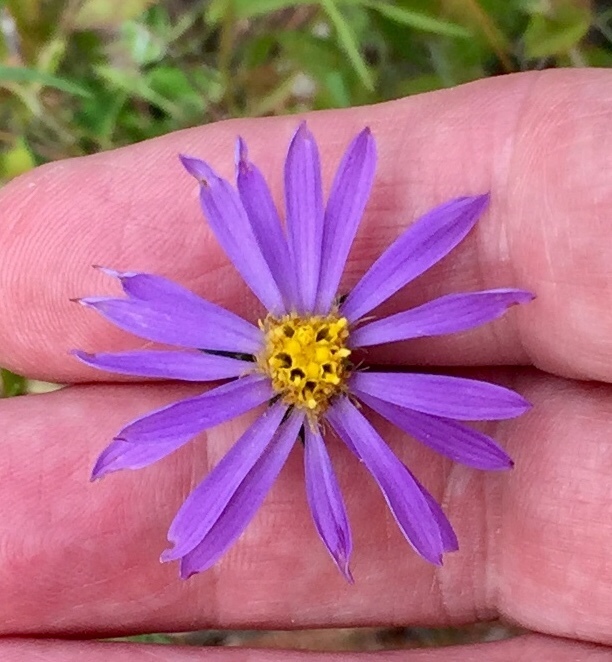
southern swamp aster
Eurybia paludosa
Eurybia paludosa, commonly known as the southern swamp aster or Savannah grass-leaved aster, is an herbaceous perennial in the family Asteraceae. It is native to the southeastern United States where it is confined to the Carolinas and the states of Georgia and Florida. It is generally confined to moist soils, though it can occasionally be found on sand hills along the coastal plain. The southern swamp aster is often confused with the closely related southern prairie aster (Eurybia hemispherica), though they do not occur in the same habitats or geographical areas. Its flower heads emerge in the late summer through fall and show deep lavender to purple rays with yellow centres.
From the article Eurybia paludosa on Wikipedia (CC BY-SA), quoted section by section
Range & habitat
Eurybia paludosa is confined to the U.S. states of North Carolina, South Carolina, Georgia and Florida. In Florida it is only known in Nassau County in the extreme northeast of the state. It is found in wet soils in habitats that include the edges of swamps and pools, moist savannas and low-lying pinelands. It is also encountered with much less frequency in drier habitats including atop small sand dunes along coastal plains and in open hammocks. As a principally low-lying species it is only found at elevations from sea-level to 100 metres.
Wikipedia: “Distribution and habitat”
Where it lives
Recorded sightings
—
geo-referenced records in GBIF, from museums, herbaria and field observers.
Drag the globe to turn it. Dots are where records exist, not a range map; darker means more records.
In the stacks
Searching the stacks…
Every page naming Eurybia paludosa in the Biodiversity Heritage Library →
This page is assembled live from iNaturalist, GBIF, Wikipedia, the Source Library and the Internet Archive. It is not yet part of the hand-edited codex. iNaturalist taxon 162886.