On eBird ↗
Buff-breasted Tody-Tyrant
Live sightings near you, the range map, bar charts of when it is seen, and Macaulay Library photos and recordings.
Buff-breasted Tody-Tyrant
Hemitriccus mirandae
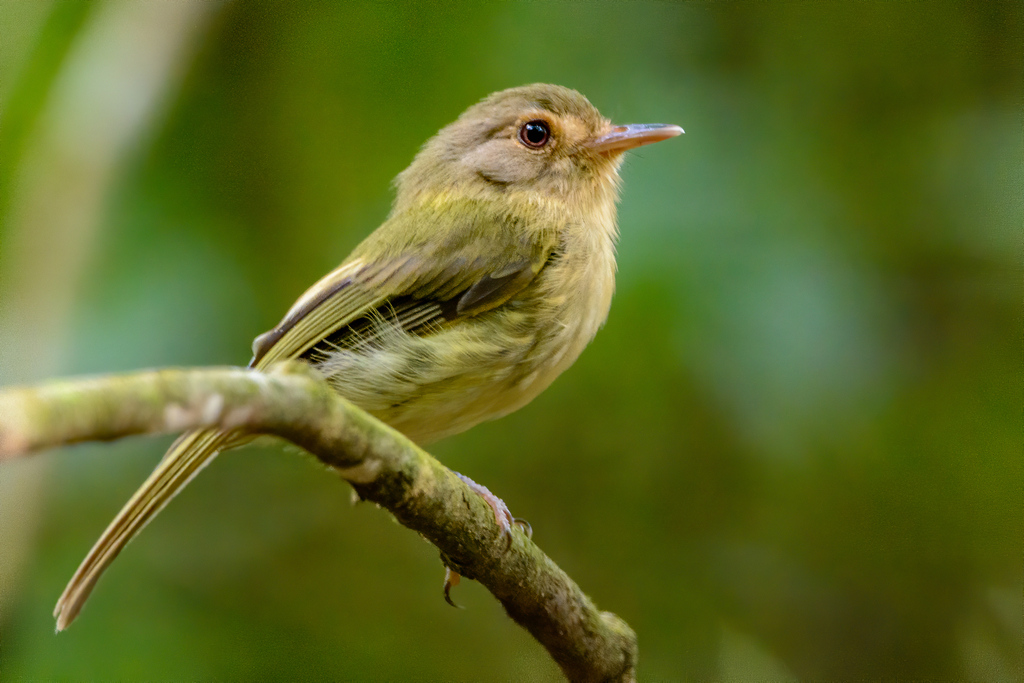
The buff-breasted tody-tyrant (Hemitriccus mirandae) is a species of bird in the family Tyrannidae, the tyrant flycatchers. It is endemic to Brazil.
From the article Buff-breasted tody-tyrant on Wikipedia (CC BY-SA), quoted section by section
Description
The buff-breasted tody-tyrant is about 10 cm (3.9 in) long. The sexes have the same plumage. Adults have a darkish olive crown and pale creamy buff face. Their back and rump are darkish olive. Their wings are dusky olive with wide creamy edges on the innermost secondaries. Their tail is dusky olive. Their throat and breast are pale creamy buff, their belly more whitish, and their crissum pale yellow. They have an orange iris, a gray maxilla, a paler mandible, and gray to pale pinkish legs and feet.
Range & habitat
The buff-breasted tody-tyrant has a disjunct distribution in northeastern Brazil, intermittently in the states of Ceará, Paraíba, Pernambuco, and Alagoas. It inhabits semi-humid forest both primary and secondary in the highlands. It occurs only on the slopes of isolated ridges between 600 and 1,000 m (2,000 and 3,300 ft).
Wikipedia: “Distribution and habitat”
What it does
The buff-breasted tody-tyrant feeds on insects. It typically forages singly and is not known to join mixed-species feeding flocks. It mostly forages from the forest's understory to its middle levels, often in dense vine tangles, between about 2 and 5 m (7 and 16 ft) above the ground. It mostly takes prey using short upward sallies from a perch to grab it from the underside of leaves.
Wikipedia: “Feeding”
Listen
Looking for field recordings…
Where it lives
Recorded sightings
—
geo-referenced records in GBIF, from museums, herbaria and field observers.
Drag the globe to turn it. Dots are where records exist, not a range map; darker means more records.
In the stacks
Searching the stacks…
Every page naming Hemitriccus mirandae in the Biodiversity Heritage Library →
This page is assembled live from iNaturalist, GBIF, Wikipedia, the Source Library and the Internet Archive. It is not yet part of the hand-edited codex. iNaturalist taxon 16283.