- Plants
- ›Vascular Plants
- ›flowering plants
- ›Dicots
- ›Mallows, Rock Roses, and Allies
- ›Mallow and Hibiscus Family
- ›Malvoideae
- ›Hibisceae
- ›Hibiscus
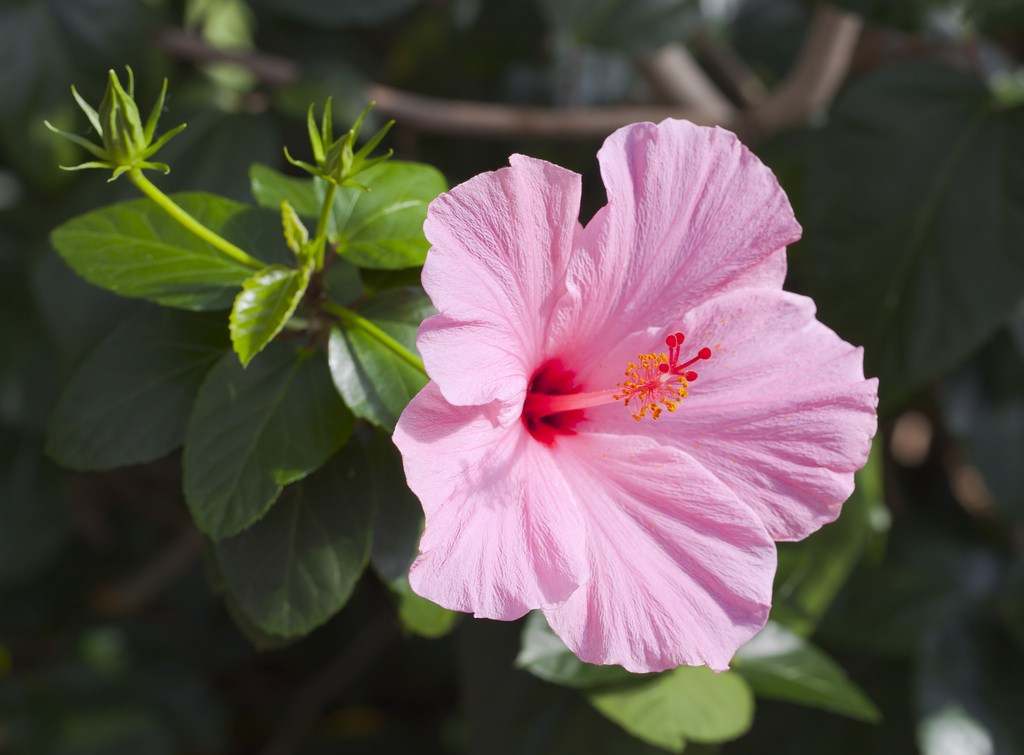
Tricolor Hibiscus
Hibiscus × rosa-sinensis
Hibiscus × rosa-sinensis (known colloquially as Chinese hibiscus, China rose, Hawaiian hibiscus, rose mallow and shoeblack plant) is a cultigen of tropical hibiscus, a flowering plant in the Hibiscus genus and Hibisceae tribe of the family Malvaceae.
It is an artificial hybrid created in cultivation during the pre-Columbian era by Polynesians in the west Pacific from the species Hibiscus cooperi and H. kaute (native to Vanuatu and French Polynesia, respectively). It is widely cultivated as an ornamental plant in the tropics and subtropics. The hibiscus is the national flower of Malaysia, where it holds official status, and is also considered the unofficial national flower of Haiti.
From the article Hibiscus × rosa-sinensis on Wikipedia (CC BY-SA), quoted section by section
What it does
Despite its size and colorful hues which are typically attractive to nectarivore birds, the flowers of Hibiscus × rosa-sinensis are not visited regularly by hummingbirds when grown in the Neotropics. Generalist species, like the sapphire-spangled emerald (Amazilia lactea), or long-billed species, like the stripe-breasted starthroat (Heliomaster squamosus) are occasionally seen to visit the flowers. In the subtropical and temperate Americas, hummingbirds are regularly attracted to hibiscus. The endangered Papilio homerus butterfly, the largest in the western hemisphere, is known to feed on the nectar of H. × rosa-sinensis.
Wikipedia: “Ecology”
At the table
The flowers of H. × rosa-sinensis are edible and are used in salads in the Pacific Islands. The flower is used as an accessory, particularly as a hairpiece. It is also used to shine shoes in certain parts of India, hence the common name "shoeblack plant". In Indonesia and Malaysia, these flowers are called "kembang sepatu" or "bunga sepatu", which literally means "shoe flower". The flower can also be used as a pH indicator; when used, the flower turns acidic solutions to a dark pink or magenta color and turns basic solutions to green. In several countries the flowers are dried to use in a beverage, usually tea. Hibiscus × rosa-sinensis is considered to have a number of medical uses in Chinese herbology. Traditional uses in China have been to make a black shoe-polish from its flower petals, or to make a woman's black hair dye. The flowers are also used in parts of China to color various intoxicating liquors. The plant may have some potential in cosmetic skin care; for example, an extract from the flowers of H. × rosa-sinensis has been shown to function as an anti-solar agent by absorbing ultraviolet radiation.
Wikipedia: “Uses”
How it is grown
Hibiscus × rosa-sinensis is widely grown as an ornamental plant throughout the tropics and subtropics. As it does not tolerate temperatures below 10 °C (50 °F), in temperate regions it is best grown under glass. Plants grown in containers may be placed outside during the summer months and moved into shelter during the winter months. Numerous cultivars exist, with flower colors ranging from white through yellow and orange to scarlet and shades of pink, with both single and double sets of petals. The cultivar 'Cooperi' has gained the Royal Horticultural Society's Award of Garden Merit.
Wikipedia: “Cultivation”
In human culture
Hibiscus × rosa-sinensis is the national flower of Malaysia, called bunga raya in Malay. This can be translated in a number of ways, including "great flower" or "celebratory flower." Introduced into the Malay Peninsula in the 12th century, it was nominated as the national flower in the year 1958 by the Ministry of Agriculture amongst a few other flowers, namely ylang ylang, jasmine, lotus, rose, magnolia, and medlar. On 28 July 1960, it was declared by the government of Malaysia that H. × rosa-sinensis would be the national flower. The red of the petals symbolizes the courage, life, and rapid growth of the Malaysian people, and the five petals represent the five Rukun Negara of Malaysia. The flower can be found imprinted on the notes and coins of the Malaysian ringgit. Hibiscus × rosa-sinensis is an unofficial national flower in Haiti, where it has been used as a symbol for the promotion of tourism. The flower is also the symbol of the Fusion of Haitian Social Democrats political party. It is known in Haitian Creole language as choeblack or rose kayenn. Red hibiscus flowers are also used for worship; in Hinduism, they are used for the worship of Devi, and in the Bengal area of eastern India, they are used to worship Kali. The hibiscus also has an important part in tantra.
Stamps. …
Wikipedia: “In culture”
Where it lives
Recorded sightings
—
geo-referenced records in GBIF, from museums, herbaria and field observers.
Drag the globe to turn it. Dots are where records exist, not a range map; darker means more records.
In the stacks
Searching the stacks…
Every page naming Hibiscus × rosa-sinensis in the Biodiversity Heritage Library →
This page is assembled live from iNaturalist, GBIF, Wikipedia, the Source Library and the Internet Archive. It is not yet part of the hand-edited codex. iNaturalist taxon 1628098.