- Plants
- ›Vascular Plants
- ›flowering plants
- ›Dicots
- ›Sunflowers, Bellflowers, Fanflowers, and Allies
- ›Sunflowers, Daisies, Asters, and Allies
- ›Asteroideae
- ›bonesets, blazingstars, and allies
- ›Eupatoriinae
- ›Eupatorium
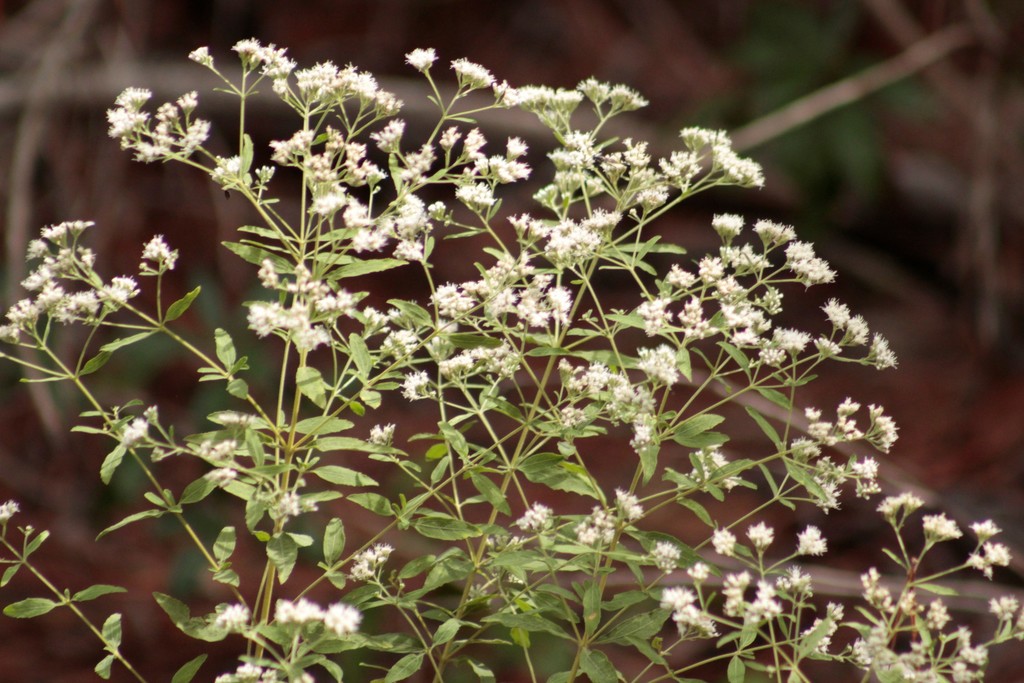
smallflower thoroughwort
Eupatorium semiserratum
Eupatorium semiserratum, commonly called smallflower thoroughwort, is a North American plant species in the family Asteraceae. It is native to the southeastern and south-central United States, found in all the coastal states from Maryland to Texas and inland as far as Missouri and Kentucky.
Eupatorium semiserratum stems sometimes more than 100 cm (40 inches) tall and are produced from short rhizomes. The inflorescences, which can be present from late July-October, are composed of a large number of small white flower heads with 5 disc florets but no ray florets. This species is similar to Eupatorium linearifolium but has smaller heads of flowers and stems which branch near the tips rather than near the base. The plants previously known as Eupatorium glaucescens or Eupatorium cuneifolium are now classified as E. semiserratum or E. linearifolium.
From the article Eupatorium semiserratum on Wikipedia (CC BY-SA), quoted section by section
Range & habitat
Eupatorium semiserratum is found the southeastern United States, from southeast Virginia south to northern Florida, west to Texas and Arkansas, with a disjunct population found in Tennessee. Generally, it can be found in wetlands such as swamp forests, seepage bogs, clay-based Carolina bays. It is also found in savannas.
Wikipedia: “Distribution and habitat”
At the table
E. semiserratum has anticancer properties against various human cancer cell lines.
== References ==
Wikipedia: “Uses”
Where it lives
Recorded sightings
—
geo-referenced records in GBIF, from museums, herbaria and field observers.
Drag the globe to turn it. Dots are where records exist, not a range map; darker means more records.
In the stacks
Searching the stacks…
Every page naming Eupatorium semiserratum in the Biodiversity Heritage Library →
This page is assembled live from iNaturalist, GBIF, Wikipedia, the Source Library and the Internet Archive. It is not yet part of the hand-edited codex. iNaturalist taxon 162802.