- Plants
- ›Vascular Plants
- ›flowering plants
- ›Dicots
- ›pinks, cactuses, and allies
- ›cacti
- ›globular cacti, moonlight cacti, torch cacti, and allies
- ›Pachycereae
- ›Echinocereus
- ›Echinocereus
- ›Wilcoxia
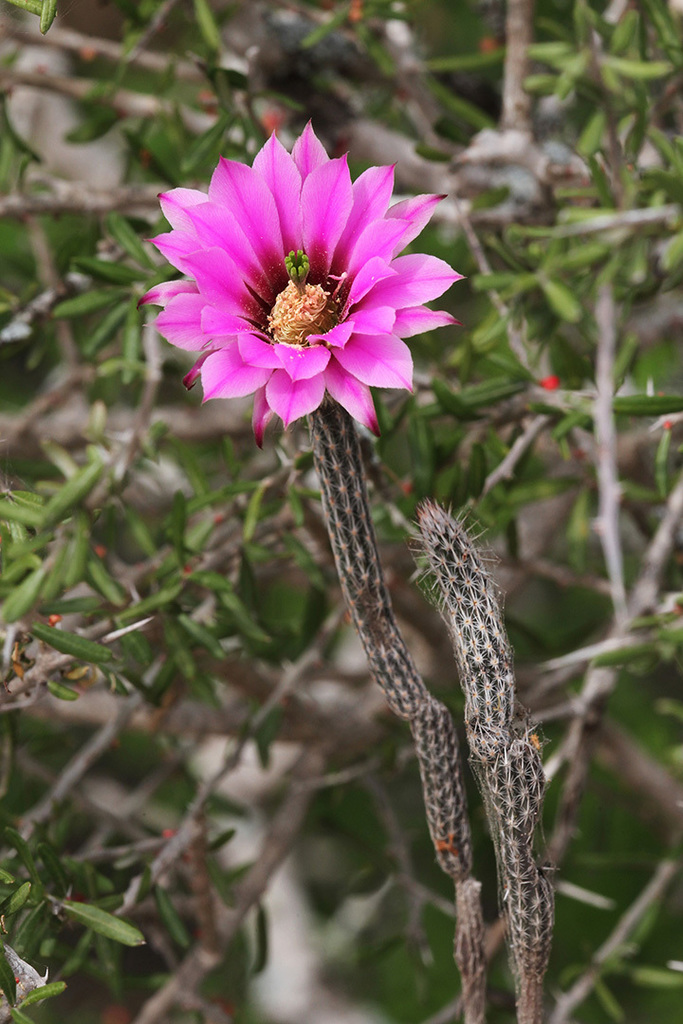
Dahlia Hedgehog Cactus
Echinocereus poselgeri
Echinocereus poselgeri, also known as the dahlia cactus, is a species of Echinocereus. It is native to Coahuila and southern Texas.
From the article Echinocereus poselgeri on Wikipedia (CC BY-SA), quoted section by section
Description
Echinocereus poselgeri typically grows with several spreading shoots, forming a tuberous, dahlia-like rhizome. The dark blue-green shoots are slender, cylindrical, and taper to a point, measuring 60 to 120 cm (24 to 47 in) long and 1 to 2 cm (0.39 to 0.79 in) in diameter. They have eight to ten low, inconspicuous ribs that are not tuberculated. A single, slightly flattened, dark central spine points toward the shoot tip and is up to 9 mm (0.35 in) long. The eight to 16 whitish or grayish marginal spines, which have darker tips, are 2 to 4.5 mm (0.079 to 0.177 in) long. The funnel-shaped flowers are slightly pinkish-magenta, appearing near the tips of the shoots. They can be up to 6 cm (2.4 in) long and 7 cm (2.8 in) in diameter. The dark green to brown fruits are egg-shaped and covered with persistent wool and thorns.
Range & habitat
Echinocereus poselgeri is growing in scrub valleys and hills of southern Texas, USA, and the Mexican states of Coahuila, Nuevo León, Tamaulipas, and San Luis Potosí, typically found at low elevations in sandy soil at elevations up to 1150 meters.
Wikipedia: “Distribution”
Where it lives
Recorded sightings
—
geo-referenced records in GBIF, from museums, herbaria and field observers.
Drag the globe to turn it. Dots are where records exist, not a range map; darker means more records.
In the stacks
Searching the stacks…
Every page naming Echinocereus poselgeri in the Biodiversity Heritage Library →
This page is assembled live from iNaturalist, GBIF, Wikipedia, the Source Library and the Internet Archive. It is not yet part of the hand-edited codex. iNaturalist taxon 162185.