On eBird ↗
Piura Chat-Tyrant
Live sightings near you, the range map, bar charts of when it is seen, and Macaulay Library photos and recordings.
Piura Chat-Tyrant
Ochthoeca piurae
The Piura chat-tyrant (Ochthoeca piurae) is a species of bird in the family Tyrannidae, the tyrant flycatchers. It is endemic to Peru.
From the article Piura chat-tyrant on Wikipedia (CC BY-SA), quoted section by section
Description
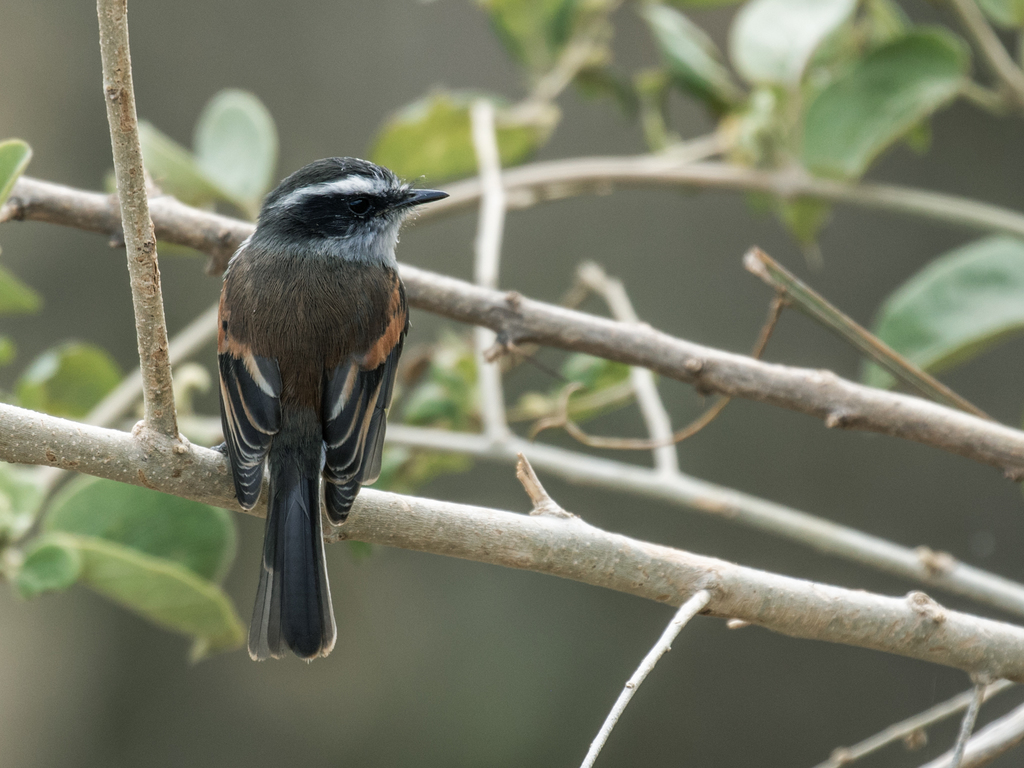
The Piura chat-tyrant is 12 to 12.5 cm (4.7 to 4.9 in) long and weighs about 9 g (0.32 oz). The sexes have the same plumage. Adults have a dark brown crown, a wide white supercilium that begins at the lores and extends well past the eye, and a blackish "mask". Their upperparts are dark brown with a rufescent tinge on the lower back and rump. Their wings are dark brown with two wide rufous wing bars and white edges on the flight feathers. Their tail is dark brown with white outer edges on the outermost feathers. Their throat and underparts are gray that becomes whitish on the lower belly and vent. They have a brown iris, a black bill, and black legs and feet.
Range & habitat
The Piura chat-tyrant is found in northern Peru on the western slope of the Andes from southeastern Piura Department south to central Ancash Department. One record in Lima Department suggests its range may extend further south than thought. The species inhabits the edges of arid and semi-arid montane forest and also scrubby hillsides. In elevation it ranges between 1,400 and 2,850 m (4,600 and 9,400 ft).
Wikipedia: “Distribution and habitat”
What it does
The Piura chat-tyrant feeds on insects, though details are lacking. It usually forages singly or in pairs. Its foraging behavior is not known but it is assumed to "capture prey with sallys to the ground or to air" like other chat-tyrants.
Wikipedia: “Feeding”
Listen
Looking for field recordings…
Where it lives
Recorded sightings
—
geo-referenced records in GBIF, from museums, herbaria and field observers.
Drag the globe to turn it. Dots are where records exist, not a range map; darker means more records.
In the stacks
Searching the stacks…
Every page naming Ochthoeca piurae in the Biodiversity Heritage Library →
This page is assembled live from iNaturalist, GBIF, Wikipedia, the Source Library and the Internet Archive. It is not yet part of the hand-edited codex. iNaturalist taxon 16211.