- Plants
- ›Vascular Plants
- ›flowering plants
- ›monocots
- ›Agaves, Orchids, Irises, and Allies
- ›Orchids
- ›Lower Epidendroid Orchids
- ›Malaxideae
- ›Malaxidinae
- ›Malaxis
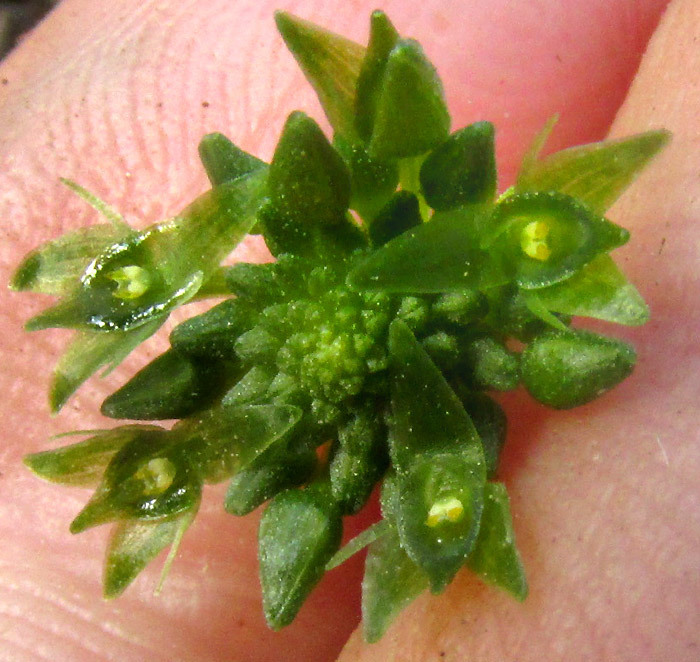
Malaxis magniauriculata
Malaxis magniauriculata, with no English name other than adder's mouth, which is applied to all species of Malaxis, is an orchid native only to Mexico. It belongs to the family Orchidaceae.
From the article Malaxis magniauriculata on Wikipedia (CC BY-SA), quoted section by section
Description
Malaxis magniauriculata is similar to several of the 172 or so species of the genus Malaxis, plus it was recognized as a distinct species only in 2024, so older literature does not include it. Nonetheless, the following combination of key features enables its identification:
It is a terrestrial plant growing up to 33 cm (13 in) tall, including its inflorescence. The visible part of the orchid arises from an underground corm, which is white, egg-shaped, and measuring up to 20 mm × 15 mm (3⁄4 in × 1⁄2 in). When young, the corm is completely covered by the leaf's petiole base, which itself is surrounded by a "corm scale" or cataphyll. There is only one leaf, the petiole of which is tubular and squarish in cross-section, with each corner bearing a translucent ridge, or keel. The petiole arises from within the cataphyll. The pale green leaf's blade is somewhat fleshy, ascends upward, has 3 veins and grows up to 68 mm × 37 mm (2+1⁄2 in × 1+1⁄2 in). The blade's base varies from rounded to having 2 short, backward directed lobes. The single corymb-type inflorescence, with the first flowers to open appearing at the edges, has a peduncle up to 15 cm (6 in) long. Flowers are small for the genus, becoming only about 6.5 mm (1⁄4 in) across, with the flower's "faces" directed upward. The sepals are fused for about ¼ of their length, curved egg-shape, and up to about 3.3 mm (1⁄8 in) long. …
Range & habitat
Malaxis magniauriculata is endemic just to the three Mexican states of Hidalgo, Puebla and Oaxaca.
Wikipedia: “Distribution”
What it does
All orchid species produce large numbers of dust-like seeds containing only very small amounts of stored nutrients. These seeds must be colonized by mycorrhizal fungi which enter into a symbiotic relationship between the orchid and the fungus, called myco-heterotrophy. The fungi provide the seeds nutrients needed to provision the formation of non-photosynthetic structures known as "protocorms", from which later the regular corms and above-ground parts emerge. With regard to the flower's shiny, wet-looking, sticky "apical droplet" or viscidium, which glues the pollinia to visiting pollinators, in another Malaxis species with very small, greenish flowers, the wet-looking droplets have been found to attract small Diptera such as mosquitoes and gnats, and to contain chemical compounds creating scent bouquets smelling of flowers and mushrooms. Certain of these compounds displayed molecular structures similar to pheromones involved in reproductive behavior. These observations suggest that the shiny droplets may have been attracting pollinators by signaling the possibility of food and/or mating opportunities, while possibly offering nothing in return -- attraction of pollinators by deception.
Wikipedia: “Symbiotic relationship”
In human culture
The genus name Malaxis derives from the Greek malaxis, meaning "softening", referring to the soft and tender texture of leaves of the species. The species name magniauriculata is constructed of magni-, a combining form appearing in loanwords from Latin, meaning "large, great", and the Latin auriculatus, meaning "shaped like an ear". Thus "big ears", referring to the prominent lobes or "ears" at the labellum's base, which is the most distinctive feature of this species.
== References ==
Wikipedia: “Etymology”
Where it lives
Recorded sightings
—
geo-referenced records in GBIF, from museums, herbaria and field observers.
Drag the globe to turn it. Dots are where records exist, not a range map; darker means more records.
In the stacks
Searching the stacks…
Every page naming Malaxis magniauriculata in the Biodiversity Heritage Library →
This page is assembled live from iNaturalist, GBIF, Wikipedia, the Source Library and the Internet Archive. It is not yet part of the hand-edited codex. iNaturalist taxon 1619082.