- Plants
- ›Vascular Plants
- ›flowering plants
- ›monocots
- ›grasses, sedges, cattails, and allies
- ›grasses
- ›Panicums, Bluestems, Paspalums, and Allies
- ›bristle, rosette, and barnyard grasses, and allies
- ›Anthephorinae
- ›Digitaria
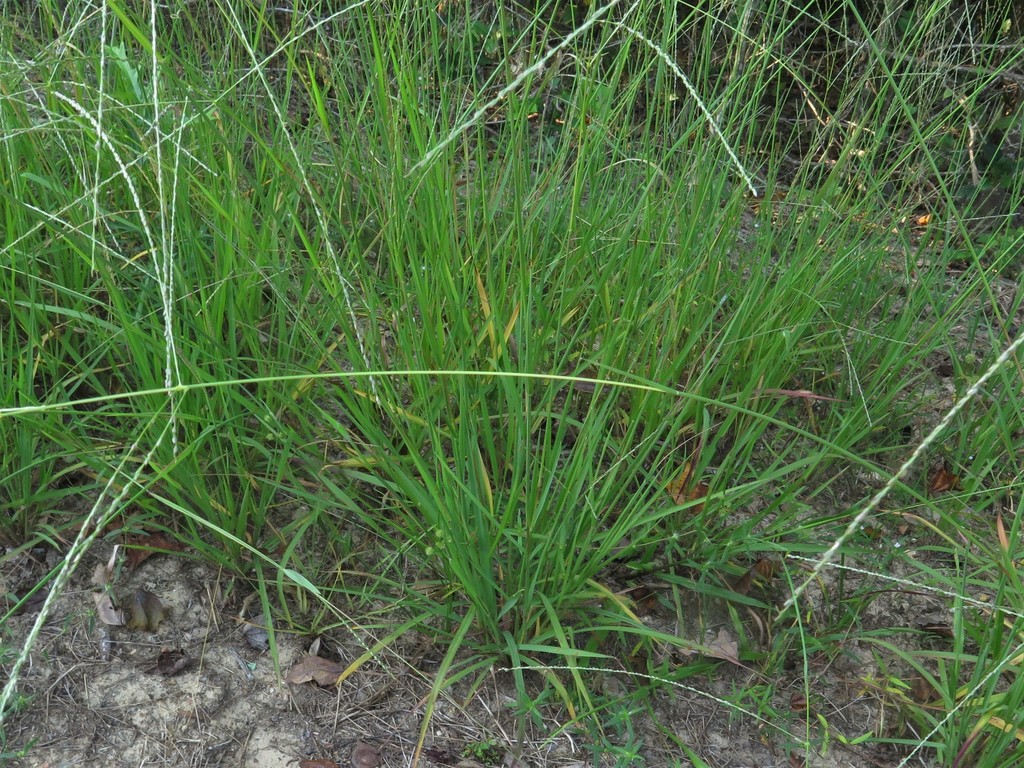
slender crabgrass
Digitaria filiformis
Digitaria filiformis, commonly known as slender crabgrass, is a tufted annual grass in the family Poaceae native to North America.
From the article Digitaria filiformis on Wikipedia (CC BY-SA), quoted section by section
Description
Slender crabgrass is known for its slender, upright stems reaching 30–120 cm in height. The leaves are narrow (2–4 mm wide) and up to 15 cm long, typically rough and hairy above, with smooth or sparsely hairy undersides; the sheaths are also hairy. Ligules are short (0.5–1 mm), membranous, and often jagged or torn. The plant produces 2–7 ascending racemes, each 3–12 cm long, with a rough, triangular rachis. Spikelets are small (1.8–2.5 mm), with hairy second glumes and ciliate sterile lemmas; the fertile lemma and palea are smooth, purplish, and lined with tiny papillae. Grains are ellipsoid, whitish to brownish, and measure about 1–1.2 mm long. Like other species in the genus, D. filiformis can be a persistent weed in disturbed soils.
Range & habitat
Slender crabgrass is widely distributed in eastern North America. It grows in longleaf pine sandhills, pine flatwoods, fields, roadsides, and disturbed areas. There are three varieties: D. filiformis var. laeviglumis; D. filiformis var. filiformis; and D. filiformis var. dolichophylla. D. filiformis var. laeviglumis is rare and endemic to New Hampshire in peaty depressions on granite ledges.
== References ==
Wikipedia: “Distribution and habitat”
Where it lives
Recorded sightings
—
geo-referenced records in GBIF, from museums, herbaria and field observers.
Drag the globe to turn it. Dots are where records exist, not a range map; darker means more records.
In the stacks
Searching the stacks…
Every page naming Digitaria filiformis in the Biodiversity Heritage Library →
This page is assembled live from iNaturalist, GBIF, Wikipedia, the Source Library and the Internet Archive. It is not yet part of the hand-edited codex. iNaturalist taxon 161904.