- Plants
- ›Vascular Plants
- ›flowering plants
- ›monocots
- ›Agaves, Orchids, Irises, and Allies
- ›amaryllis, onions, and allies
- ›amaryllis subfamily
- ›Amaryllideae
- ›Swamplily Subtribe
- ›Crinum
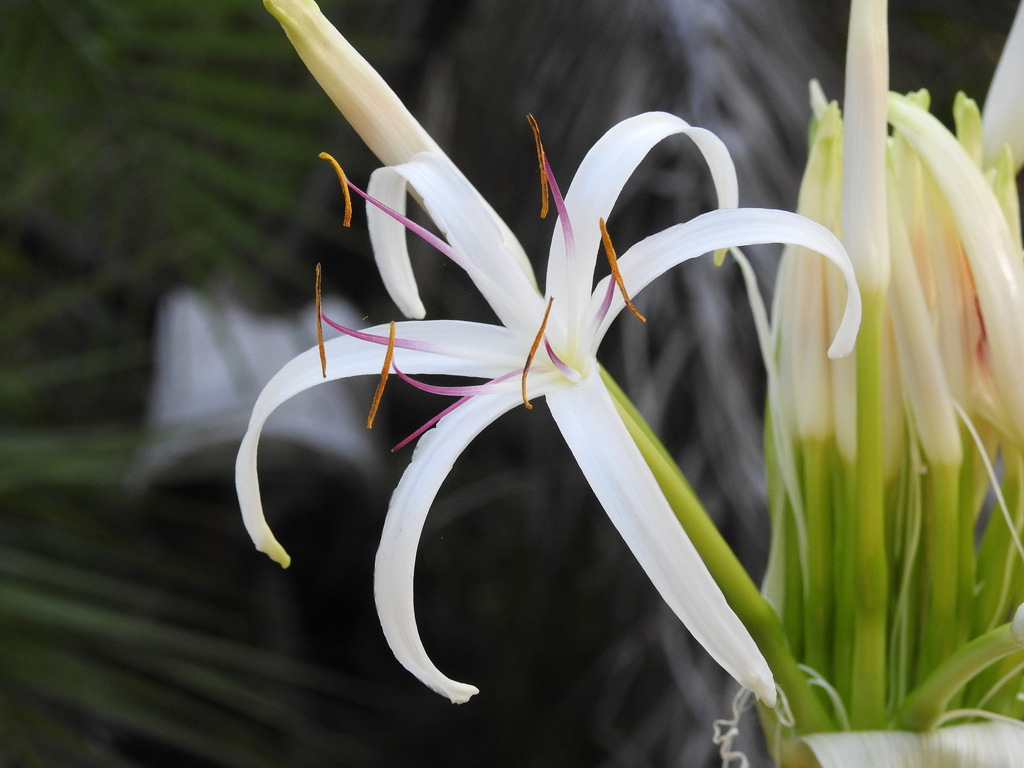
Tree Crinum
Crinum asiaticum
Crinum asiaticum, commonly known as poison bulb, giant crinum lily, grand crinum lily, or spider lily, is a plant species widely planted in many warmer regions as an ornamental. It is a bulb-forming perennial producing an umbel of large, showy flowers that are prized by gardeners. However, all parts of the plant are poisonous if ingested. Some reports indicate exposure to the sap may cause skin irritation.
Crinum asiaticum is native to East Asia, tropical Asia, Australia and islands of the Pacific and western Indian oceans. It is naturalized in Mexico, the West Indies, the US (Florida and Louisiana), numerous Pacific islands, Madagascar and the Chagos Archipelago.
From the article Crinum asiaticum on Wikipedia (CC BY-SA), quoted section by section
Description
Crinum asiaticum is a perennial herb that typically grows up to 1.2 m (3.9 ft) tall. It has a leaf base. Its pseudobulb is spherical. The upper part of the bulb is cylindrical. The base is laterally branched, with a diameter of about 6–15 cm (2.4–5.9 in). Its leaves are lanceolate, margin undulate, apically acuminate. They feature 1 sharp point and are dark green, growing up to 1 m long. Their width is 7–12 cm (2.8–4.7 in) or wider and they number 20–30. The inflorescence is an umbel with 10-24 flowers, six petaloid tepals, and aromatic. The flower stem is erect, as long as the leaf, and solid. The spathe is lanceolate, membranous, and 6–10 cm (2.4–3.9 in). The bractlet liner is 3–7 cm (1.2–2.8 in). Its perianth tube is slender and straight, green white, 7–10 cm (2.8–3.9 in), diameter 1.5–2 mm. The corolla is spider-like shaped, white, linear, revolute, attenuate, 4.5–9 cm (1.8–3.5 in) long, and 6–9 mm wide. The corolla is 6-lobed. The pedicel is ca. 0.5–2.5 cm (0.2–1.0 in) long. It has 6 reddish stamens. The filaments are 4–5 cm (1.6–2.0 in) long. The anthers are liner, attenuate, ca. 1.5 cm (0.6 in) long or more. The ovary is fusiform, and up to 2 cm (0.8 in) long. The fruit is an oblate capsule, green, and 3–5 cm (1.2–2.0 in) in diameter. The seeds are large, and the exotesta is spongy.
Toxicity
The entire plant is toxic, especially the bulb. It contains a variety of alkaloids such as lycorine and tazettine. When eaten, it can cause vomiting, abdominal pain, severe diarrhea, constipation, irregular breathing, rapid pulse, fever, etc.; sufficient misuse can cause nervous system paralysis and death.
Where it lives
Recorded sightings
—
geo-referenced records in GBIF, from museums, herbaria and field observers.
Drag the globe to turn it. Dots are where records exist, not a range map; darker means more records.
In the stacks
Searching the stacks…
Every page naming Crinum asiaticum in the Biodiversity Heritage Library →
This page is assembled live from iNaturalist, GBIF, Wikipedia, the Source Library and the Internet Archive. It is not yet part of the hand-edited codex. iNaturalist taxon 161124.