On eBird ↗
Greater Pewee
Live sightings near you, the range map, bar charts of when it is seen, and Macaulay Library photos and recordings.
Greater Pewee
Contopus pertinax
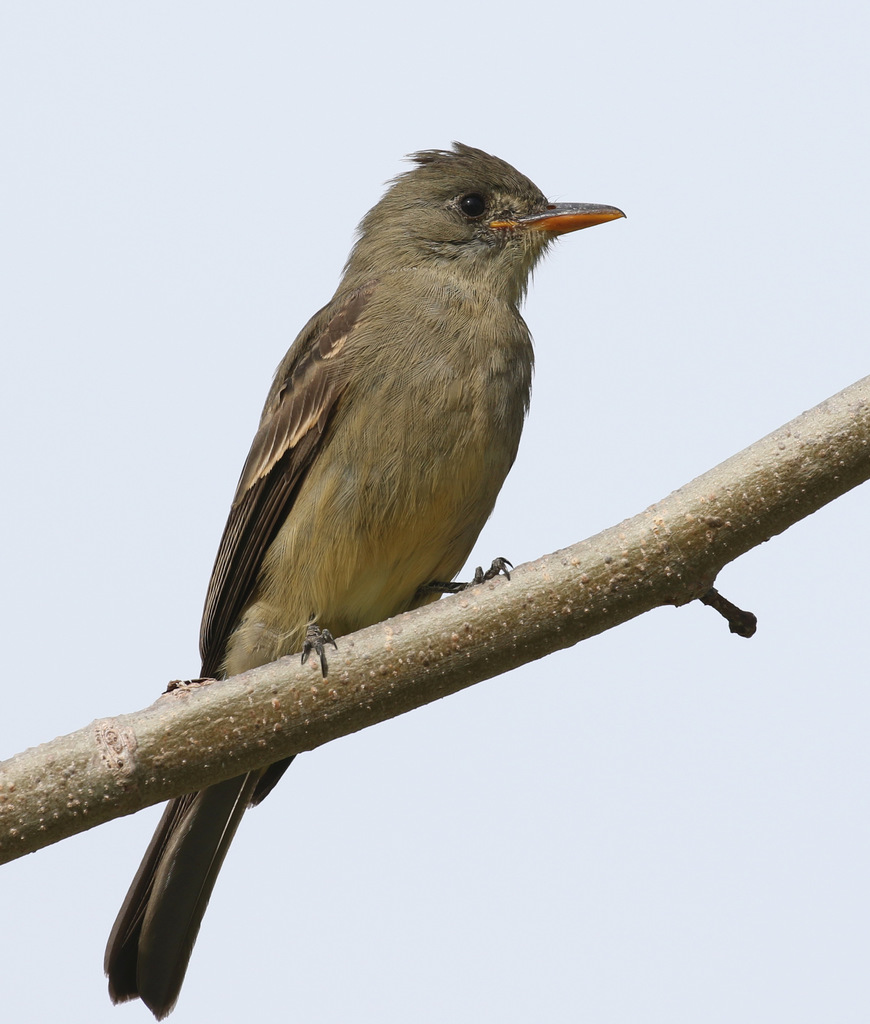
The greater pewee (Contopus pertinax) is a passerine and is in the tyrant flycatcher group. This species' range is further north than the other Mexican species. This bird was formerly known as Coues' flycatcher.
From the article Greater pewee on Wikipedia (CC BY-SA), quoted section by section
Description
The greater pewee is 18 to 20 cm (7.1 to 7.9 in) long and weighs about 22 to 36 g (0.78 to 1.3 oz). The sexes have the same plumage with a spiky crest. Subspecies C. p. minor is smaller than the nominate but has essentially the same plumage. Adults have a plain olive-gray head and upperparts, with pale lores and a slightly lighter face than the rest of the head. Their wings are dusky grayish brown with grayish olive ends on the coverts that show as two faint wing bars. They have pale grayish edges on their secondaries. Their tail is dusky grayish brown. Their chin is dull whitish and their throat and sides are olive-gray with a buffy yellowish tinge. The center of their breast, their belly, and their undertail coverts are buffy. Their plumage fades with wear, becoming less olive. Both subspecies have a brown iris, a dusky brown to almost black maxilla, a yellowish to orange mandible, and dusky brown to blackish legs and feet.
Range & habitat
The greater pewee has a disjunct distribution, with river valleys and lowlands separating some populations. The nominate subspecies is the more northerly of the two. It ranges from central and southeastern Arizona and southwestern New Mexico in the United States south through western and southern Mexico to the Isthmus of Tehuantepec and in migration further south into Guatemala. Subspecies C. p. minor is found from east of the Isthmus of Tehuantepec intermittently through Guatemala, Belize, El Salvador, and Honduras into far north-central Nicaragua. The nominate subspecies occurs as a vagrant in California and migrates in small numbers through western Texas. The greater pewee primarily inhabits pine and pine-oak forest in the subtropical and temperate zones. In migration and to some extent during the non-breeding season it also occurs in deciduous riparian forest within pine and pine-oak forest but not within more open areas. In elevation it ranges between 900 and 3,400 m (3,000 and 11,200 ft) overall. In the northern part of its range it mostly is found between 2,100 and 3,000 m (6,900 and 9,800 ft) and in Oaxaca between 1,360 and 2,575 m (4,500 and 8,400 ft). South of Mexico it mostly occurs between 1,300 and 3,350 m (4,300 and 11,000 ft) but is found as low as 400 m (1,300 ft).
Wikipedia: “Distribution and habitat”
What it does
The greater pewee feeds mostly on flying insects and during the non-breeding season adds other insects and some berries to its diet. It sits erect near a treetop or high up in an edge tree, typically on a dead branch, and captures prey in mid-air with sallies from it ("hawking"). It usually returns to the same perch after a sally. It often accompanies mixed-species feeding flocks while they pass through its territory.
Wikipedia: “Feeding”
Listen
Looking for field recordings…
Where it lives
Recorded sightings
—
geo-referenced records in GBIF, from museums, herbaria and field observers.
Drag the globe to turn it. Dots are where records exist, not a range map; darker means more records.
In the stacks
Searching the stacks…
Every page naming Contopus pertinax in the Biodiversity Heritage Library →
This page is assembled live from iNaturalist, GBIF, Wikipedia, the Source Library and the Internet Archive. It is not yet part of the hand-edited codex. iNaturalist taxon 16106.