- Plants
- ›Vascular Plants
- ›flowering plants
- ›Dicots
- ›Sunflowers, Bellflowers, Fanflowers, and Allies
- ›Sunflowers, Daisies, Asters, and Allies
- ›Asteroideae
- ›Coreopsis and allies
- ›Coreopsis
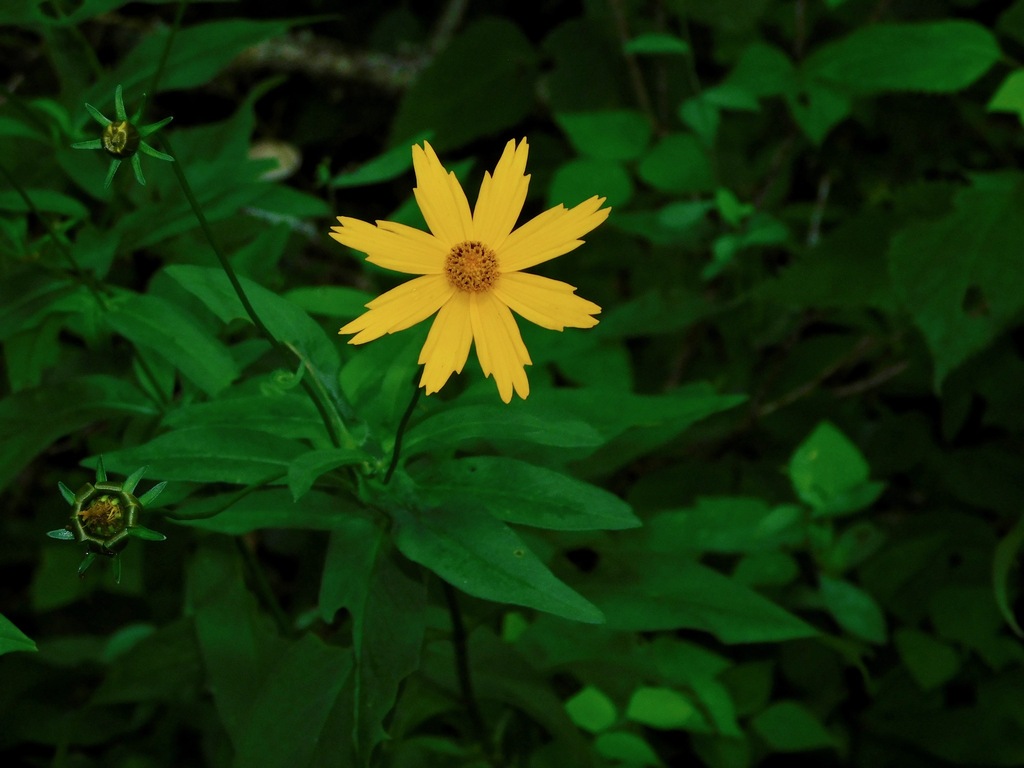
Star Tickseed
Coreopsis pubescens
Coreopsis pubescens, called star tickseed, is a North American species of tickseeds in the sunflower family. It is native to the central and southeastern United States from eastern Kansas and eastern Texas east as far as Virginia, Florida, and the Carolinas. There are also reports of isolated populations in New England and in northern Indiana, probably as escapes from cultivation.
From the article Coreopsis pubescens on Wikipedia (CC BY-SA), quoted section by section
Description
Coreopsis pubescens is a perennial herbaceous plant that can grow to 90 cm (3 feet) tall. It primarily flowers from April to September, and typically blooms with both the ray florets and disc florets being completely yellow.
Range & habitat
Coreopsis pubescens has been found in the states of Texas, Oklahoma, Kansas, Louisiana, Arkansas, Missouri, Illinois, Indiana, Kentucky, Tennessee, Mississippi, Alabama, Florida, Georgia, South Carolina, North Carolina, Virginia, West Virginia, Connecticut, Massachusetts. It prefers to grow in sandy soils, granite outcrops, open woods with pine and oak, and disturbed sites such as ditches and roadsides.
Wikipedia: “Distribution and habitat”
Where it lives
Recorded sightings
—
geo-referenced records in GBIF, from museums, herbaria and field observers.
Drag the globe to turn it. Dots are where records exist, not a range map; darker means more records.
In the stacks
Searching the stacks…
Every page naming Coreopsis pubescens in the Biodiversity Heritage Library →
This page is assembled live from iNaturalist, GBIF, Wikipedia, the Source Library and the Internet Archive. It is not yet part of the hand-edited codex. iNaturalist taxon 160902.