- Plants
- ›Vascular Plants
- ›flowering plants
- ›Dicots
- ›Mints, Plantains, Olives, and Allies
- ›Mint Family
- ›Nepetoideae
- ›Mentheae
- ›balms, mints, and thymes
- ›Clinopodium
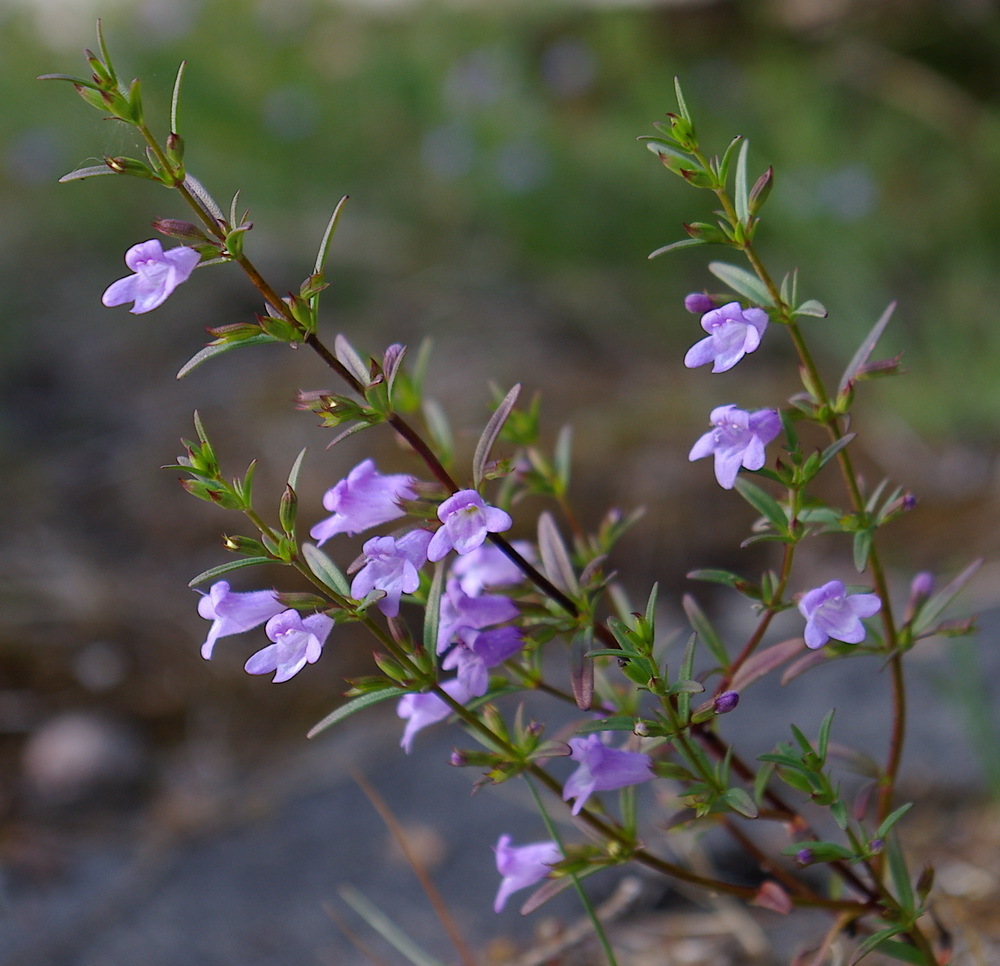
low calamint
Clinopodium arkansanum
Clinopodium arkansanum is a species of North American flowering plant in the family Lamiaceae. It is commonly known as limestone calamint.
From the article Clinopodium arkansanum on Wikipedia (CC BY-SA), quoted section by section
Description
Clinopodium arkansanum is a perennial herbaceous plant that can reach approximately 5–30 cm (2–12 inches) in height, with four-angled, green to reddish-purple stems. The leaves are oval in shape, about 3 mm (0.12 in) across and 1–3 cm (0.5–1 in) long, with untoothed margins and no leaf stalks. They are arranged opposite but often appear whorled because of the plant's habit of growing additional leaves in the main leaf axils. The white to purple mint-like flowers bloom mainly in spring and summer. They grow from the leaf axils and measure about 12 mm (0.47 in) in length. The fruit is a one-seeded nutlet.
Range & habitat
The plant grows naturally in southeastern North America, native to the American states of Arkansas, Illinois, Indiana, Kansas, Michigan, Minnesota, Missouri, New Mexico, New York, Ohio, Oklahoma, Pennsylvania, Tennessee, Texas, Virginia, West Virginia, and Wisconsin, and the Canadian province of Ontario. Its habitat includes mainly moist to wet soil containing limestone, and it grows best in full sun.
Wikipedia: “Habitat and distribution”
Where it lives
Recorded sightings
—
geo-referenced records in GBIF, from museums, herbaria and field observers.
Drag the globe to turn it. Dots are where records exist, not a range map; darker means more records.
In the stacks
Searching the stacks…
Every page naming Clinopodium arkansanum in the Biodiversity Heritage Library →
This page is assembled live from iNaturalist, GBIF, Wikipedia, the Source Library and the Internet Archive. It is not yet part of the hand-edited codex. iNaturalist taxon 160752.