On eBird ↗
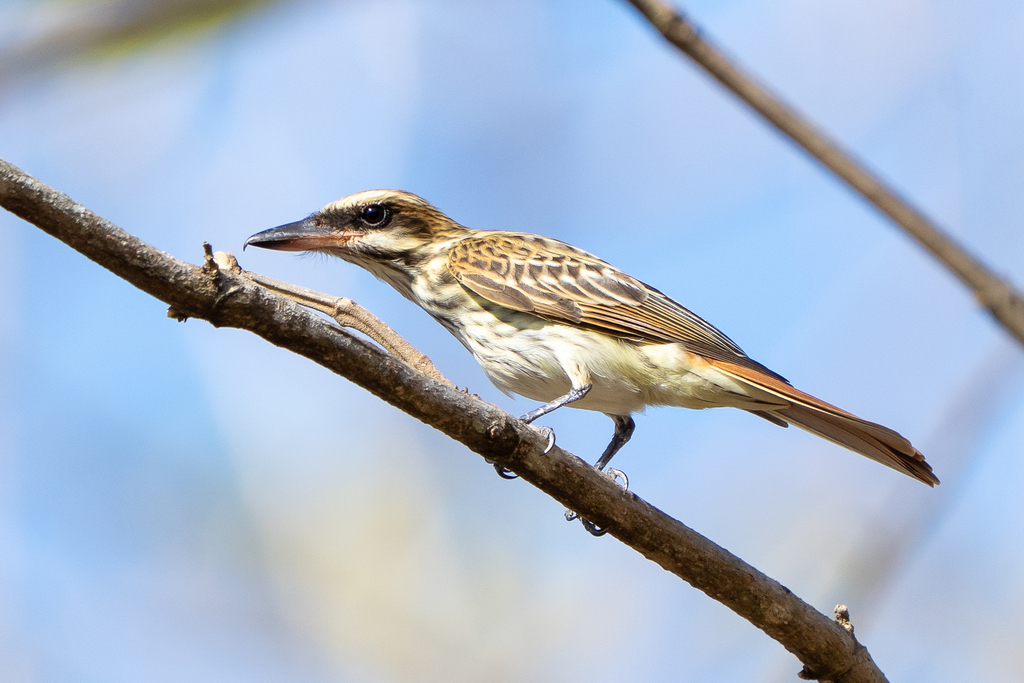
Streaked Flycatcher
Live sightings near you, the range map, bar charts of when it is seen, and Macaulay Library photos and recordings.
Streaked Flycatcher
Myiodynastes maculatus
The streaked flycatcher (Myiodynastes maculatus) is a passerine bird in the family Tyrannidae, the tyrant flycatchers. It is found in Mexico, in every South American country except El Salvador, in Trinidad and Tobago, in every mainland South American country (though only as a vagrant to Chile), and as a vagrant to Bonaire.
From the article Streaked flycatcher on Wikipedia (CC BY-SA), quoted section by section
Description
The streaked flycatcher is 20.5 to 23 cm (8.1 to 9.1 in) long and weighs 36.5 to 50 g (1.3 to 1.8 oz). The sexes have the same plumage. Adults of the nominate subspecies M. m. maculatus have an olive to olive-brown crown and nape with thin cinnamon edges on the feathers and a large, partially hidden, bright yellow to orange-yellow patch in the center of the crown. They have black lores; the color extends to the ear coverts and forms a dark "mask". They have a dull white to yellowish white rather blurry supercilium and a white streak below the mask. Their upperparts to the upper rump are grayish brown to olive with buffy edges and dusky shafts on the feathers that give a streaked appearance. Their lower rump and uppertail coverts are cinnamon-rufous with black or dusky streaks. Their wings are dusky with pale cinnamon-rufous edges on the lesser coverts and thin cinnamon-rufous edges on the outer webs of the other coverts and most of the flight feathers. Their tail is mostly cinnamon-rufous with dusky to black along the shafts that shows as streaks. Their chin and underparts are mostly white with yellowish flanks, lower belly, and undertail coverts. Their throat has thin dusky streaks and the breast and flanks have heavier streaks. …
Range & habitat
The subspecies of the streaked flycatcher are found thus:
m. insolens: Gulf-Caribbean slope from southern Tamaulipas in Mexico south, including the southern Yucatán Peninsula, through Belize, northern Guatemala, and northwestern Honduras into northern Nicaragua; in migration to Colombia M. m. difficilis: southwestern Nicaragua south through western Costa Rica, through Panama including offshore islands, and across central Colombia into western Venezuela through Zulia and Táchira to Portuguesa M. m. nobilis: across Colombia from northern Córdoba Department including the Sierra Nevada de Santa Marta into the western Serranía del Perijá M. m. chapmani: from Chocó Department in western Colombia south through western Ecuador into extreme northwestern Peru's Piura Department M. m. maculatus: Suriname, French Guiana, northern Brazil north of the Amazon from the upper Negro River east to northwestern Maranhão M. m. tobagensis: Venezuela except the west, Venezuela's Margarita Island, Trinidad, Tobago, and Guyana M. m. …
Wikipedia: “Distribution and habitat”
What it does
The streaked flycatcher feeds mostly on insects including large cicadas, locusts, and beetles. Its diet also includes berries and other fruits and there are records of it feeding on small lizards. It typically forages singly or in pairs and occasionally joins mixed-species feeding flocks. The migrants from southern South America eat a higher proportion of fruit than resident subspecies. The species forages mostly from the forest's mid-level to the canopy, and catches most insect prey in mid-air with short sallies from a perch. It also takes insects while briefly hovering or after a short glide, and takes fruit by gleaning while perched and while hovering.
Wikipedia: “Feeding”
Listen
Looking for field recordings…
Where it lives
Recorded sightings
—
geo-referenced records in GBIF, from museums, herbaria and field observers.
Drag the globe to turn it. Dots are where records exist, not a range map; darker means more records.
In the stacks
Searching the stacks…
Every page naming Myiodynastes maculatus in the Biodiversity Heritage Library →
This page is assembled live from iNaturalist, GBIF, Wikipedia, the Source Library and the Internet Archive. It is not yet part of the hand-edited codex. iNaturalist taxon 16063.