On eBird ↗
Venezuelan Flycatcher
Live sightings near you, the range map, bar charts of when it is seen, and Macaulay Library photos and recordings.
Venezuelan Flycatcher
Myiarchus venezuelensis
The Venezuelan flycatcher (Myiarchus venezuelensis) is a passerine bird in the tyrant flycatcher family. It was formerly considered to be a race of the short-crested flycatcher, Myiarchus ferox, but the two species overlap without interbreeding in Venezuela, and the calls are different.
From the article Venezuelan flycatcher on Wikipedia (CC BY-SA), quoted section by section
Description
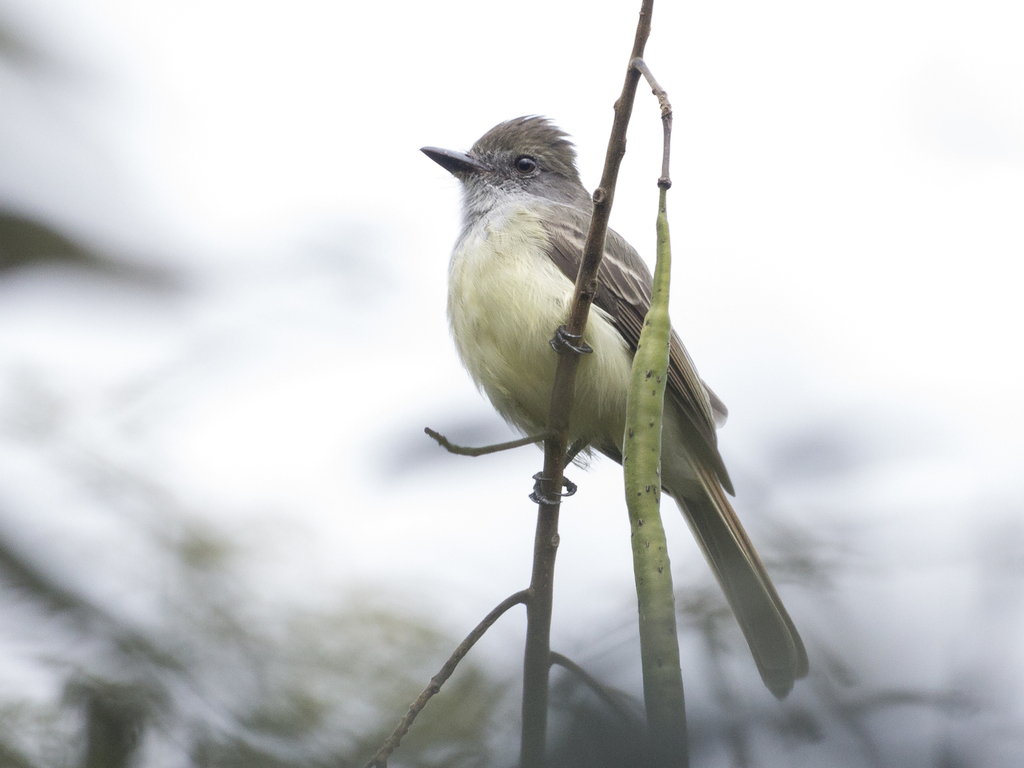
The Venezuelan flycatcher is 18 to 19 cm (7.1 to 7.5 in) long and weighs 27 to 33 g (0.95 to 1.2 oz). The sexes have the same plumage. Adults have a dark olive-green to brownish olive crown and upperparts. The crown has a slight crest and is slightly darker in the center, giving a streaked effect. Their lores are gray that extends to a short supercilium. Their cheeks are gray and their ear coverts brownish olive. Their wings are mostly dusky with thin rufous outer edges on the primaries. The secondaries and tertials have rufous, pale yellowish, and white edges on respectively their outer, middle, and inner feather sets. Their wing coverts are dusky with pale rufous to whitish tips that form two wing bars. Their tail's upper surface is dusky and its lower surface lighter. The outermost pair of feathers have whitish or yellow edges and the rest have rufous edges. Their chin, throat, and upper breast are gray with a slight olivaceous tinge on the edge of the breast. Their belly and undertail coverts are pale yellow. There is some geographical variation in the intensity of the upper- and underparts' colors. They have a brown iris, a brownish black bill with often a pinkish to orange base to the mandible's underside, and gray to slaty-black legs and feet. It is almost identical to the short-crested flycatcher and Panama flycatcher (M. …
Range & habitat
The Venezuelan flycatcher has a disjunct distribution. Separate populations are on the islands of Trinidad and Margarita and in Venezuela's northern Bolívar state. Sources differ on the extent of its largest range. They agree that it extends from northern Colombia's Sucre Department east into Venezuela. McMullan's field guide shows it extending south straddling the Colombia-Venezuela border to Norte de Santander Department. Hilty's field guide shows it on the border only in the far north and in northern Táchira on the Colombian border, and the BirdLife International (BLI) map shows it extending south to the east of the border and crossing it from Táchira into Norte de Santander. Hilty and BLI agree that its range continues from northeastern Colombia across northern Venezuela to Guárico. BLI then shows the range extending south to central Apure; Hilty does not show that. The Venezuelan flycatcher inhabits a variety of landscapes; throughout in most it is especially associated with the understory of deciduous and semi-deciduous woodlands. It is found in clearings and the edges of both dry and moist forest, in gallery forest, in pastures with scattered trees and scrub, and in anthropogenic landscapes such as plantations, gardens, and parks. In its isolated eastern Venezuelan range it is found within deciduous woodland bordered by dry savanna and wet evergreen forest. …
Wikipedia: “Distribution and habitat”
What it does
The Venezuelan flycatcher feeds on insects and small fruits. It usually forages singly or in pairs. It perches in the open in the forest's mid-story and primarily captures prey and collects fruit while briefly hovering after a short sally. To a lesser degree it captures it in mid-air and by grabbing it from vegetation without hovering.
Wikipedia: “Feeding”
Listen
Looking for field recordings…
Where it lives
Recorded sightings
—
geo-referenced records in GBIF, from museums, herbaria and field observers.
Drag the globe to turn it. Dots are where records exist, not a range map; darker means more records.
In the stacks
Searching the stacks…
Every page naming Myiarchus venezuelensis in the Biodiversity Heritage Library →
This page is assembled live from iNaturalist, GBIF, Wikipedia, the Source Library and the Internet Archive. It is not yet part of the hand-edited codex. iNaturalist taxon 16044.