- Plants
- ›Vascular Plants
- ›flowering plants
- ›Dicots
- ›nightshades, bindweeds, gooseweeds, and allies
- ›nightshade family
- ›cestrums and allies
- ›Cestreae
- ›Cestrum
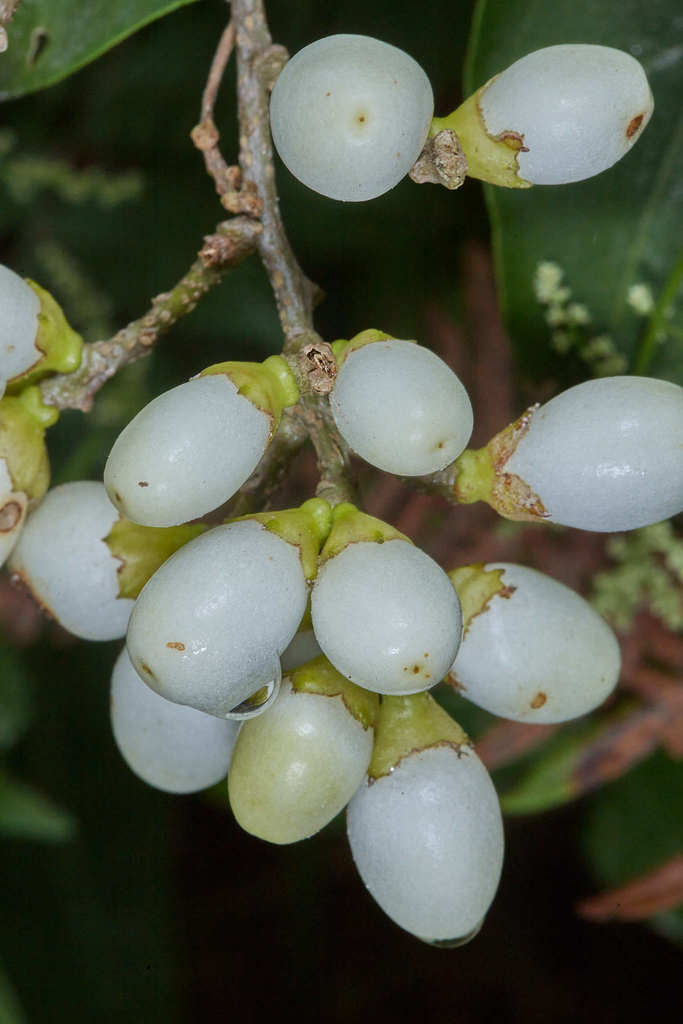
orange cestrum
Cestrum aurantiacum
Cestrum aurantiacum (Orange Cestrum, "orange jessamine", orange-flowering jessamine, and yellow Cestrum; syn. Capraria lanceolata L.f.) is an invasive species native to North and South America. This plant is used as an ornamental plant, and it is a poisonous plant if eaten by animals. It is regarded as medicinal in Peru.
From the article Cestrum aurantiacum on Wikipedia (CC BY-SA), quoted section by section
Description
Cestrum aurantiacum is a shrub 1.5 to 6.5 m tall or occasionally up to 8.5 m tall. The branches are glabrous or sparsely tomentose. The leaves are ovate to elliptical, 7 to 17 cm long and 2.5 to 5.5 cm wide. Both sides of the leaf are glabrous, the tip is acuminate or shortly tapering, the base is acuminate to blunt or occasionally shortly tapering. The petioles are 1 to 3 cm long and glabrous.
Inflorescences. The terminal or axillary, umbelliferous or racemose inflorescences consist of a few to a few flowers. The inflorescence axis is finely hairy or hairless, the bracts linear and later deciduous. The flowers are sessile, almost sessile or stand on flower stalks up to 1.5 mm long. Blooming constantly through the year, the flowers produce a citrus-like scent at night. The calyx is tubular, 5 to 6.5 (rarely up to 9) mm long and hairless except for the (0.7) 1 to 2 (3) mm long, ciliate calyx lobes. These are awl-shaped and long-spiked or rounded and long-spiked and run further down the calyx tube as five nerve tracts.
The orange or rarely yellow corolla has a 17.5 to 20 mm long corolla tube, the corolla lobes are 3 to 3.5 (5.5) mm long, egg-shaped or lanceolate. The edges are covered with papillose hairs. The stamens are 4 to 6.5 mm long, swollen and bent over in a knee-like shape, groove-like or almost appendage-like. The base and the vascular bundles of the stamens are hairy. …
Range & habitat
This species is distributed in an area extending from southern Mexico to Nicaragua, where it is found in moist thickets or forests, often in pine-oak forests at altitudes between 1000 and 2600 m.
Wikipedia: “Distribution”
How it is grown
This plant is used as an ornamental plant, and it is a poisonous plant if eaten by animals. However, the species is widely grown as an ornamental plant and in some places it has escaped from cultivation and returned to the wild. In parts of Africa, Asia and Australia, the species has become a harmful invasive species. The top of the plant is hardy to zone 8 but it is root hardy to zone 7. Drought tolerant, the species grows best in occasionally moist, humus-rich, well-drained soil in full sun or partial shade. The size of the shrub is easily controlled by pruning. It is regarded as medicinal in Peru. The flowers attract hummingbirds, butterflies, and other pollinating insects.
== References ==
Wikipedia: “Cultivation”
Where it lives
Recorded sightings
—
geo-referenced records in GBIF, from museums, herbaria and field observers.
Drag the globe to turn it. Dots are where records exist, not a range map; darker means more records.
In the stacks
Searching the stacks…
Every page naming Cestrum aurantiacum in the Biodiversity Heritage Library →
This page is assembled live from iNaturalist, GBIF, Wikipedia, the Source Library and the Internet Archive. It is not yet part of the hand-edited codex. iNaturalist taxon 160361.