- Plants
- ›Vascular Plants
- ›flowering plants
- ›monocots
- ›grasses, sedges, cattails, and allies
- ›Bromeliads
- ›Tillandsioids
- ›Catopsis
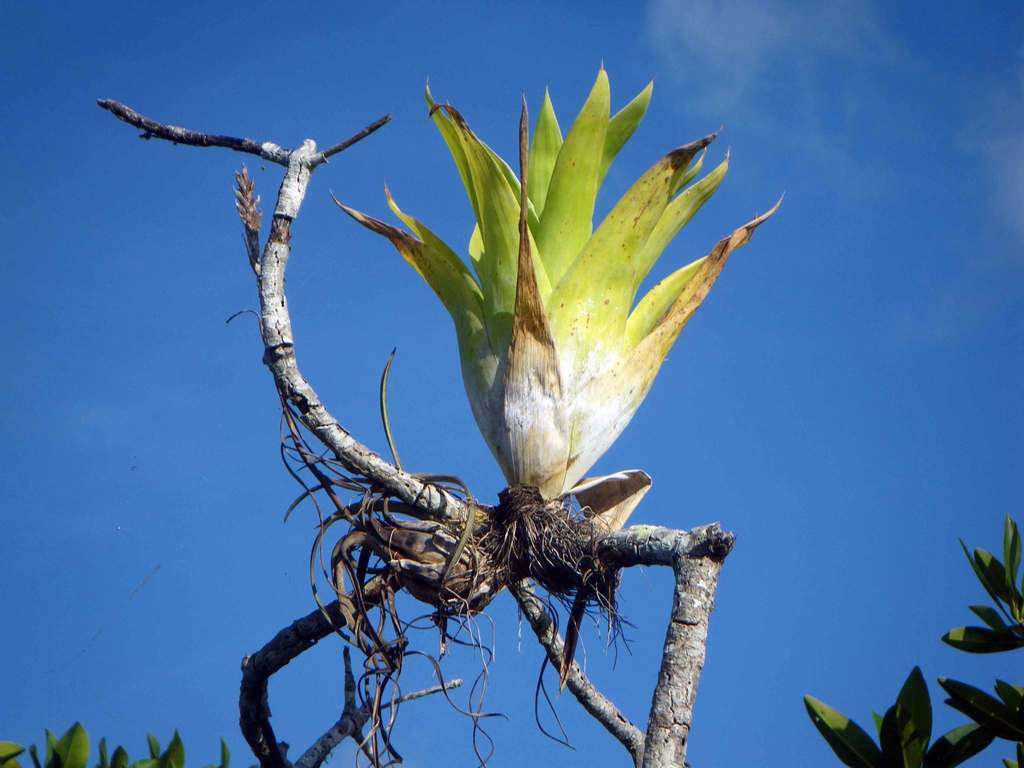
Powdery-strap Bromeliad
Catopsis berteroniana
Catopsis berteroniana , commonly known as the powdery strap airplant or the lantern of the forest, is an epiphytic bromeliad thought to be a possible carnivorous plant, similar to Brocchinia reducta, although the evidence is equivocal. Its native range is from southern Florida to southern Brazil. It generally grows on the unshaded twigs of trees, and has been shown experimentally to trap more insects in its tank than other bromeliads of comparable size. There are several other species in the genus, none of which is believed to be carnivorous.
From the article Catopsis berteroniana on Wikipedia (CC BY-SA), quoted section by section
Description
Catopsis berteroniana is an epiphytic plant with elongate leaves. These erect leaves overlap to form tube-like structures characteristic of many tank bromeliads. Rainwater falls and lands in the tubes, forming pools of water called phytotelmata, an aqueous medium filled with copious amounts of nutrients available for the plant to absorb. This medium is slightly acidic, but very close to neutral; according to algae in bromeliads, the pH of the phytotelmata of Catopsis berteroniana is 6.8. This species has sessile glands located on the plant epidermis that are used to absorb nutrients. Other species of carnivorous plants, such as Cephalotus follicularis, use these glands to secrete enzymes to break down detritus and trap prey. However, C. berteroniana lacks enzyme production, so this plant breaks down materials using other methods. An important feature located on the leaves of Catopsis berteroniana is the presence of a white powder. This powder is released from the leaves of the plant. It is very slippery and reflects ultraviolet light.
Epiphytes. Catopsis berteroniana is an epiphyte, meaning it grows on another host. However, the plant does not receive nutrients from its host via its roots. Instead, the roots attach to the tree in order to provide stability. In turn, nutrients are obtained from its leaves. …
Wikipedia: “Characteristics”
Range & habitat
Catopsis berteroniana is found in the neotropics, from southern Florida to southern Brazil. It grows above the tree canopies where it is exposed to a high amount of sunlight. According to Fish, 1976, due to the location of Catopsis berteroniana above the tree canopies, this species dodges direct competition with other species because they do not need to receive any nutrients from the soil or tree canopies. In Everglades National Park in southern Florida, these plants were found at the apex of red mangroves and in areas of limited shade. One of the major reasons this species is restricted to the neotropics is because the phytotelmata are limited to humid environments. This is because the plant does not have enough energy available to make up for the excessive evaporation that occurs in very dry climates.
Wikipedia: “Distribution”
Where it lives
Recorded sightings
—
geo-referenced records in GBIF, from museums, herbaria and field observers.
Drag the globe to turn it. Dots are where records exist, not a range map; darker means more records.
In the stacks
Searching the stacks…
Every page naming Catopsis berteroniana in the Biodiversity Heritage Library →
This page is assembled live from iNaturalist, GBIF, Wikipedia, the Source Library and the Internet Archive. It is not yet part of the hand-edited codex. iNaturalist taxon 160238.