- Plants
- ›Vascular Plants
- ›flowering plants
- ›Dicots
- ›Mints, Plantains, Olives, and Allies
- ›broomrape family
- ›Pedicularideae
- ›Castilleja
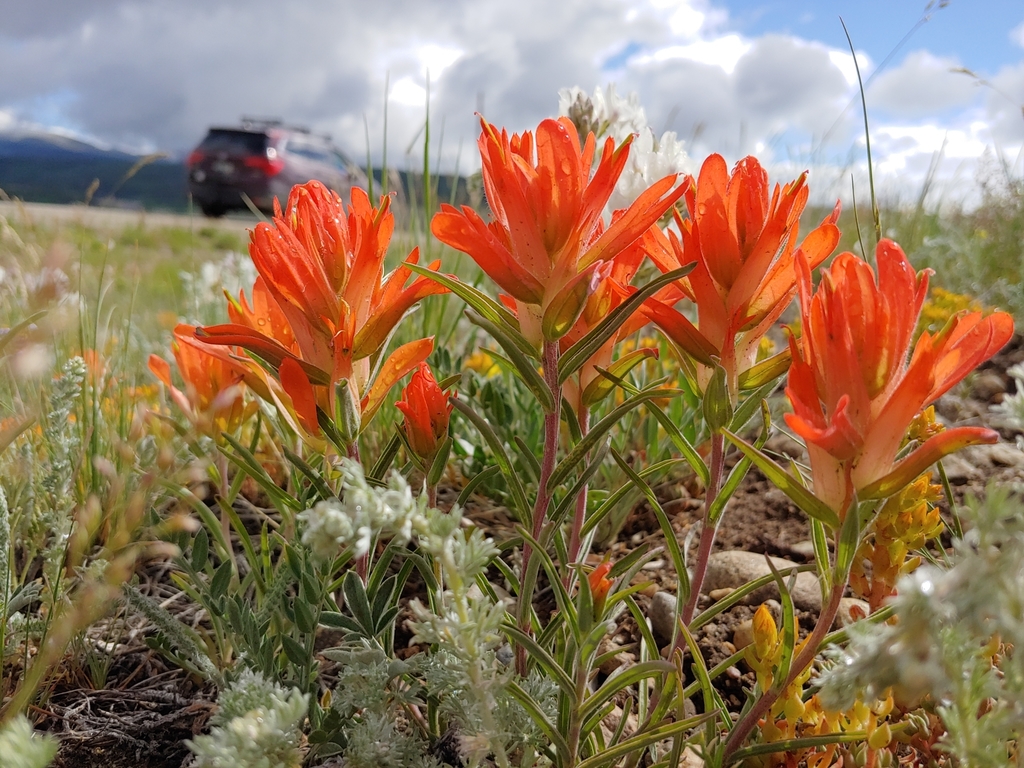
Wholeleaf Paintbrush
Castilleja integra
Castilleja integra, with the common names orange paintbrush, Southwestern paintbrush, and wholeleaf paintbrush, is a partially parasitic herbaceous perennial plant native to the Southwestern United States and Northern Mexico. The species produces a relatively large amount of nectar and is attractive to hummingbirds. It is better suited to cultivation than most other species in the paintbrush genus (Castilleja) and is therefore used in xeriscape gardens and naturalistic meadows, even outside its native range.
From the article Castilleja integra on Wikipedia (CC BY-SA), quoted section by section
Description
Mature individuals of Castilleja integra are typically 9–50 centimeters (3.5–20 in) in size, though they have been reported to grow as tall as 100 centimeters (39 in). All above ground parts of the plants, the leaves, bracts, stems, and flowers, are covered in light coating of soft down, called tomentum by botanists. The herbaceous stems regrow each season from a hard, woody structure called a caudex that is atop a substantial taproot or stout branched roots. The stems either grow straight up from the ground (erect stems) or have a curved bend at their base to grow outwards a short distance then upwards (ascending stems). C. integra may have just one solitary stem or several, they are always unbranched near the base, but may have short branches near the end of the stems.
Castilleja integra has leaves that may range in color from purplish to fully green, but will usually be pale or dusty looking because of the fine, unbranched hairs on the surface. The leaves are always narrow, but vary from being very narrow and thin like a blade of grass (linear leaves) to being almost rectangular, but still not very wide (narrowly oblong leaves). The leaves are usually whole without divisions or toothed edges (entire), but will occasionally have two shallow divisions near the end of the leaf, giving it three lobes. The edges of the leaves can be wavy, but are never thick or fleshy. …
Range & habitat
The natural range of Castilleja integra can be broadly defined as northern Mexico and the southwestern United States. In the United States its range includes Arizona, Colorado, New Mexico, and Texas, but it not found in California or Nevada. It also grows in much of northern Mexico including the states of Baja California, Sonora, Chihuahua, Coahuila, Nuevo León, Tamaulipas, and Durango. The distribution of elevations is quite wide for this species, most often 1,000 to 3,300 meters (3,300 to 10,800 ft) and they may be occasionally be found all the way down to 600 meters (2,000 ft). Castilleja integra can be found in a variety of wild habitats including open grasslands, dry meadows, Madrean pine–oak woodlands, open pinyon–juniper woodlands, and subalpine meadows. They are not typically found in cooler or moist habitats like aspen woodlands. They are at least somewhat fire adapted, a study finding no extirpation in low intensity wildfires and only small amount in moderate intensity fires.
Conservation. NatureServe last evaluated Castilleja integra in 1986, listing it as apparently secure (G4) at that time. They similarly found it to be apparently secure (S4) at the state level in Arizona, but they did not evaluate the rest of its range.
Wikipedia: “Distribution and habitat”
What it does
The variable checkerspot butterfly (Euphydryas chalcedona) feeds upon various species in both the Orobanchaceae and Scrophulariaceae families as a caterpillar, including Castilleja integra. The somewhat similar looking leanira checkerspot (Chlosyne leanira) is more selective. It is only recorded as eating the paintbrush genus, very often Castilleja integra in southern Colorado. Hummingbirds are a frequent pollinator of Castilleja integra including the rufous hummingbird, broad-tailed hummingbird, and black-chinned hummingbird, due to the good nectar flow, each flower producing about 2 milligrams of sugar in its nectar each day. Pollen is deposited by the plants on the bill and crown of the hummingbirds, who are attracted by the nectar reward concealed in the long tube of the flower. Rufous hummingbirds of both sexes fiercely defend a territory or try to steal a territory of blooming flowers including the orange paintbrush. They try to keep approximately the same number of flowers within the territory and only abandon a territory due to aggression or as the number of flowers decrease. Castailleja integra is considered to be a hemi-parasite, because a host plant is not required for seedlings to sprout and they can photosynthesize to produce at least some of their own energy. …
Wikipedia: “Ecology”
At the table
The Zuni people used the root's bark, mixed with minerals, to dye deerskin black.
Wikipedia: “Traditional uses”
How it is grown
Paintbrush flowers are a desirable species in gardens for their showy flowers and attraction of hummingbirds, but can be difficult to grow because of their dependence upon a host species and dislike of being transplanted. This means that plants grown for sale by nurseries must be grown with a compatible host plant in the same pot that will also be desirable to buyers. Orange paintbrush and desert paintbrush (Castilleja chromosa) are two of the most tolerant species of garden conditions and being transplanted. The best survival rates for orange paintbrush when planted in pots are with fringed sagebrush, lemon sagewort, rubber rabbitbrush, pine-leaved penstemon, yellow sundrops, Blue Mountain buckwheat, or antelope sage. Among penstemon species, Penstemon strictus has some of the best survival rates. Distance from the host plant is also a factor, with the survival rate falling by more than 80% when placed at a distance of 4 centimeters instead of just 2 centimeters. Gardening sources often mention grasses as a host species for paintbrush flowers and Bouteloua gracilis is recommended by gardening books. Plants rarely survive being transplanted once established, and for this reason they are generally not moved in gardens or transplanted from the wild. Orange paintbrush is best suited to unproductive soils, ones without much organic material, that drain very well. …
Wikipedia: “Cultivation”
Where it lives
Recorded sightings
—
geo-referenced records in GBIF, from museums, herbaria and field observers.
Drag the globe to turn it. Dots are where records exist, not a range map; darker means more records.
In the stacks
Searching the stacks…
Every page naming Castilleja integra in the Biodiversity Heritage Library →
This page is assembled live from iNaturalist, GBIF, Wikipedia, the Source Library and the Internet Archive. It is not yet part of the hand-edited codex. iNaturalist taxon 160199.