On eBird ↗
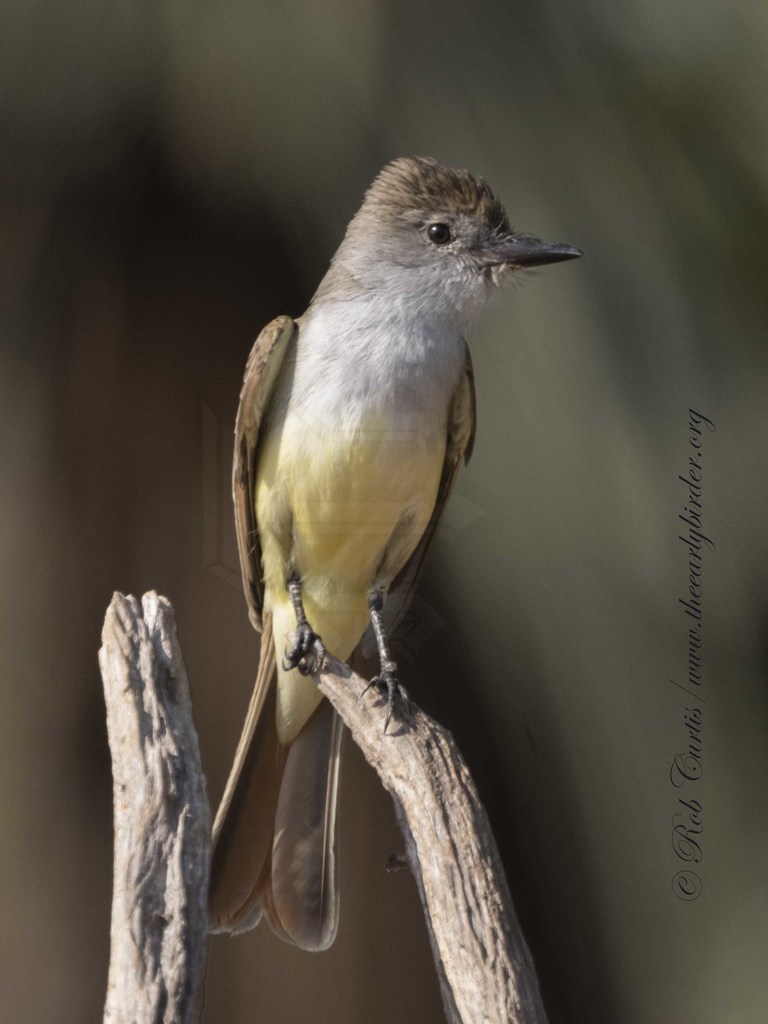
Brown-crested Flycatcher
Live sightings near you, the range map, bar charts of when it is seen, and Macaulay Library photos and recordings.
Brown-crested Flycatcher
Myiarchus tyrannulus
The brown-crested flycatcher (Myiarchus tyrannulus) is a passerine bird in the tyrant flycatcher family Tyrannidae. It is found from the southwestern United States south through Mexico and Central America to Costa Rica; on Aruba, Bonaire, Curaçao, Trinidad, and Tobago; and in every mainland South American country except Chile and possibly Ecuador.
From the article Brown-crested flycatcher on Wikipedia (CC BY-SA), quoted section by section
Description
The brown-crested flycatcher is 18 to 23 cm (7.1 to 9.1 in) long, with a general trend of larger to smaller from north to south. Subspecies M. t. magister is the largest taxon within the entire genus Myiarchus, weighing 36 to 54 g (1.3 to 1.9 oz). The other subspecies weigh 21 to 45 g (0.74 to 1.6 oz). The sexes have the same plumage. Adults of the subspecies M. t. magister and M. t. cooperi have a grayish brown crown whose feathers have darker shafts and form a bushy crest. Their upperparts are mostly light brownish gray to dark olive gray with often a rufous tinge on the uppertail coverts. Their face is otherwise medium gray. Their wings are mostly dark grayish brown to brownish black with rufous edges on all but the outermost primaries and white, pale lemon, or grayish edges on the secondaries. The wing's greater and median coverts have pale grayish brown to brownish white tips that show as two wing bars. Their tail is dark grayish brown to brownish black with rufous inner webs on all but the inner pair of feathers. Their throat and upper breast are light gray that is slightly lighter on the throat. Their lower breast, flanks, and belly are bright yellow with a light gray wash on the sides and their undertail coverts are light yellow. The other subspecies of the brown-crested flycatcher differ from M. t. magister and M. t. cooperi and each other thus:
M. t. …
Range & habitat
The brown-crested flycatcher's subspecies have disjunct distributions, both within Central and South America and between them. Its range skirts most of the Amazon Basin. The subspecies are found thus:
M. t. magister: from southeastern California, southern Nevada and southwestern Utah, south-central and southeastern Arizona, and southwestern New Mexico in the United States south through western Mexico all the way to eastern Oaxaca; also Tres Marias Islands M. t. cooperi: from southern Texas in the U.S. south through eastern Mexico including the Yucatán Peninsula and through Belize and northern Guatemala into northern Honduras M. t. cozumelae: Cozumel Island M. t. insularum: the Bay Islands off Honduras' Caribbean coast M. t. brachyurus: western Nicaragua and northwestern Costa Rica M. t. tyrannulus: Aruba, Bonaire, Curaçao, Trinidad, and Tobago; northern and eastern Colombia; northern and central Venezuela; the Guianas and adjacent Brazil north of the Amazon and east of the Negro River; western Brazil from Acre to western Mato Grosso do Sul; extreme southeastern Peru; northern and eastern Bolivia; western Paraguay; northern Argentina south to Córdoba and Santa Fe provinces; separately in northern Peru M. t. …
Wikipedia: “Distribution and habitat”
What it does
The brown-crested flycatcher feeds almost exclusively on arthropods during the breeding season and occasionally includes small vertebrates and fruit in its diet. In the non-breeding season it feeds on a more even mix of arthropods and fruit. It takes fruit and most of its arthropod prey with sallies from a perch to grab it from vegetation. It less often takes insects in mid-air and occasionally from the ground.
Wikipedia: “Feeding”
Listen
Looking for field recordings…
Where it lives
Recorded sightings
—
geo-referenced records in GBIF, from museums, herbaria and field observers.
Drag the globe to turn it. Dots are where records exist, not a range map; darker means more records.
In the stacks
Searching the stacks…
Every page naming Myiarchus tyrannulus in the Biodiversity Heritage Library →
This page is assembled live from iNaturalist, GBIF, Wikipedia, the Source Library and the Internet Archive. It is not yet part of the hand-edited codex. iNaturalist taxon 16016.