- Plants
- ›Vascular Plants
- ›flowering plants
- ›Dicots
- ›Sunflowers, Bellflowers, Fanflowers, and Allies
- ›bellflower family
- ›bellflower subfamily
- ›Campanula
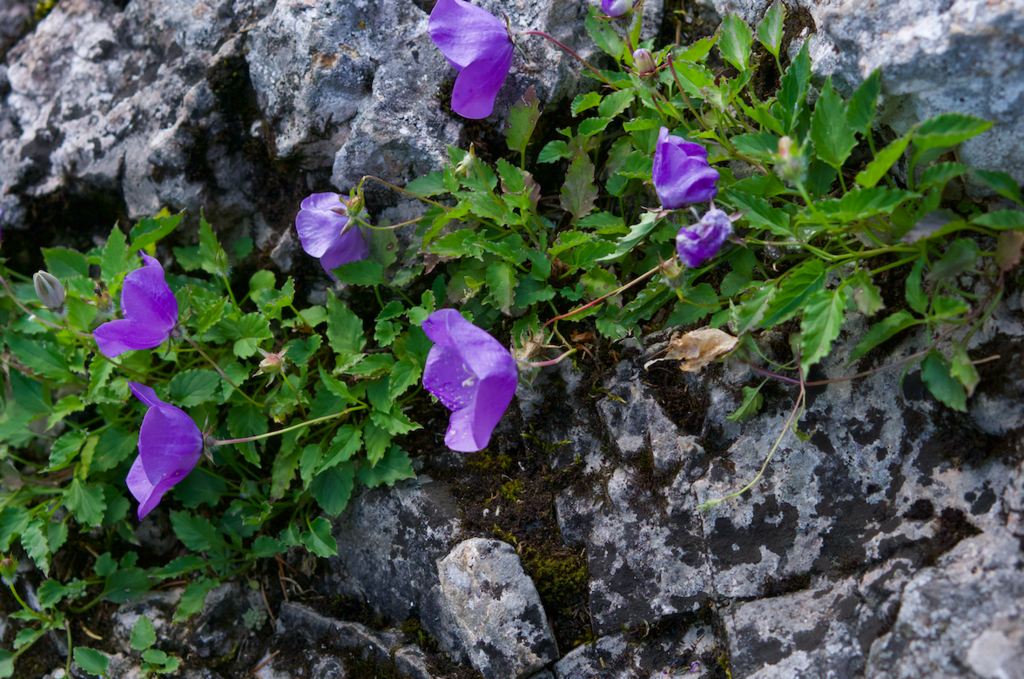
tussock bellflower
Campanula carpatica
Campanula carpatica, the tussock bellflower or Carpathian harebell, is a species of flowering plant in the family Campanulaceae, native to the Carpathian Mountains of Central Europe. It is a low-growing herbaceous perennial, with long stems bearing solitary blue bell-shaped flowers. It was introduced to the Royal Botanic Garden at Kew in 1774 by Nikolaus Joseph von Jacquin. Several cultivars in shades of white, blue, pink and purple, have been developed for garden use.
From the article Campanula carpatica on Wikipedia (CC BY-SA), quoted section by section
Description
Campanula carpatica is a low-growing herbaceous perennial. Plants possess basal leaves and thin, white rhizomes. Stems grow up to 45 cm (18 in) long. Flowers are solitary and stand on stalks ranging from 10–15 cm (3.9–5.9 in) long. Flowers are purple in colour and plants bloom from June to August.
Range & habitat
Campanula carpatica is native to parts of Europe including the Czech Republic, Romania, Slovakia, Ukraine, Poland and Western Russia. It can also be found growing within the Carpathian Mountains of Central Europe.
Wikipedia: “Native Range”
How it is grown
It was introduced to the Royal Botanic Garden at Kew in 1774 by Nikolaus Joseph von Jacquin. Several cultivars in shades of white, blue, pink and purple, have been developed for garden use. This plant has gained the Royal Horticultural Society's Award of Garden Merit.
== References ==
Wikipedia: “Cultivation”
Where it lives
Recorded sightings
—
geo-referenced records in GBIF, from museums, herbaria and field observers.
Drag the globe to turn it. Dots are where records exist, not a range map; darker means more records.
In the stacks
Searching the stacks…
Every page naming Campanula carpatica in the Biodiversity Heritage Library →
This page is assembled live from iNaturalist, GBIF, Wikipedia, the Source Library and the Internet Archive. It is not yet part of the hand-edited codex. iNaturalist taxon 159757.