- Plants
- ›Vascular Plants
- ›flowering plants
- ›monocots
- ›Agaves, Orchids, Irises, and Allies
- ›agave and allies
- ›Century plant subfamily
- ›Camassia
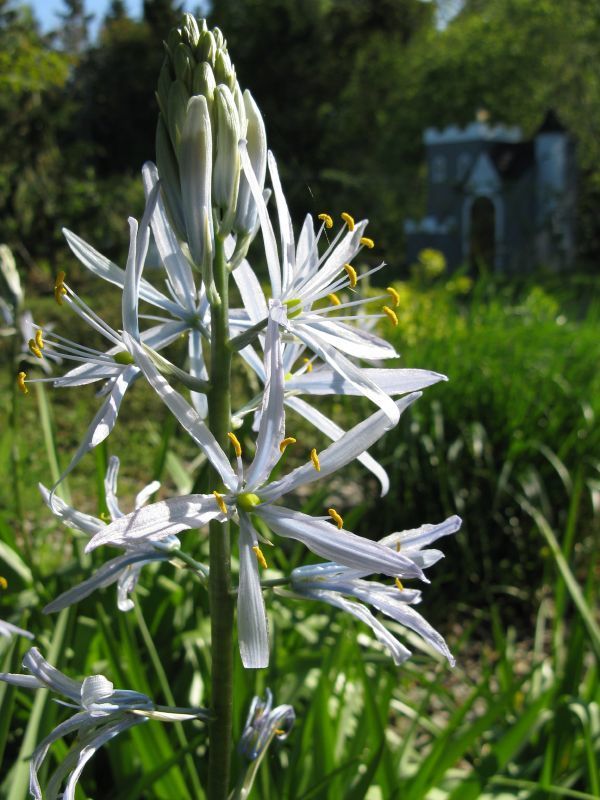
Cusick's Camas
Camassia cusickii
Camassia cusickii, common name Cussick's camas, is a species of plant in the Asparagaceae family (subfamily Agavoideae). It is native to parts of North America. It has linear leaves with parallel venation and flowers in parts of three. The flowers are usually ice blue or baby blue in color, although they can be various shades of blue, cream and white.
From the article Camassia cusickii on Wikipedia (CC BY-SA), quoted section by section
Description
Camassia cusickii has linear leaves with parallel venation and flowers in parts of three. The flowers are usually ice blue or baby blue, although they can be various shades of blue, cream, and white. The flowers are slightly zygomorphic with the tepals withering separately after anthesis. C. cusickii has yellow anthers and a fruiting pedicel incurving-erect or slightly spreading. The capsules are not deciduous, they are light brown in color, and have an ovoid or ellipsoid shape. The flowers in the wild have a deeper, darker hue compared to their garden forms tending to be a lighter blue color.
Range & habitat
Although scattered from coast to coast, Camassia cusickii is more abundant in the northwestern states, specifically Oregon and Idaho. It is commonly found in the Canadian Life Zone and prefers damp meadows. Stations have been located in the Eagle Creek Mountains, Powder River Mountains, and Blue Mountains of northeastern Oregon. C. cusickii is a federal 3c Bureau of Land Management Sensitive Species and 'Idaho Native Plant Society Sensitive Species'. This species spreads over Eastern Oregon in a variety of the local climates, from Mount Hebo on the North Coast, to the isolated area of the Hell's Canyon overlook.
Wikipedia: “Distribution”
What it does
A native to North America, Camassia cusickii tolerates damp meadows at subalpine and alpine elevations (4,000–6,000 feet (1,220–1,830 m)) and tolerates pond edges, rich soils, and bloom well in either sun or shade. C. cusickii generally blooms in May. Cusick's camas self-seed and germinate easily, as long as they find rich, moist, and well-drained soil.
Wikipedia: “Habitat and ecology”
At the table
This plant was not used as a food source for Native Americans. The large root of this relative of Camassia is pungent, slimy, and bitter tasting. This bitter taste is due to steroidal saponins within the plant. These saponins found in the bulbs of C. cusickii are being isolated and used in multiple studies helping to provide a point of reference for further studies on plant saponins. C. cusickii is commonly confused with its near sister relative the C. quamash, which Native Americans would harvest the roots to consume as raw vegetables, or they boiled them to create a "sweet, molasses-like treat."
Wikipedia: “Food”
How it is grown
C. cusickii prefers fertile moist soil, but well drained humus rich soil that does not become over saturated with water. The bulbs are usually planted 6 inches (150 mm) deep in late summer or early fall, but later planting can also be successful. In very cold areas, the soil should be mulched to protect the bulbs in late autumn. Camassias can be propagated by removing the offsets that have formed round the main bulbs and replanting them individually; do this in summer when they are dormant. Sweet William and Peonies offer as good companions to C. cusickii. They can be planted in flower beds, borders, rock gardens, and also be planted as cut flowers. This plant thrives among perennials. C. cusickii can naturalize and serve as ground cover. C. cusickii is generally resistant to deer and rodents.
Wikipedia: “Cultivation”
Where it lives
Recorded sightings
—
geo-referenced records in GBIF, from museums, herbaria and field observers.
Drag the globe to turn it. Dots are where records exist, not a range map; darker means more records.
In the stacks
Searching the stacks…
Every page naming Camassia cusickii in the Biodiversity Heritage Library →
This page is assembled live from iNaturalist, GBIF, Wikipedia, the Source Library and the Internet Archive. It is not yet part of the hand-edited codex. iNaturalist taxon 159729.