- Plants
- ›Vascular Plants
- ›flowering plants
- ›Dicots
- ›sandalwoods, mistletoes, and allies
- ›sandalwood family
- ›Buckleya
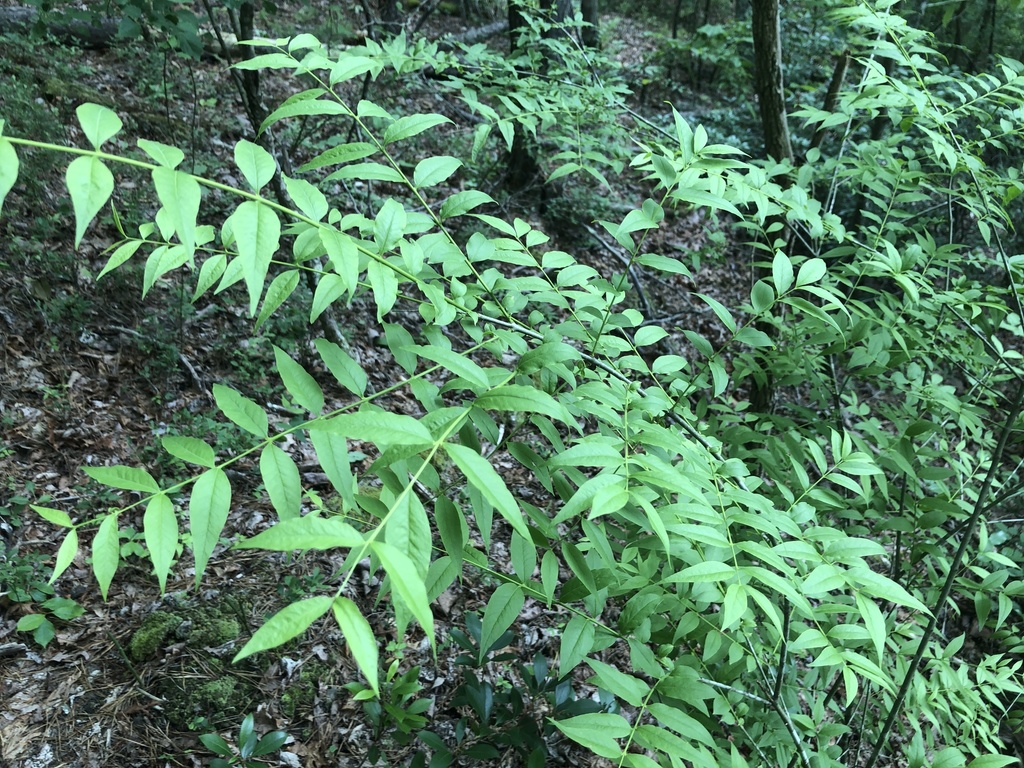
piratebush
Buckleya distichophylla
Buckleya distichophylla, commonly called piratebush, is a flowering plant in the family Santalaceae, native to the Southern United States. It is a rare plant, found only in sporadic mountainous areas of North Carolina, Tennessee, and Virginia.
Buckleya distichophylla is a deciduous shrub growing to heights of up to 15 feet (4.6 m), with leaves that are 2-4 inches (5.1-10.2 cm) in length requiring direct sunlight to grow. Its flowers are 1 inch (2.5 cm) long with 4 yellow-green, long narrow bracts. What makes the piratebush unique is in how it survives. The plant does not survive on photosynthesis only as its pale green leaves indicate less chlorophyll than other plants. In addition to photosynthesis, piratebush receives nutrients through parasitizing other species. The plant is hemiparasitic, attaching itself to the root systems of other plants with structures called haustoria and draw nutrients through them. Although originally thought to attach itself only to hemlock trees, it has since been determined that piratebush can attach to many different species.
Where it lives
Recorded sightings
—
geo-referenced records in GBIF, from museums, herbaria and field observers.
Drag the globe to turn it. Dots are where records exist, not a range map; darker means more records.
In the stacks
Searching the stacks…
Every page naming Buckleya distichophylla in the Biodiversity Heritage Library →
This page is assembled live from iNaturalist, GBIF, Wikipedia, the Source Library and the Internet Archive. It is not yet part of the hand-edited codex. iNaturalist taxon 159583.