- Plants
- ›Vascular Plants
- ›flowering plants
- ›Dicots
- ›pinks, cactuses, and allies
- ›four o'clock family
- ›Bougainvillea
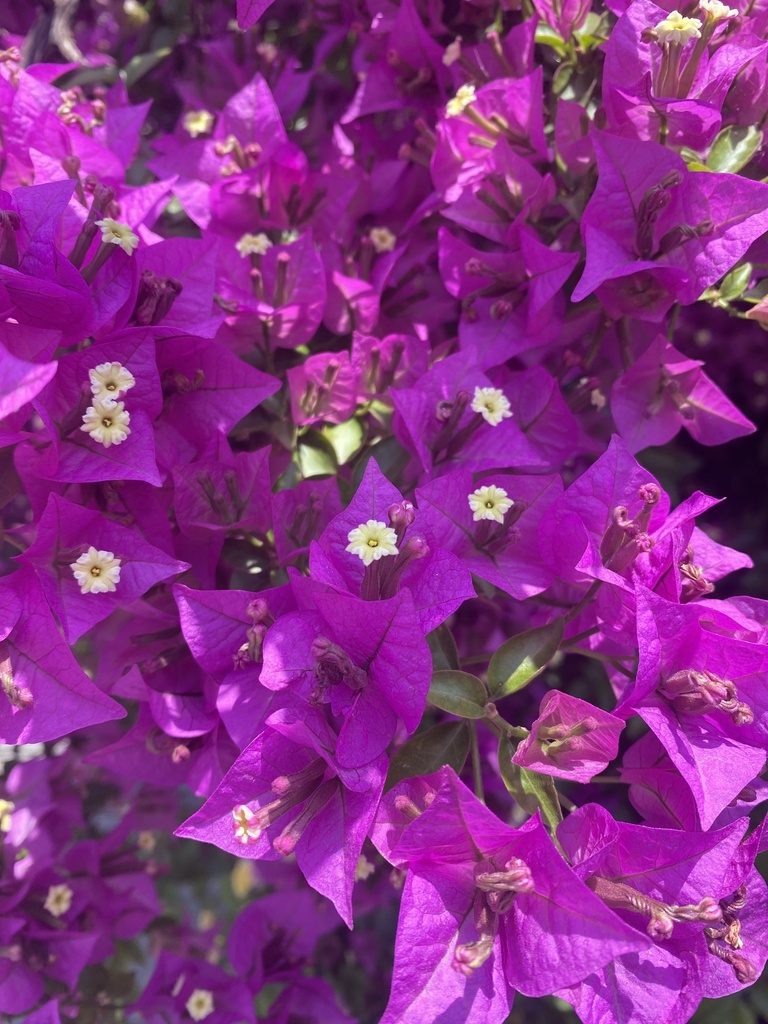
lesser bougainvillea
Bougainvillea glabra
Bougainvillea glabra, the lesser bougainvillea or paperflower, is the most common species of bougainvillea used for bonsai. The epithet 'glabra' comes from Latin and means "bald".
From the article Bougainvillea glabra on Wikipedia (CC BY-SA), quoted section by section
Description
It is an evergreen, climbing shrub that usually grows 3–3.5 m (10–12 ft) tall, occasionally up to 9 m (30 ft). It features thick, thorny stems and drooping branches that are glabrous or sparsely hairy. The leaves have a 3–10-millimetre-long (1⁄8–3⁄8 in) stem. The leaf blade is ovate to ovate-lanceolate, pointed or briefly pointed, 5 to 13 centimeters long and 3 to 6 centimeters wide, sparsely fluffy hairy on the underside and bald on the top. The leaf-like bracts are purple, oblong or elliptical, pointed, 65–90 mm (2+1⁄2–3+1⁄2 in) long and about 50 mm (2 in) wide. They tower over the flowers. These grow individually in pairs or in groups of three on flower stems about 3.5 millimeters long. Raphides have been found in the stem, bracts and different parts of the flower.
Inflorescences. The crown tube is greenish, clearly angled, about 2 centimeters long, sparsely downy hairy, ribbed and points away from the flower stalk. The tip is lobed five times and forms a short, spread, white or yellowish hem. The six to eight stamens have 8 to 13 millimeter long stamens. The ovary is about 2 millimeters long, the stylus 1 millimeter and the scar 2.5 millimeters. Tiny white flowers usually appear in clusters surrounded by colorful papery bracts, hence the name paperflower. The leaves are dark green, variable in shape, up to 100 mm (4 in) long. …
At the table
Being of medical importance, the infusion of the plant's tender leaves and bracts is used orally to treat gastrointestinal problems (diarrhoea, stomach pain), and respiratory conditions (asthma, bronchitis, catarrh, chest pain, fever, pneumonia, whooping cough).
Wikipedia: “Uses”
How it is grown
B. glabra is heat and drought tolerant and frost sensitive. It is easily propagated by cuttings. It needs full sunlight, warm weather and well drained soil to flower well. The species is often used in culture, in areas with frost in glass houses, otherwise outdoors. The similar Bougainvillea spectabilis, which differs from Bougainvillea glabra by the velvety-felty underside of the leaves, is also cultivated, but less frequently.
Uses. Being of medical importance, the infusion of the plant's tender leaves and bracts is used orally to treat gastrointestinal problems (diarrhoea, stomach pain), and respiratory conditions (asthma, bronchitis, catarrh, chest pain, fever, pneumonia, whooping cough).
Wikipedia: “Cultivation”
Where it lives
Recorded sightings
—
geo-referenced records in GBIF, from museums, herbaria and field observers.
Drag the globe to turn it. Dots are where records exist, not a range map; darker means more records.
In the stacks
Searching the stacks…
Every page naming Bougainvillea glabra in the Biodiversity Heritage Library →
This page is assembled live from iNaturalist, GBIF, Wikipedia, the Source Library and the Internet Archive. It is not yet part of the hand-edited codex. iNaturalist taxon 159346.