On eBird ↗
Black Bushbird
Live sightings near you, the range map, bar charts of when it is seen, and Macaulay Library photos and recordings.
Black Bushbird
Neoctantes niger
The black bushbird (Neoctantes niger) is a species of bird in the family Thamnophilidae. It is monotypic within the genus Neoctantes. It is found in Brazil, Colombia, Ecuador, and Peru. Its natural habitat is subtropical or tropical moist lowland forests.
From the article Black bushbird on Wikipedia (CC BY-SA), quoted section by section
Description
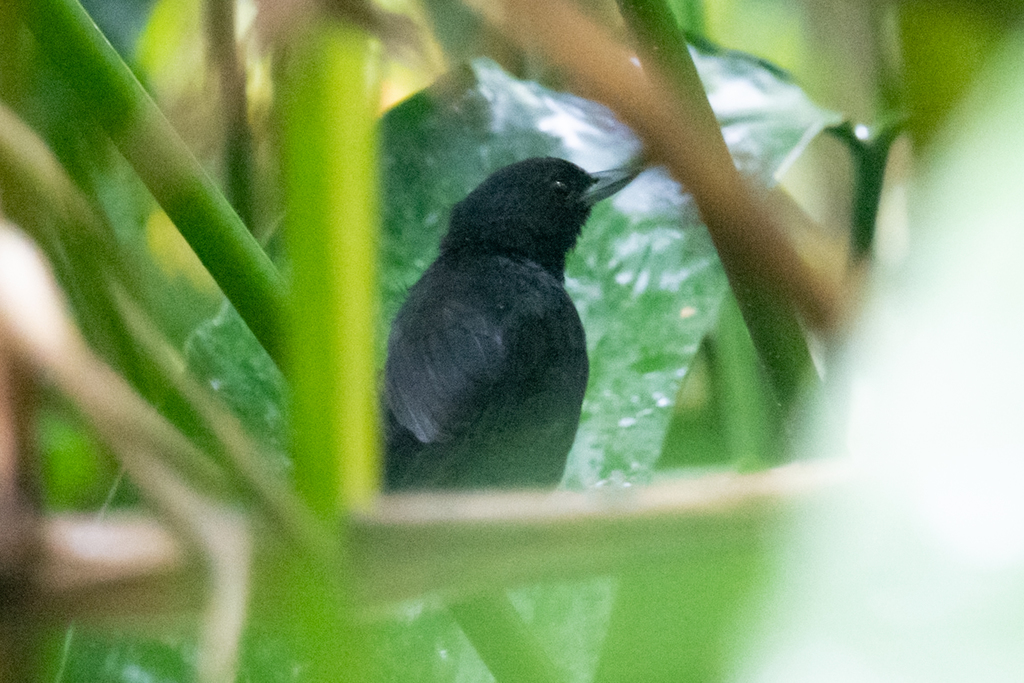
The black bushbird is 15 to 16 cm (5.9 to 6.3 in) long and weighs 29 to 32 g (1.0 to 1.1 oz). It is rather stocky with a short tail and an unusual upturned bill. The sexes have different plumage. Adult males are entirely black except for a small, mostly hidden, patch of white between the shoulders. Adult females are mostly sooty black with a rufous breast and upper belly.
Range & habitat
The black bushbird has a disjunct distribution. The largest range encompasses south-central and southeastern Colombia, eastern Ecuador, northeastern and southeastern Peru, and western Brazil. Isolated ranges are scattered throughout central Amazonian Brazil. The species inhabits lowland terra firme and várzea evergreen forest; it is more common in the latter. It favors dense undergrowth along edges, in treefalls, and along swampy streams.
Wikipedia: “Distribution and habitat”
What it does
The black bushbird is thought to feed on insects and other arthropods. It forages singly or in pairs in dense vegetation from the ground up to about 10 m (35 ft) above it. It occasionally joins mixed-species feeding flocks that pass through its territory but does not travel with them. It forages mostly by picking, hammering, and digging into branches, woody vines, and rotten wood. It uses its unusual bill to wedge or flake off bark or pieces of the substrate.
Wikipedia: “Feeding”
Listen
Looking for field recordings…
Where it lives
Recorded sightings
—
geo-referenced records in GBIF, from museums, herbaria and field observers.
Drag the globe to turn it. Dots are where records exist, not a range map; darker means more records.
In the stacks
Searching the stacks…
Every page naming Neoctantes niger in the Biodiversity Heritage Library →
This page is assembled live from iNaturalist, GBIF, Wikipedia, the Source Library and the Internet Archive. It is not yet part of the hand-edited codex. iNaturalist taxon 15924.