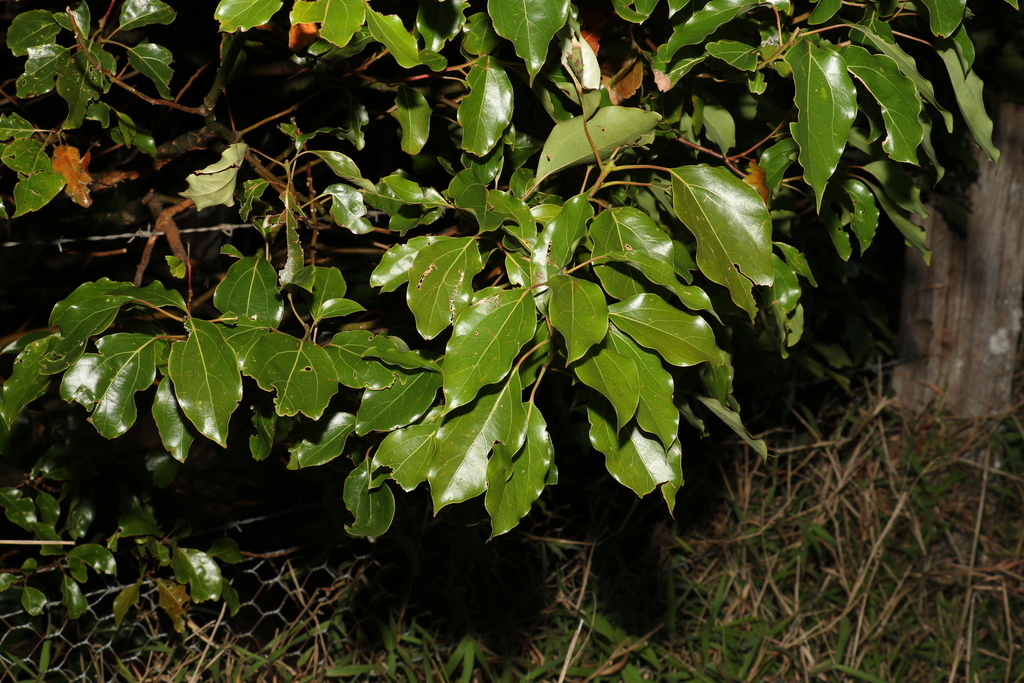
Camphor
Camphora officinarum
Camphora officinarum is a species of evergreen tree indigenous to warm temperate to subtropical regions of East Asia, including countries such as China, Taiwan, Vietnam, Korea, Japan and India. It is known by various names, most notably the camphor tree, camphorwood or camphor laurel.
From the article Camphora officinarum on Wikipedia (CC BY-SA), quoted section by section
Description
Camphora officinarum grows up to 20–30 m (66–98 ft) tall. In Japan, where the tree is called kusunoki, five camphor trees are known with a trunk circumference above 20 m (66 ft), with the largest individual, Kamō no Ōkusu (蒲生の大楠; "Great camphor of Kamō"), reaching 24.22 m (79+1⁄2 ft). The leaves have a glossy, waxy appearance and smell of camphor when crushed. In spring, it produces bright green foliage with masses of very small white fragrant flowers from which its common namesake "smells good tree" in Chinese 香樟 xiang zhang was given. It produces clusters of black, berry-like fruit around 1 cm (3⁄8 in) in diameter. Its pale bark is very rough and fissured vertically.
Range & habitat
The species is native to Japan, Korea, the Ryukyu Islands, and Taiwan. It has been introduced to China south of the Yangtze River, the Himalayas, Bangladesh, Cambodia, Laos, Vietnam, eastern Australia, the southeastern United States, and many other countries.
Wikipedia: “Distribution and habitat”
What it does
In Australia, the larval stages of two native butterflies, the purple brown-eye and common red-eye feed on camphor despite it being an introduced plant.
In Australia. Camphor laurel was introduced to Australia in 1822 as an ornamental tree for use in gardens and public parks. It has become a noxious weed throughout Queensland and central to northern New South Wales, where it is suited to the wet, subtropical climate. The camphor content of the leaf litter helps prevent other plants from germinating successfully, helping to ensure the camphor's success against any potentially competing vegetation, and the seeds are attractive to birds and pass intact through the digestive system, ensuring rapid distribution. Camphor laurel invades rainforests and pastures, and also competes against eucalyptus trees, certain species of which are the sole food source of koalas. In its favour, however, younger camphor laurel trees can quickly develop hollows, which can be utilised by wildlife, whereas natives can take hundreds of years to develop hollows.
In the United States. Introduced to the contiguous United States around 1875, the species has become naturalized in portions of Alabama, California, Florida, Virginia, Georgia, Hawaii, Louisiana, Mississippi, North Carolina, Texas, and South Carolina. It has been declared a category I invasive species in Florida.
Wikipedia: “Ecology”
At the table
The species is cultivated for camphor and timber production. The production and shipment of camphor, in a solid, waxy form, was a major industry in Taiwan prior to and during the Japanese colonial era (1895–1945). It was used medicinally and was also an important ingredient in the production of smokeless gunpowder and celluloid. Primitive stills were set up in the mountainous areas in which the tree is usually found. The wood was chipped; these chips were steamed in a retort, allowing the camphor to crystallize on the inside of a crystallization box after the vapour had passed through a cooling chamber. It was then scraped off and packed out to government-run factories for processing and sale. Camphor was one of the most lucrative of several important government monopolies under the Japanese. The wood has an insect-repellent quality.
Camphor. Camphor is a white crystalline substance, obtained from the tree C. camphora. Camphor has been used for many centuries as a culinary spice, a component of incense, and as a medicine. It is also an insect repellent and a flea-killing substance.
Chemical constituents. The species contains volatile chemical compounds in all plant parts, and the wood and leaves are steam distilled for the essential oils. …
Wikipedia: “Uses”
In human culture
Certain trees in Japan are considered sacred. An example of the importance of a sacred tree is the enshrined 700-year old camphor growing in the middle of Kayashima Station. Locals protested against moving the tree when the railway station had to be expanded, so the station was built around it.
Wikipedia: “In culture”
Where it lives
Recorded sightings
—
geo-referenced records in GBIF, from museums, herbaria and field observers.
Drag the globe to turn it. Dots are where records exist, not a range map; darker means more records.
In the old herbals & bestiaries

Collected Illustrations of the Three Realms: Plants and Trees
王圻, 王思義 · 1609 · p.52

Exotic Pleasures (Persia and Asia observations)
Engelbert Kaempfer · 1712 · p.861

Garden of Health
1507 · p.76

The Great Herbary with all the figures of the herbs
1532 · p.114

Stirpium adversaria nova
Matthias de Lobel · 1571 · p.198

Compendium of Materia Medica
李時珍 · 1596 · p.118

Compendium of Materia Medica
李時珍 · 1596 · p.110

Jan Moninckx; Maria Moninckx — Moninckx Atlas, vol. 3 (1686)
Jan Moninckx; Maria Moninckx · 1686 · p.43

Illustrated Compendium of Materia Medica (Vol. 30)
吳其濬 · 1848 · p.123

Illustrated Compendium of Materia Medica (Vol. 35)
吳其濬 · 1848 · p.28

Herbarium Portatile, Oder Behendes Kräuter- und Gewächs-Buch: Darinn nicht allein 1363. so wol Einheimische als Außländndische Kräuter mit Lateinisch und Deutscher Benennung abgebildet, sondern auch die meisten, so in der Medicin gebräuchlich, kürtzlich erkläret werden
Panckow, Thomas · 1656 · p.318
In the stacks
Searching the stacks…
Every page naming Camphora officinarum in the Biodiversity Heritage Library →
This page is assembled live from iNaturalist, GBIF, Wikipedia, the Source Library and the Internet Archive. It is not yet part of the hand-edited codex. iNaturalist taxon 1591063.