On eBird ↗
Band-tailed Antwren
Live sightings near you, the range map, bar charts of when it is seen, and Macaulay Library photos and recordings.
Band-tailed Antwren
Myrmotherula urosticta
The band-tailed antwren (Myrmotherula urosticta) is a Vulnerable species of insectivorous bird in subfamily Thamnophilinae of family Thamnophilidae, the "typical antbirds". It is endemic to Brazil.
From the article Band-tailed antwren on Wikipedia (CC BY-SA), quoted section by section
Description
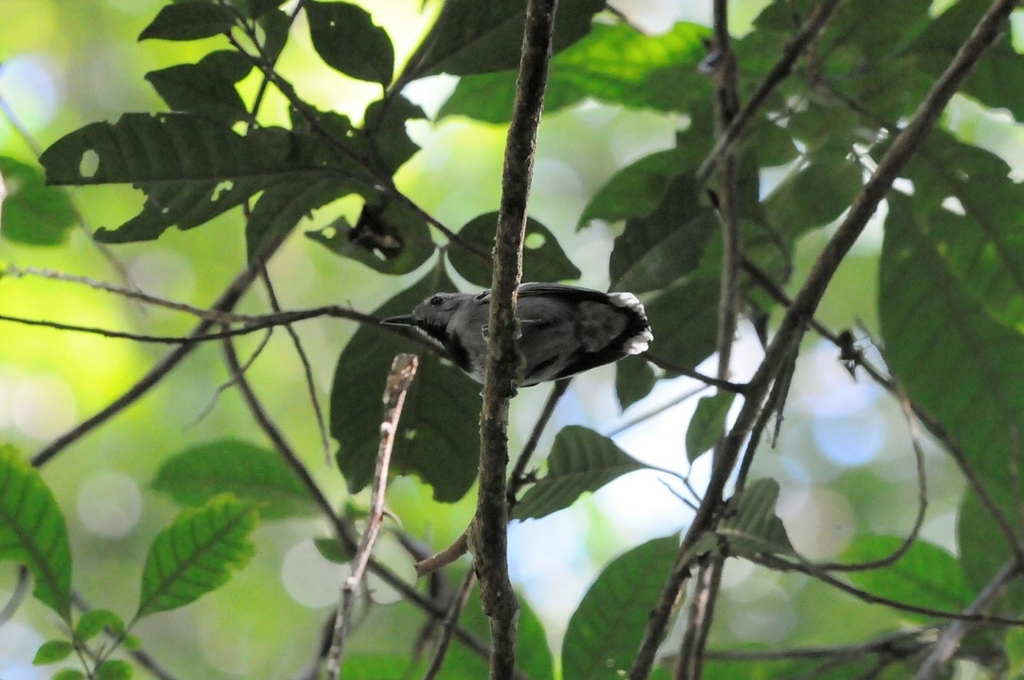
The band-tailed antwren is 9 to 10 cm (3.5 to 3.9 in) long. It is a smallish bird with a short tail. Adult males have gray upperparts with a hidden white patch between the shoulders. Their wings are gray with white-tipped black coverts. Their tail is darker gray with the eponymous wide white band at the end. Their throat and upper breast are black; the rest of their underparts are a paler gray than the upperparts. Adult females have a paler gray face and upperparts than males with white-tipped gray wing coverts. Their throat is white, their sides and flanks gray, and the rest of their underparts pale cinnamon-buff.
Range & habitat
The band-tailed antwren is a bird of the Atlantic Forest. It found very spottily and locally in coastal eastern Brazil between Bahia and northern Rio de Janeiro state. The largest numbers are found in the southern Bahia-northern Espírito Santo area. It inhabits the understorey to mid-storey of evergreen forest and adjacent mature secondary forest in the lowlands. It appears to favor tall forest on sandy soil, especially those with abundant vines in their lower reaches. In elevation it occurs below about 500 m (1,600 ft).
Wikipedia: “Distribution and habitat”
What it does
The band-tailed antwren's diet is not known in detail but is probably mostly insects and spiders. It forages singly, in pairs, or in family groups, and usually as part of a mixed-species feeding flock. It typically forages on fairly open leafy branches. It feeds mostly between about 3 and 10 m (10 and 30 ft) above the ground but will go as high as 20 m (70 ft), though rarely. It seeks prey mostly by gleaning live leaves, and also takes prey from clusters of dead leaves, vine tangles, and along branches by gleaning, reaching, lunging, and with short sallies from a perch.
Wikipedia: “Feeding”
Listen
Looking for field recordings…
Where it lives
Recorded sightings
—
geo-referenced records in GBIF, from museums, herbaria and field observers.
Drag the globe to turn it. Dots are where records exist, not a range map; darker means more records.
In the stacks
Searching the stacks…
Every page naming Myrmotherula urosticta in the Biodiversity Heritage Library →
This page is assembled live from iNaturalist, GBIF, Wikipedia, the Source Library and the Internet Archive. It is not yet part of the hand-edited codex. iNaturalist taxon 15846.