On eBird ↗
Black-spotted Bare-eye
Live sightings near you, the range map, bar charts of when it is seen, and Macaulay Library photos and recordings.
Black-spotted Bare-eye
Phlegopsis nigromaculata
The black-spotted bare-eye (Phlegopsis nigromaculata) is a species of bird in the family Thamnophilidae. It is found in Bolivia, Brazil, Colombia, Ecuador, and Peru. Its natural habitats are subtropical or tropical moist lowland forests.
From the article Black-spotted bare-eye on Wikipedia (CC BY-SA), quoted section by section
Description
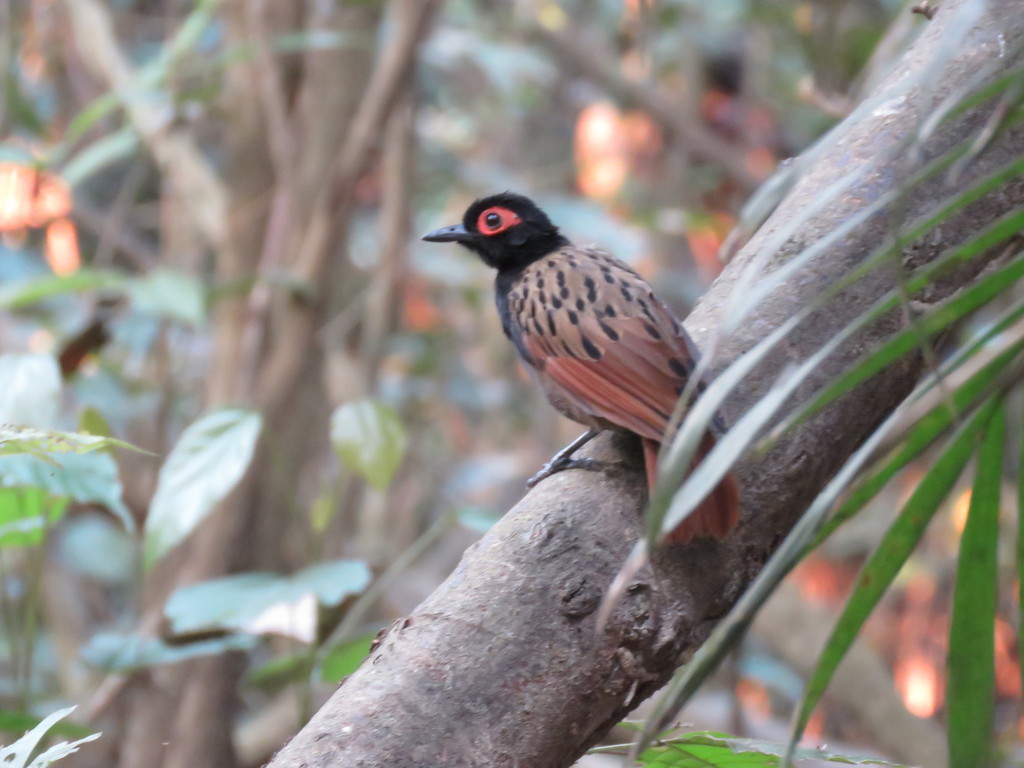
The black-spotted bare-eye is 16.5 to 18.5 cm (6.5 to 7.3 in) long and weighs 42 to 51 g (1.5 to 1.8 oz). The sexes are alike. Both have a large ring of bare red skin around the eye. Adults of the nominate subspecies P. n. nigromaculata have a black head, neck, throat, and upper belly. Their upperparts are light olive with lengthwise oval black spots that have pale yellowish olive-brown edges. Their flight feathers are cinnamon-rufous and their tail rufous-chestnut. Their underparts below the black breast are olive-brown that becomes cinnamon-rufous towards the tail. Subspecies P. n. confinis is smaller than the nominate, has a larger ring of bare facial skin, and is more heavily spotted. P. n. bowmani has brighter and more yellowish upperparts than the nominate and its spots are wider than they are long. P. n. paraensis has a larger facial ring than the nominate; it has light rufous-brown upperparts and its spots are smaller and rounder than the nominate's and edged with cinnamon.
Range & habitat
The subspecies of the black-spotted bare-eye are found thus:
P. n. nigromaculata: from south-central Colombia's Meta Department south through northeastern Ecuador, eastern Peru, and southwestern Amazonian Brazil into northeastern Bolivia P. n. bowmani: south-central Amazonian Brazil and into northeastern Bolivia's Santa Cruz Department P. n. confinis: east-central Amazonian Brazil from the Rio Xingu east to the rios Tocantins and Araguaia P. n. paraensis: northeastern Brazil in southern Amapá state and south of the Amazon east from the Tocantins to western Maranhão state The black-spotted bare-eye inhabits humid evergreen forest in lowlands and foothills. In the western part of its range it mostly occurs in várzea and less frequently in terra firme and the transition zone between the two forest types. Further east it occurs in these three forest types and also igapó . In elevation it occurs as high as 800 m (2,600 ft) in Peru but only reaches 500 m (1,600 ft) in Colombia and 400 m (1,300 ft) in Ecuador; in most of Brazil it occurs below 600 m (2,000 ft).
Wikipedia: “Distribution and habitat”
What it does
The black-spotted bare-eye is an obligate ant follower that feeds on a variety of arthropods that flee foraging army ant swarms. It typically forages individually, in pairs, and in family groups, perching within about 1 m (3 ft) of the ground and sallying or pouncing to the ground after prey. It occasionally makes short aerial sallies and also flips leaves on the ground to find prey. Several pairs family groups may attend an ant swarm; up to 22 individuals have been noted at one. It is dominant over most other ant followers but is subordinate to some other members of its genus.
Wikipedia: “Feeding”
Listen
Looking for field recordings…
Where it lives
Recorded sightings
—
geo-referenced records in GBIF, from museums, herbaria and field observers.
Drag the globe to turn it. Dots are where records exist, not a range map; darker means more records.
In the stacks
Searching the stacks…
Every page naming Phlegopsis nigromaculata in the Biodiversity Heritage Library →
This page is assembled live from iNaturalist, GBIF, Wikipedia, the Source Library and the Internet Archive. It is not yet part of the hand-edited codex. iNaturalist taxon 15818.